

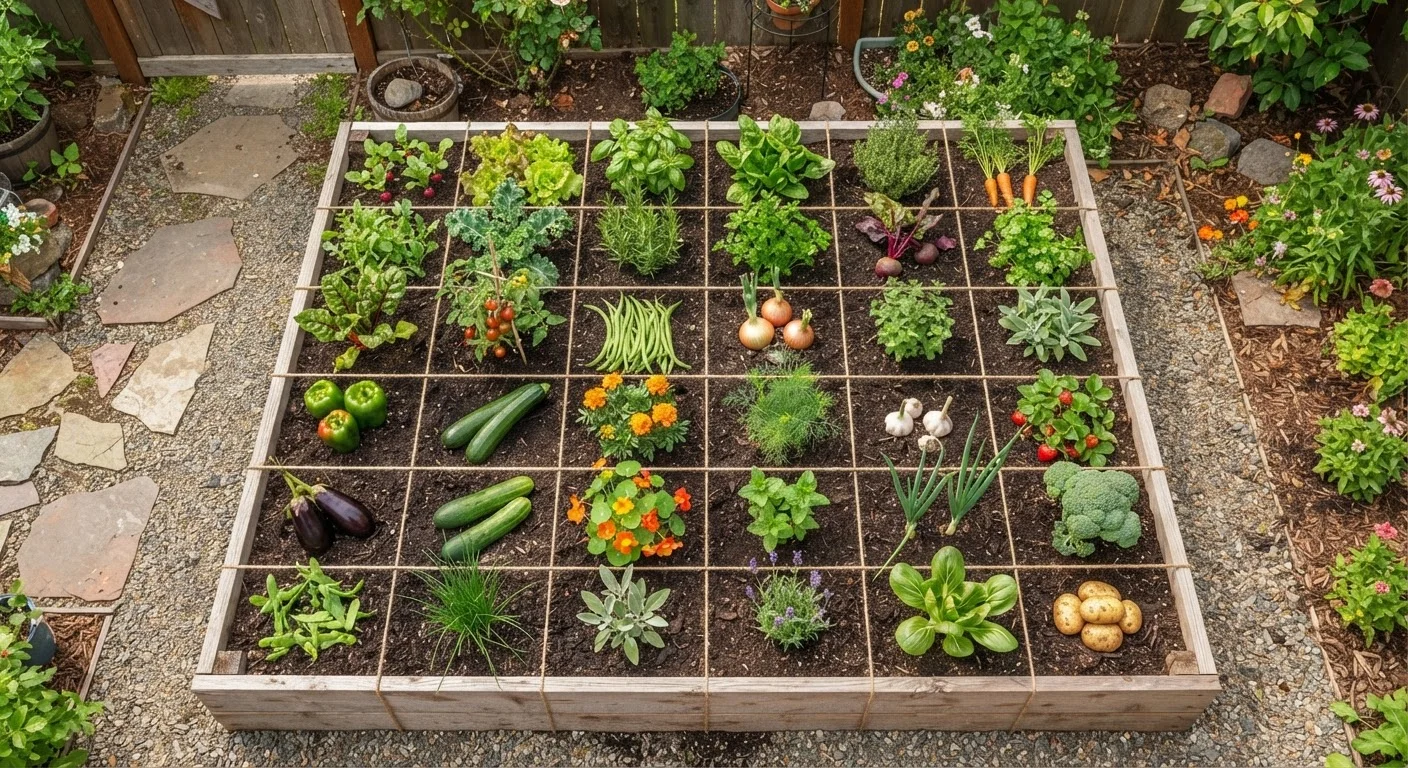
How the Grid System Works
The foundation of square foot gardening is a physical grid laid over your planting bed - usually made from wooden lath strips, twine, or any rigid material that creates clear one-foot divisions. Each square functions as its own mini-plot. You plant it, tend it, and harvest it somewhat independently from its neighbors.
The grid serves two practical purposes. First, it removes guesswork. You always know exactly how many plants belong in each cell, which eliminates the over-planting and under-planting that trips up many beginners. Second, it keeps the garden visually organized, making it easier to spot gaps where a square has been harvested and is ready for a new succession planting.
Most practitioners work with a 4×4-foot bed, which fits comfortably in a small backyard, along a fence line, or even on a wide patio. If you're just starting out, our guide to starting a home garden on a tight budget covers how to set up your first bed without overspending.
Mark Your Grid Permanently
Use wooden lath strips screwed to the top edge of your raised bed frame to create a fixed, reusable grid rather than restringing twine each season. A permanent grid makes it faster to plan and replant squares throughout the year and holds up to weather without sagging.
Planting Density: The Core Rule
Every crop has a recommended spacing distance - the room it needs to reach full size without crowding its neighbors. In traditional row gardening, that spacing is applied in two directions, leaving long empty corridors between rows. Square foot gardening applies spacing only within each square, filling the available area far more efficiently.
Here's how the density math works in practice:
- 1 plant per square: Tomatoes, peppers, broccoli, cabbage, eggplant
- 2-4 plants per square: Kale, Swiss chard, parsley, dwarf marigolds
- 4-9 plants per square: Spinach, bush beans, beets, garlic
- 9-16 plants per square: Carrots, radishes, onions, turnips
This density is possible because the soil in a square foot bed stays loose and uncompacted - you never walk on it. Loose soil lets roots spread efficiently in all directions, so plants can grow closer together than they could in a packed, walked-on in-ground plot.
Pairing your grid plan with smart companion planting combinations can push productivity even further by letting compatible plants share squares and naturally deter pests.
Soil, Water, and Weed Management
One reason square foot gardening appeals to families on a budget is that it concentrates your inputs - soil amendments, water, and effort - exactly where plants are growing. There is no wasted watering of bare paths, and no fertilizing ground that holds nothing.
A rich, well-draining growing medium is especially important in a confined grid bed. A blend of compost, coarse vermiculite, and a moisture-retaining base like coconut coir or peat moss is a well-regarded starting point. Compost does the heaviest nutritional lifting; making your own is a cost-effective option covered in detail in our guide to building compost at home.
Dense planting creates a living mulch effect. As plants fill in, their leaves shade the soil below, limiting light available for weed germination. Most square foot gardeners report significantly fewer weeds than they experienced with row gardening - not zero weeds, but far fewer and easier to pull when they do appear.
Watering can often shift from a hose to a simple watering can. Concentrated beds mean you deliver moisture precisely, which reduces overall water use and helps prevent the overwatering that is one of the most common reasons vegetable gardens keep underperforming.
Up to 5×
More yield per square foot vs. row gardening
Square foot gardening advocates, including Mel Bartholomew in his foundational work on the method, have cited yield improvements of this magnitude attributed to dense planting and soil quality.
~2 ft²
Minimum productive growing area needed
Even a 1×2-foot section of a balcony planter, properly managed with this method, can yield a meaningful supply of herbs or salad greens throughout the growing season.
70%
Potential reduction in water use vs. row gardening
Because water is applied only to planted squares rather than bare row corridors, concentrated bed gardening can substantially reduce overall irrigation needs, though actual savings vary by climate and crop.
Planning Your Grid Before You Plant
A few minutes of paper planning before the season starts pays dividends throughout the growing year. Sketch your grid on paper, label each square with its intended crop, and check that the planting density, sun requirements, and mature height of neighboring squares are compatible. Tall plants like pole beans or tomatoes should sit on the north side of the bed so they don't shade shorter neighbors.
Think in successions, not just single plantings. A square of radishes matures in as little as three to four weeks. Once harvested, that square is immediately available for a new crop - lettuce, a quick herb, or a second round of radishes. Succession planting is one of the most effective ways to keep a small bed producing across the entire season rather than delivering one flush of food and sitting empty.
If your bed is adjacent to a fence or wall, consider which squares get the most sun throughout the day. Most vegetables need at least six hours of direct sunlight. Before you finalize your layout, it's worth running through a spring garden prep checklist to confirm your site's drainage, sunlight, and soil conditions are ready.
Square foot gardening contrasts in useful ways with container gardening and raised bed approaches. If you're weighing your options, see our comparison of raised beds versus in-ground plots and our honest look at growing food in containers to find the format that suits your space and goals.
Frequently Asked Questions
A 4×4-foot raised bed is the most commonly recommended starting size. It gives you 16 squares to work with and is narrow enough that you can reach the center from any side without stepping on the soil, which helps prevent compaction.
A blend often referred to as 'Mel's Mix' - roughly equal parts coarse vermiculite, peat moss or coconut coir, and finished compost - is widely used for this method. It drains well, stays loose, and provides steady nutrients. You can also enrich existing soil with generous amounts of compost.
Yes. The grid principle applies just as well to large container planters or balcony box gardens. You simply adapt the grid to whatever footprint you have. Keep in mind that containers dry out faster, so watering frequency increases.
The number depends on how much space each plant needs at maturity. Large plants like tomatoes or peppers get one square each. Medium plants like kale or chard get two to four per square. Small crops like carrots, beets, or radishes can fit nine to sixteen per square.
Crop rotation is still a good practice, even in small beds. Moving plant families to different squares each season helps prevent soil-borne diseases and pest buildup. Keep simple notes on what grew where each year to make rotation straightforward.
It's one of the more beginner-friendly approaches available. The small, clearly defined planting units make it easy to plan, plant, and manage without feeling overwhelmed. Starting with just a few squares of easy crops builds confidence quickly.
The content provided on our blog site traverses numerous categories, offering readers valuable and practical information. Readers can use the editorial team’s research and data to gain more insights into their topics of interest. However, they are requested not to treat the articles as conclusive. The website team cannot be held responsible for differences in data or inaccuracies found across other platforms. Please also note that the site might also miss out on various schemes and offers available that the readers may find more beneficial than the ones we cover.