

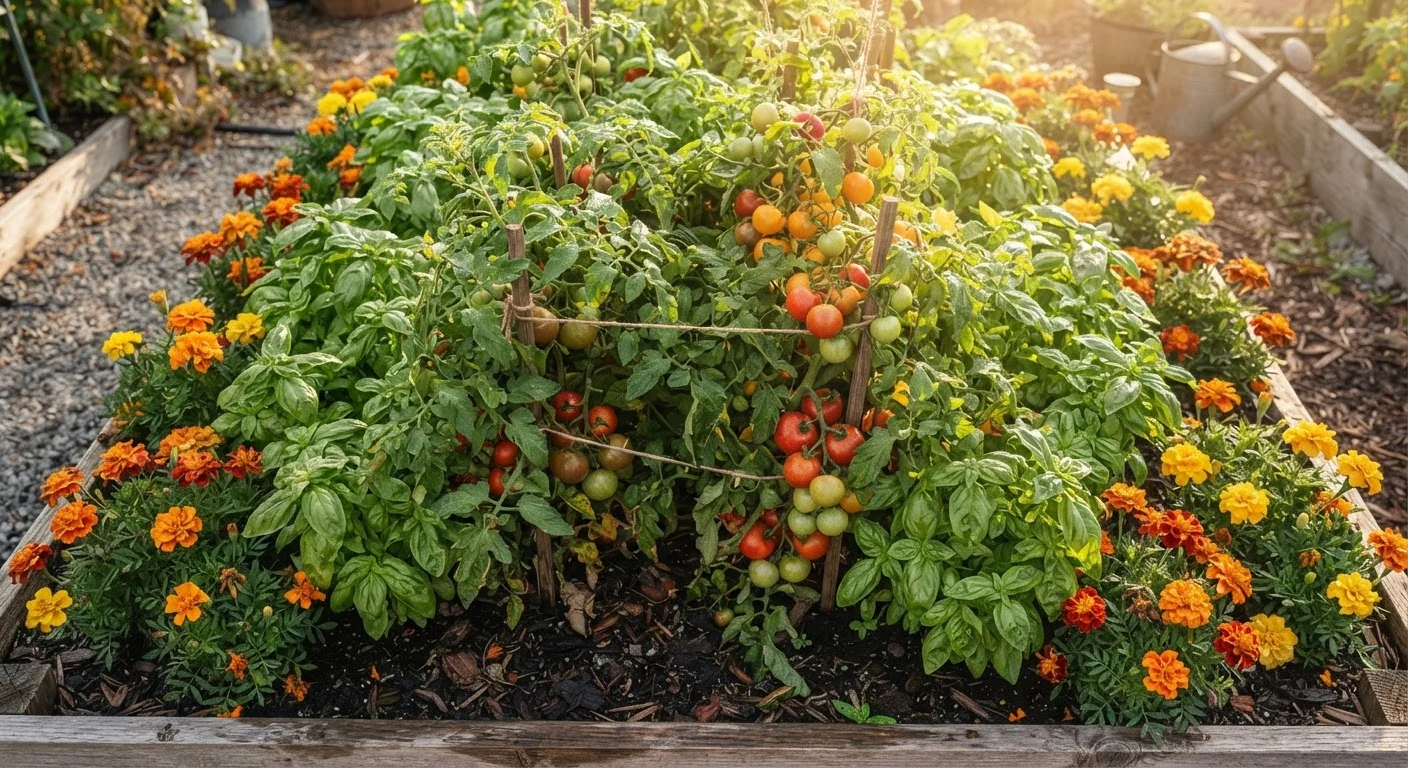
Why Companion Planting Is Worth Your Attention
Companion planting is the practice of growing certain plants near one another to take advantage of the natural benefits they exchange - from deterring insects to improving soil chemistry to shading out weeds. It costs nothing extra to implement, requires no special equipment, and can meaningfully reduce how much time and money you spend managing pest and fertility problems.
Before you start pairing plants, it helps to have your beds in good shape. Our spring garden prep checklist walks through soil, drainage, and pest prevention steps that set the foundation for any planting strategy.
The combinations below are grounded in long-standing horticultural practice. Results can vary by region, soil type, and season, so think of these as strong starting points to test in your own garden rather than guaranteed formulas.
Tomatoes and Basil
This is one of the most widely used pairings in home vegetable gardens. Basil is thought to repel aphids, thrips, and certain flies that commonly trouble tomato plants. The strong aromatic oils in basil leaves may also help mask the scent of tomatoes from pests. Plant basil around the base of tomato plants, roughly 12 inches away to avoid root competition. As a bonus, you'll have fresh basil within easy reach of your tomatoes at harvest - a practical kitchen benefit that doubles the value of the space.
Basil's aromatic oils may help mask tomatoes from common insect pests.
The Three Sisters: Corn, Beans, and Squash
Used by Indigenous farmers across North America for centuries, this trio works as a self-supporting system. Corn grows tall and provides a natural pole for beans to climb. Beans are legumes, meaning they fix atmospheric nitrogen back into the soil - a direct fertility benefit for neighboring plants. Squash spreads along the ground, shading out weeds and retaining moisture with its broad leaves. Plant corn first, then add beans once the stalks are several inches tall, and tuck squash seedlings at the edges. This combination makes excellent use of vertical and horizontal space simultaneously.
Beans fix nitrogen into the soil, feeding their corn and squash companions naturally.
Marigolds and Almost Any Vegetable
French marigolds (Tagetes patula) are among the most researched companion plants in home gardening. They produce a root secretion that has been shown in some studies to suppress soil-dwelling nematodes - microscopic pests that damage plant roots. Above ground, their scent is believed to deter whiteflies, aphids, and certain beetles. Plant them as a border around vegetable beds or tuck them between rows. They're inexpensive to grow from seed, and their bright blooms also attract pollinators. One important note: while marigolds are broadly helpful, they can inhibit the germination of beans if planted too close.
French marigold root secretions may suppress soil nematodes that damage vegetable roots.
Carrots and Onions
These two deter each other's most damaging pests through scent. Onions (and their relatives like leeks and chives) release sulfur compounds that are believed to confuse and repel carrot flies. Carrots, in turn, may help deter onion flies. Interplanting them in alternating rows keeps pest populations lower than growing either crop in a solid block. Both are compact growers, making this pairing particularly well-suited to smaller garden beds. It also works well in containers - a strategy explored further in our honest look at container gardening.
Alternating carrot and onion rows uses scent to confuse and repel each crop's main pests.
Cucumber and Nasturtium
Nasturtiums are a classic trap crop - they attract aphids away from cucumbers and other nearby vegetables, concentrating pest pressure on a plant that can tolerate it and is easily removed or replaced. They also attract predatory insects like hoverflies whose larvae feed on aphids. Beyond pest management, nasturtiums are edible themselves: both the flowers and leaves are usable in salads, which means they contribute food as well as function. Plant them at the edges of your cucumber bed or along the perimeter of the garden. Avoid planting nasturtiums directly next to brassicas like cabbage or broccoli, as they can encourage certain caterpillars in that context.
Nasturtiums act as a trap crop, drawing aphids away from cucumbers and attracting beneficial insects.
Lettuce and Tall Crops
Lettuce is a cool-season crop that bolts (goes to seed prematurely) when exposed to intense summer heat. Planting it in the shade of taller crops like tomatoes, pole beans, or trellised cucumbers gives it protection during the warmer parts of the day, extending your harvest window by several weeks. This arrangement also makes use of otherwise wasted space beneath tall plants. Choose loose-leaf varieties for the best results in partial shade. Be mindful of watering - taller plants can create dry zones in their footprint, so check soil moisture in shaded areas more carefully than you might expect.
Growing lettuce under tall crops extends the harvest season by shielding it from summer heat.
Making the Most of What Works
Companion planting is most effective when it's part of a broader, thoughtful approach to your garden. If you're still seeing underperformance despite good pairings, spacing, watering habits, or timing may be the culprit - our guide on common reasons vegetable gardens underperform can help you identify and correct those issues.
Start Small and Observe Results
Rather than reworking your entire garden at once, try one or two companion pairings in a defined bed and compare results to beds planted without companions. Keep simple notes on pest pressure and yield across the season. This makes it easier to identify what's working in your specific conditions before scaling up.
For families working with tight square footage, combining companion planting with a grid-based layout can dramatically increase what you grow. See how that works in our article on square foot gardening for small spaces. And if you'd like to go further with natural pest management beyond plant pairings, our organic pest control guide covers low-cost, chemical-free methods that are safer around children and pets.
The content provided on our blog site traverses numerous categories, offering readers valuable and practical information. Readers can use the editorial team’s research and data to gain more insights into their topics of interest. However, they are requested not to treat the articles as conclusive. The website team cannot be held responsible for differences in data or inaccuracies found across other platforms. Please also note that the site might also miss out on various schemes and offers available that the readers may find more beneficial than the ones we cover.