

Our Verdict
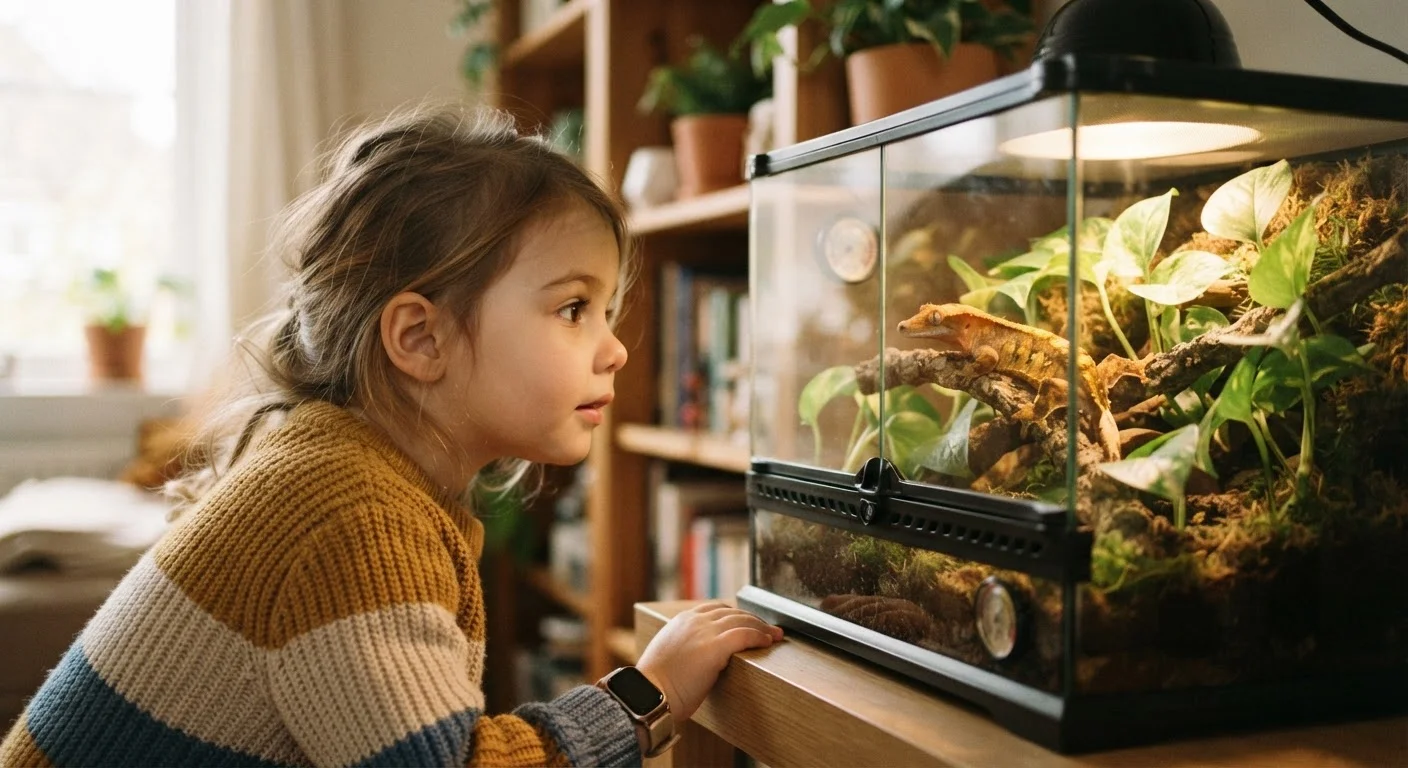
Reptiles can be rewarding and educational pets in the right household, but they are not naturally child-friendly in the way many families assume. The health risks, handling limitations, and specialized husbandry demands mean they require mature oversight and consistent household routines to keep everyone - children and animals - genuinely safe.
Families with children aged seven and older who are ready to learn responsible, supervised interaction and whose adults are committed to maintaining strict hygiene and species-appropriate habitat.
Why Families Are Drawn to Reptiles
Reptiles occupy a unique space in the pet world. They're quiet, they don't shed fur, and they can genuinely captivate a child's imagination in ways that few animals match. For families living in apartments or smaller homes, a well-maintained terrarium offers the appeal of an animal companion without the space demands of a dog. The sheer variety - from leopard geckos to bearded dragons to corn snakes - also means families can choose a species scaled to their experience level and lifestyle.
There's also a real educational angle. Caring for a reptile introduces children to concepts like ecosystems, thermoregulation, and predator-prey food chains in a hands-on way. Many families find that even reluctant readers become enthusiastic researchers when a live animal depends on what they learn. For a broader look at which traits actually signal a good family fit, see what makes a pet truly kid-friendly.
The Genuine Advantages
Set against more traditional pets, reptiles have some real practical strengths for busy households.
Hypoallergenic for many dander-sensitive families
Reptiles don't produce the airborne dander that triggers allergies in millions of households, making them one of the few genuinely low-allergen pet options for children with sensitivities.
Quiet and contained within enclosures
A properly set-up terrarium keeps the animal secure and the household calm - no barking, no scratching, and no unexpected encounters with toddlers during unsupervised moments.
Strong educational value for curious children
Reptile care naturally introduces children to biology, ecology, and responsibility. Many children become motivated self-directed learners when a living animal depends on what they understand.
Lower daily time commitment than dogs or cats
Most reptiles do not require daily walks, grooming sessions, or social play in the way mammals do, which suits families with unpredictable schedules.
Long lifespan allows deep, sustained connection
Many commonly kept reptiles - including bearded dragons and corn snakes - can live 10 to 20 years under good care, meaning a child can grow alongside the same animal through their entire childhood.
Their low noise footprint is meaningful - no barking at delivery drivers, no midnight scratching at doors. And because most reptiles are housed in enclosed terrariums, the risk of them roaming into rooms unsupervised is essentially eliminated, which matters for pet-proofing your home when toddlers are involved.
The Risks Families Must Take Seriously
The appeal of reptiles can make it easy to underestimate what comes with them. The risks below aren't reasons to automatically rule them out - but they are reasons to go in with clear eyes.
Salmonella risk is well-documented and real
Reptiles of all species can carry Salmonella bacteria asymptomatically, and children under five are at higher risk of serious illness. The CDC has linked multiple multi-state outbreaks to pet reptiles in family homes.
Most reptiles tolerate, not enjoy, handling
Unlike dogs or cats, reptiles are not social animals that seek human contact. Stress from excessive or rough handling can cause defensive behavior and long-term health problems in the animal.
Specialized husbandry is demanding and ongoing
Precise temperature gradients, UVB lighting cycles, and species-appropriate diets must be maintained consistently. Errors in husbandry - even brief ones - can cause serious health issues that aren't immediately visible.
Exotic veterinary care can be costly and less accessible
Reptile-experienced vets are not available in all communities, and exotic animal consultations and treatments often carry higher fees than standard small-animal veterinary care.
Not emotionally responsive in familiar ways
Young children often expect pets to reciprocate affection visibly. Reptiles' limited emotional expressiveness can frustrate younger children and create a disconnect that leads to neglect or mishandling.
Some species grow large and require significant space
Commonly purchased reptiles like iguanas and ball pythons can grow substantially beyond what families anticipate, requiring enclosures that may not be practical in smaller homes.
~70,000
Annual Salmonella cases linked to reptiles in the US
The CDC estimates approximately 70,000 Salmonella infections each year in the United States are associated with contact with reptiles or amphibians.
Under 5
Age group at highest Salmonella risk from reptiles
Children younger than five are disproportionately represented in reptile-associated Salmonella outbreaks, according to CDC epidemiological reports.
10-20 years
Typical lifespan of commonly kept pet reptiles
Species such as bearded dragons, corn snakes, and blue-tongued skinks commonly live one to two decades in captivity with proper husbandry.
Hygiene protocols are non-negotiable. The CDC consistently advises that households with children under five, pregnant women, or immunocompromised individuals carefully weigh the Salmonella risk before acquiring a reptile. This isn't a remote risk - it's an established epidemiological pattern. Teaching children how to interact safely with any pet is important across all species, but with reptiles the stakes around handwashing and no-kiss rules are especially concrete.
Husbandry: The Commitment Families Underestimate
Unlike a dog that will signal distress vocally or a cat that will seek out warmth, reptiles are stoic. A bearded dragon suffering from a deficiency in UVB lighting or improper temperatures may show no obvious symptoms for weeks. By the time a problem is visible, it's often advanced.
Proper reptile husbandry involves maintaining specific temperature gradients within the enclosure, providing appropriate UVB lighting on timed cycles, sourcing live or frozen prey for many species, and scheduling regular checks with a reptile-experienced exotic veterinarian. These vets are not always easy to find, and their fees often differ from standard small-animal practice costs. Families need to locate a qualified exotic vet before acquiring a reptile, not after a health crisis develops.
Finding a Reptile-Experienced Veterinarian
Not all veterinary practices have experience with reptiles - they are considered exotic animals requiring specialized training. Before acquiring any reptile, families should identify a local exotic animal vet and schedule an initial consultation. The Association of Reptilian and Amphibian Veterinarians (ARAV) maintains a member directory that can help families locate qualified practitioners in their region. Establishing this relationship before a health crisis occurs is strongly recommended.
For families weighing a reptile against other compact-space-friendly animals, it's worth exploring pets that work well in small homes and apartments with children to understand the full range of options.
Setting Up for Success If You Decide to Proceed
If a family decides a reptile is the right fit, a few foundational practices reduce risk considerably. Establish a dedicated handling area away from food-preparation surfaces, and make handwashing with soap and water - not just hand sanitizer - a non-negotiable rule after every interaction. Never allow reptiles in bedrooms or bathrooms shared with young children.
Assign age-appropriate responsibilities. A seven-year-old can observe feeding and help with water changes under supervision; a ten-year-old can take on more active care tasks with guidance. Keeping children involved in structured, supervised ways builds the respect and understanding the animal needs. For families also navigating the introduction of other pets, the considerations covered in introducing a rescue dog to a home with children highlight how much household routines matter across different species. The broader principles of pet safety at home apply here too: structure, supervision, and consistency protect everyone.
This article is for general informational purposes only and does not constitute medical, veterinary, or professional advice. Always consult a qualified veterinarian or healthcare provider with questions specific to your family's circumstances.
The content provided on our blog site traverses numerous categories, offering readers valuable and practical information. Readers can use the editorial team’s research and data to gain more insights into their topics of interest. However, they are requested not to treat the articles as conclusive. The website team cannot be held responsible for differences in data or inaccuracies found across other platforms. Please also note that the site might also miss out on various schemes and offers available that the readers may find more beneficial than the ones we cover.