

Finding the Right Fit When Square Footage Is Limited
Living in an apartment or compact home doesn't disqualify a family from the genuine benefits of pet ownership - it just calls for more intentional decision-making. The animal that makes life richer in a suburban house with a yard may be the wrong choice in a third-floor, two-bedroom apartment. But the reverse is equally true: some pets are actually better suited to quieter, contained environments than to roomy, stimulating ones.
The traits that matter most in smaller spaces include low-to-moderate noise output, a temperament that handles occasional unpredictability from children without extreme stress, and care requirements that fit realistically into family life. For guidance on which animal traits signal a safer family match, it helps to look beyond the obvious appeal of a species to its day-to-day behavioral reality.
The following pets tend to perform well against these criteria - though every individual animal varies, and adoption decisions always deserve careful thought.
Guinea Pigs
Guinea pigs are widely regarded by veterinarians and animal welfare organizations as one of the most child-compatible small pets. They are social, rarely bite when handled gently, and communicate with soft vocalizations that most children find endearing rather than startling. Unlike hamsters, they are naturally active during daylight hours, which aligns with family schedules.
They need a spacious enclosure relative to their body size - a common minimum recommendation is around 7.5 square feet of floor space for two guinea pigs - but their habitat can sit comfortably in a bedroom corner or living area without dominating the room. They also do best in pairs, which means children get twice the personality without doubling the space footprint significantly.
See our comparison of guinea pigs, rabbits, and hamsters for a deeper look at how these small mammals differ in care needs and temperament.
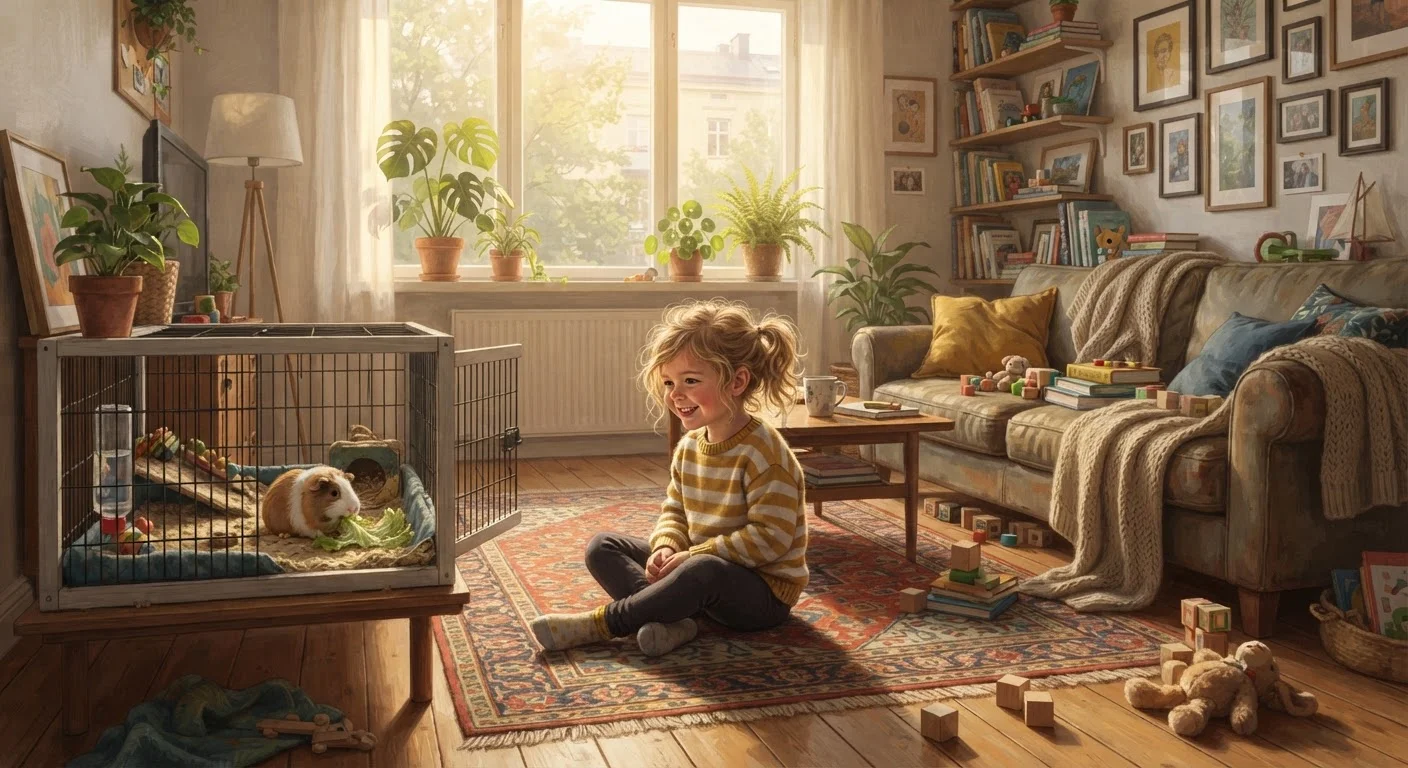
Guinea pigs are active during the day and rarely bite, making them an excellent match for young children.
Cats (Calm, Apartment-Adapted Breeds)
Cats are natural apartment dwellers. They don't need outdoor access to stay healthy, they're quiet enough not to disturb neighbors, and they self-entertain in ways that suit busy families. The key consideration when pairing cats with children is temperament - some cats are naturally more tolerant of handling, noise, and unpredictable movement than others.
Cats with a calmer, more adaptable personality tend to be better fits for households with young children. Providing vertical space - cat trees, shelving - allows them to retreat when they need quiet, which protects both the cat and the child. Teaching children how to read feline body language is equally important, and our guide to safe pet interaction covers this in practical detail.
Vertical retreat space lets apartment cats decompress safely, reducing stress-related reactions around children.
Small Dog Breeds With Lower Exercise Demands
Not every dog needs a yard. Several smaller breeds - and many mixed-breed dogs of moderate size - adapt well to apartment life provided they get daily walks and mental stimulation. The relevant variable isn't just physical size; it's energy level and noise tendency. A calm, adaptable small dog can thrive in a two-bedroom apartment far better than a high-strung breed in a larger home.
Families should research individual temperament carefully and, where possible, meet a dog before committing. Rescue organizations often have detailed behavioral profiles that help families find the right match. For a grounded comparison of dogs and cats as first family pets, visit our dogs vs. cats breakdown.
Energy level and noise tendency are better predictors of apartment suitability than a dog's physical size alone.
Aquarium Fish
An aquarium introduces children to the concept of daily responsibility - feeding, observation, basic tank maintenance - with a manageable care load and no allergy risk. Fish are also genuinely calming to watch; some research suggests that observing aquariums can reduce stress in both children and adults, though more study is needed to establish robust conclusions.
Freshwater fish are generally more forgiving for beginners than saltwater setups, which require more precise water chemistry management. A well-maintained 10- to 20-gallon freshwater tank can house a small community of compatible fish, costs relatively little to run monthly, and fits neatly on a sturdy piece of furniture. The main caution is avoiding impulse purchases - overstocking is the leading cause of tank problems for new owners.
A freshwater aquarium builds daily responsibility habits in children with a care load that won't overwhelm busy families.
Budgerigars (Budgies)
Budgerigars - commonly called budgies or parakeets in the US - are among the most space-efficient companion birds available. A pair can be housed in a cage that occupies a modest corner of a room, and their vocalizations, while cheerful, don't approach the volume of larger parrot species. Many budgies learn to mimic words, which children typically find captivating.
Their care requires daily fresh food and water, regular cage cleaning, and meaningful out-of-cage time. Families should note that birds generally don't enjoy being grabbed or squeezed, so interaction guidelines for young children matter here. For a more complete picture of what daily life with a pet bird involves, see our honest look at living with indoor birds.
Budgies offer real companionship and even vocal mimicry in a footprint small enough for most apartment rooms.
Rabbits
Rabbits can be litter-trained, are quiet, and bond meaningfully with their human family members - qualities that make them appealing in shared living situations. However, they are also prey animals with a sensitive stress response, which means young children need clear guidance on respectful handling. Rabbits rarely tolerate being picked up the way cats or dogs do, and a rabbit that feels threatened can scratch or bite.
That said, a rabbit that is introduced to children carefully and given a safe retreat space can thrive in an apartment environment. They do need space to move - a single rabbit ideally has access to at least 12 square feet of living and exercise area combined. Understanding those needs before adoption prevents the common scenario of a rabbit spending its life confined to a cage that's too small.
Litter-trained and quiet, rabbits suit apartments well - but children need guidance on stress-sensitive handling.
Making Your Space Work for Both Kids and Pets
Choosing the right animal is only part of the equation. How you set up your home determines whether that animal genuinely thrives. Even in limited square footage, thoughtful arrangement can give pets meaningful territory and children clear, safe boundaries.
Allergies and Lease Agreements Matter
Before adopting any pet, families in rented homes should review their lease carefully - some buildings that allow pets still restrict species, weight, or breed. It's also worth discussing potential pet allergies with a healthcare provider, particularly if any family member has asthma or existing sensitivities. These practical checks upfront can save significant stress later.
Creating distinct zones - a calm retreat for the pet, a play area for children, and shared spaces governed by consistent rules - reduces the friction that leads to stress on both sides. Our resource on creating safe zones for pets and toddlers walks through practical ways to divide living areas without turning your home into an obstacle course.
Budget is another real consideration. Routine veterinary care, appropriate food, habitat maintenance, and enrichment items add up regardless of how small the pet is. Understanding those ongoing costs before adoption helps families avoid the difficult position of being unable to provide adequate care. Our article on pet wellness on a budget offers a grounded look at what families actually need to spend - and where there's genuine flexibility.
Think About Routine, Not Just Space
The question isn't only 'will this pet fit in our home?' but 'will this pet fit in our day?' A pet that thrives on consistent human interaction during school and work hours will struggle in a family that's out all day. Match the animal's social needs to your household's real schedule, not your ideal one.
The right pet, chosen thoughtfully and set up well, can add real warmth to compact family life. The goal is a match that works for the animal just as much as it works for the household.
The content provided on our blog site traverses numerous categories, offering readers valuable and practical information. Readers can use the editorial team’s research and data to gain more insights into their topics of interest. However, they are requested not to treat the articles as conclusive. The website team cannot be held responsible for differences in data or inaccuracies found across other platforms. Please also note that the site might also miss out on various schemes and offers available that the readers may find more beneficial than the ones we cover.