

Why the Stage Matters More Than the Label
Walk into any store selling child safety equipment and you'll see seats marketed by age ranges: "infant," "toddler," "big kid." Those labels are marketing shorthand. The actual safety guidance from the American Academy of Pediatrics (AAP) and the National Highway Traffic Safety Administration (NHTSA) is built around a child's physical measurements - weight and height - not their age.
A large 18-month-old and a petite 3-year-old may need identical seat configurations. Conversely, a child can appear "too big" for a seat by age while still fitting safely within its harness limits. Moving a child to the next stage too early reduces the protection they receive in a crash.
Understanding each stage as a set of measurable criteria - rather than a birthday gift - is the most important reframe any parent can make.
Stage 1: Rear-Facing Seats for Infants and Toddlers
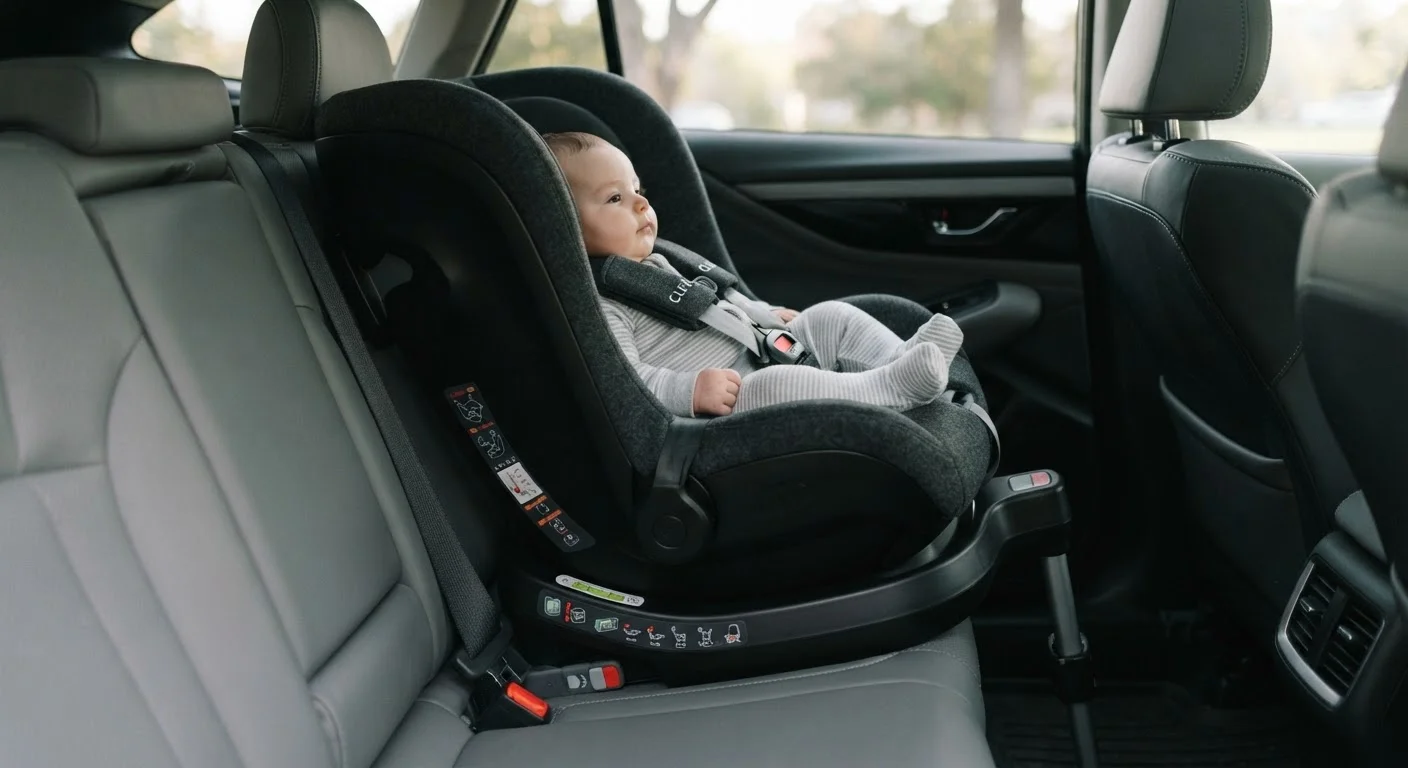
Rear-facing is the safest orientation for young children. In a frontal crash - the most common and severe type - a rear-facing seat spreads crash forces across the back, shoulders, and head simultaneously, rather than concentrating them on harness contact points. See our explanation of the physics behind this for a deeper look at why direction matters.
There are two common seat types in this stage:
- Infant-only seats: Designed specifically for newborns and smaller babies. They typically have lower weight and height limits, but include a removable carrier that makes transport easier.
- Convertible seats (used rear-facing): These accommodate rear-facing for longer, often up to 40-50 lbs depending on the model, then convert to forward-facing later.
The AAP recommends keeping children rear-facing until they reach the maximum weight or height allowed by the seat's manufacturer - not until age 2, which was an older benchmark that has since been updated to reflect individual fit.
Check the harness slot position every few months as your child grows - it's one of the most commonly missed adjustments and one of the most consequential.
Harness slots that are too high (rear-facing) or too low (forward-facing) alter how crash forces are distributed, reducing the protection the seat is designed to provide.
Before assuming your child has outgrown a seat, measure them against the seat's actual limits listed in the manual - not the age range printed on the box.
Manufacturer weight and height limits are the binding safety criteria. Marketing age ranges are approximations and routinely lead parents to transition children too early.
The harness chest clip should sit at armpit level, and the straps should thread through harness slots at or below the child's shoulders when rear-facing. A harness is too loose if you can pinch slack at the collarbone.
Stage 2: Forward-Facing Seats with a Harness
Once a child has genuinely outgrown the rear-facing limits of their seat, a forward-facing seat with an internal harness is the next step. The harness continues to distribute crash energy across the strongest parts of the child's body and keeps them contained within the seat's protective shell.
Most harnessed forward-facing seats support children up to 65 lbs; some extend to 80-90 lbs. The goal is to remain in a harnessed seat as long as the limits allow - not to rush toward a booster.
Key harness checks for this stage:
- Straps thread through slots at or above the child's shoulders (the opposite of rear-facing).
- The chest clip sits at armpit level.
- The harness passes the pinch test - no slack at the collarbone after tightening.
Most seats in this stage can be anchored using either the vehicle's LATCH system (also called ISOFIX in international markets) or the seatbelt. Our article on how ISOFIX and seatbelt installation differ covers when each method applies and what the trade-offs are.
Stage 3: Belt-Positioning Booster Seats
A booster seat does not provide its own harness. Its job is to raise the child so that the vehicle's own seatbelt - the lap band and shoulder belt - fits across the correct body structures. A seatbelt designed for an adult will cut across a small child's neck and abdomen, which creates serious injury risk in a crash.
Children are typically ready for a booster when they have outgrown the harness weight or height limit of their forward-facing seat. There are two booster types:
- High-back boosters: Include head and side support, useful in vehicles with low seat backs or no headrests.
- Backless boosters: Appropriate for older children in vehicles with adequate head restraints.
A properly fitting seatbelt in a booster should have the shoulder belt crossing the center of the chest and collarbone - not the neck - and the lap belt sitting low across the upper thighs, not the belly. When a child can consistently maintain this fit without slouching, and meets the criteria in the five-step seatbelt fit check, they may be ready to graduate from the booster.
Most children reach this point somewhere between ages 8 and 12, but fit - not age - is the deciding factor.
Common Mistakes at Every Transition
The transitions between stages are where safety slips. The most frequent errors include:
- Moving forward-facing too soon: A child who still fits rear-facing limits is safer staying there, regardless of perceived crowding in the seat.
- Skipping to a booster prematurely: If a child still fits within the harness limits of their forward-facing seat, a booster offers less protection.
- Using a second-hand seat without verifying its history: Seats that have been in a crash or are past their expiration date may not perform correctly. Our guide on what safety organisations say about used car seats explains what to check.
- Letting the child ride unbuckled in the booster: A booster provides no protection unless the seatbelt is fastened and correctly positioned.
Never Rush a Stage Transition
Each stage offers progressively less restraint than the one before it. Moving a child forward in stages ahead of their physical readiness trades protection for convenience. If a child still fits within the limits of their current seat, there is no safety benefit - and a measurable safety cost - to moving them up early.
Seat placement also matters - the rear seat is consistently safer than the front. For families considering seating arrangements, the data on the middle rear seat is worth reviewing.
Checking Your Installation
Choosing the right seat for a child's stage is only half the equation. NHTSA data has consistently shown that a significant proportion of car seats are used with at least one installation or usage error. These errors are often invisible to parents who haven't been trained to look for them.
A few practical checks every caregiver should perform:
- After installation, grip the seat at the base and try to move it side to side and forward. Movement of more than one inch in any direction indicates a problem.
- Verify the recline angle. Rear-facing seats must sit at the angle specified by the manufacturer - many seats include a built-in indicator.
- Re-read the manual. Vehicle seat configurations differ, and what works in one car may not be correct in another.
For a full breakdown of the most common installation errors and how to catch them yourself, see our article on why car seat installation goes wrong. Certified Child Passenger Safety Technicians (CPSTs) can also inspect your setup at no cost through community inspection events - NHTSA's website maintains a locator for these.
This article is for general informational purposes. Always follow the specific guidance of your car seat's manufacturer and consult a Certified Child Passenger Safety Technician for an inspection of your individual setup.
The content provided on our blog site traverses numerous categories, offering readers valuable and practical information. Readers can use the editorial team’s research and data to gain more insights into their topics of interest. However, they are requested not to treat the articles as conclusive. The website team cannot be held responsible for differences in data or inaccuracies found across other platforms. Please also note that the site might also miss out on various schemes and offers available that the readers may find more beneficial than the ones we cover.