

Our Verdict
Using a secondhand car seat is not automatically unsafe, but the conditions that make it acceptable are specific and non-negotiable. Without a complete crash history, valid expiration date, all original parts, and the original manual, the risk is real and largely invisible. Saving money on a car seat is not worth compromising the one piece of equipment designed to protect your child in a crash.
Families who can obtain a used seat from a known, trusted source with full documented history, no crash involvement, and a valid expiration date - and who verify every safety checkpoint before use.
What Safety Organizations Actually Recommend
The American Academy of Pediatrics (AAP) and the National Highway Traffic Safety Administration (NHTSA) both advise parents to avoid using a secondhand car seat unless they can verify its complete history. That's not a soft suggestion - it reflects a straightforward problem: a car seat can look perfectly fine while being structurally compromised in ways no visual inspection can catch.
The core issue is that car seats are designed as single-use safety devices. Like a bicycle helmet, they may absorb crash forces without showing obvious signs of damage. NHTSA guidance specifies that seats involved in moderate or severe crashes should be replaced immediately. Even in minor crashes - generally defined as those where the vehicle drove away under its own power, no one was injured, airbags didn't deploy, and the door nearest the seat was undamaged - manufacturers may still recommend replacement. Check the specific seat's manual for its definition.
For families navigating the full arc of child passenger safety, our guide to car seat stages from birth to booster covers what each stage requires and why the transitions matter.
The Pros: When a Used Seat Can Be Acceptable
There are genuine circumstances where using a secondhand seat carries manageable risk - but the bar is high.
Significant cost savings for budget-conscious families
New car seats can range from under $100 to over $400. A verified used seat from a trusted source can reduce that cost substantially without necessarily adding risk if all safety criteria are met.
Acceptable when full history is documented
A seat passed down within a family - where crash history, storage conditions, and age are all known - can meet safety requirements that an anonymous used seat cannot.
Reduces waste for seats nearing end of lifespan
A seat with several years remaining on its expiration date and no crash history represents a usable safety device; passing it to a family member who can verify its history avoids unnecessary disposal.
The clearest safe scenario is receiving a seat from an immediate family member whose household you know well. If you can confirm the seat has never been in a crash, is within its expiration window, has all original parts and labels intact, and comes with the original manual, the risk profile is significantly lower than buying anonymously online.
The Cons: Why Most Used Seats Are a Gamble
The disadvantages of secondhand car seats are serious, and most apply regardless of how good the seat looks.
Crash history is often impossible to verify
Sellers, including well-meaning ones, may not know or accurately recall whether a seat was in a minor collision. Invisible structural damage is the central concern safety organizations raise about secondhand seats.
Expiration dates are frequently overlooked
Many parents are unaware that car seats expire, typically 6 to 10 years from the manufacture date. A seat that looks new may be past its safe service life.
Missing manuals make correct installation impossible
Every car seat model has specific installation requirements. Without the original manual, parents cannot confirm they're using the seat as the manufacturer intended, which can undermine its protection in a crash.
Recalls may be unknown to secondhand buyers
Manufacturers issue recalls for safety defects; original owners receive notification, but secondhand buyers typically do not. An unaddressed recall can mean a seat fails at the moment it's most needed.
No consumer protection if problems arise
Secondhand sales - particularly private listings - offer no warranty, return policy, or recourse if a defect is discovered after purchase.
Parts may be missing, modified, or substituted
Aftermarket padding, replaced harness clips, or missing parts can alter how a seat performs in a crash. Manufacturers design seats as complete systems; substitutions are not safety-tested.
One point worth emphasizing: expiration dates are not arbitrary. Plastics degrade over time - exposure to heat cycles, UV light, and general stress weakens the materials car seats rely on. A seat that's past its printed expiration date should not be used, period, even if it appears undamaged. The date is typically stamped or molded into the plastic shell or printed on a label on the seat's underside.
If you're also evaluating how a seat will be installed, see our breakdown of the most common car seat installation errors - even a structurally sound seat offers less protection when it isn't correctly secured.
Where to Find the Expiration Date
The expiration date - or the manufacture date plus the stated lifespan - is usually printed on a label on the bottom or back of the seat, or molded directly into the plastic shell. If you cannot locate it, contact the manufacturer with the model number. A seat with no identifiable date or label should not be used. Some seats state the manufacture date and specify the lifespan in the manual rather than printing an expiration date directly; you'll need both pieces of information to calculate whether the seat is still within its service window.
A Practical Checklist Before Using Any Used Seat
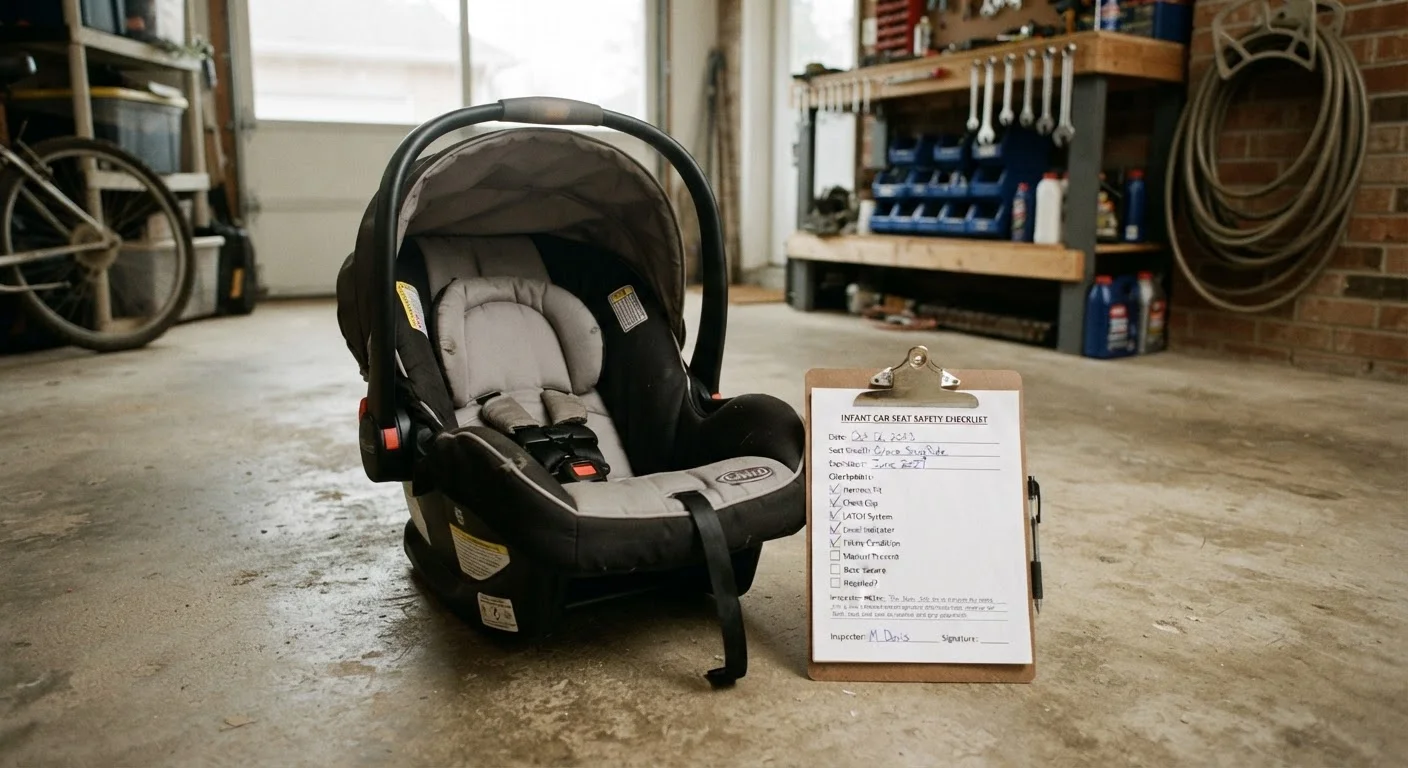
If you've decided the history of a used seat is verifiable and trustworthy, work through every item below before placing a child in it:
- Expiration date: Find the manufacture date on the label and add the manufacturer's stated lifespan (typically 6-10 years). If it's expired, stop here.
- Crash history: Confirm directly with the previous owner - in writing if possible - that the seat was never in any collision.
- Original manual: Without the manual, you cannot install or use the seat correctly. Manuals are sometimes available from manufacturers' websites, but confirm the exact model number matches.
- All parts present: Check that the harness, chest clip, base (if applicable), and all original padding and covers are intact and unmodified.
- No visible damage: Look for cracks in the shell, frayed straps, missing labels, or signs of repainting or repair.
- Recall check: Search the seat's model on the NHTSA recalls database at nhtsa.gov before use.
Understanding the anchor system your seat uses also matters - our explainer on ISOFIX vs. seatbelt installation walks through how each method works and when each applies.
72%
Car seats used with at least one misuse
NHTSA research has found that a large majority of car seats are used with at least one significant misuse that could reduce protection in a crash.
6-10 years
Typical car seat expiration window
Most manufacturers set seat expiration at 6 to 10 years from the manufacture date, after which material integrity can no longer be guaranteed.
The content provided on our blog site traverses numerous categories, offering readers valuable and practical information. Readers can use the editorial team’s research and data to gain more insights into their topics of interest. However, they are requested not to treat the articles as conclusive. The website team cannot be held responsible for differences in data or inaccuracies found across other platforms. Please also note that the site might also miss out on various schemes and offers available that the readers may find more beneficial than the ones we cover.