

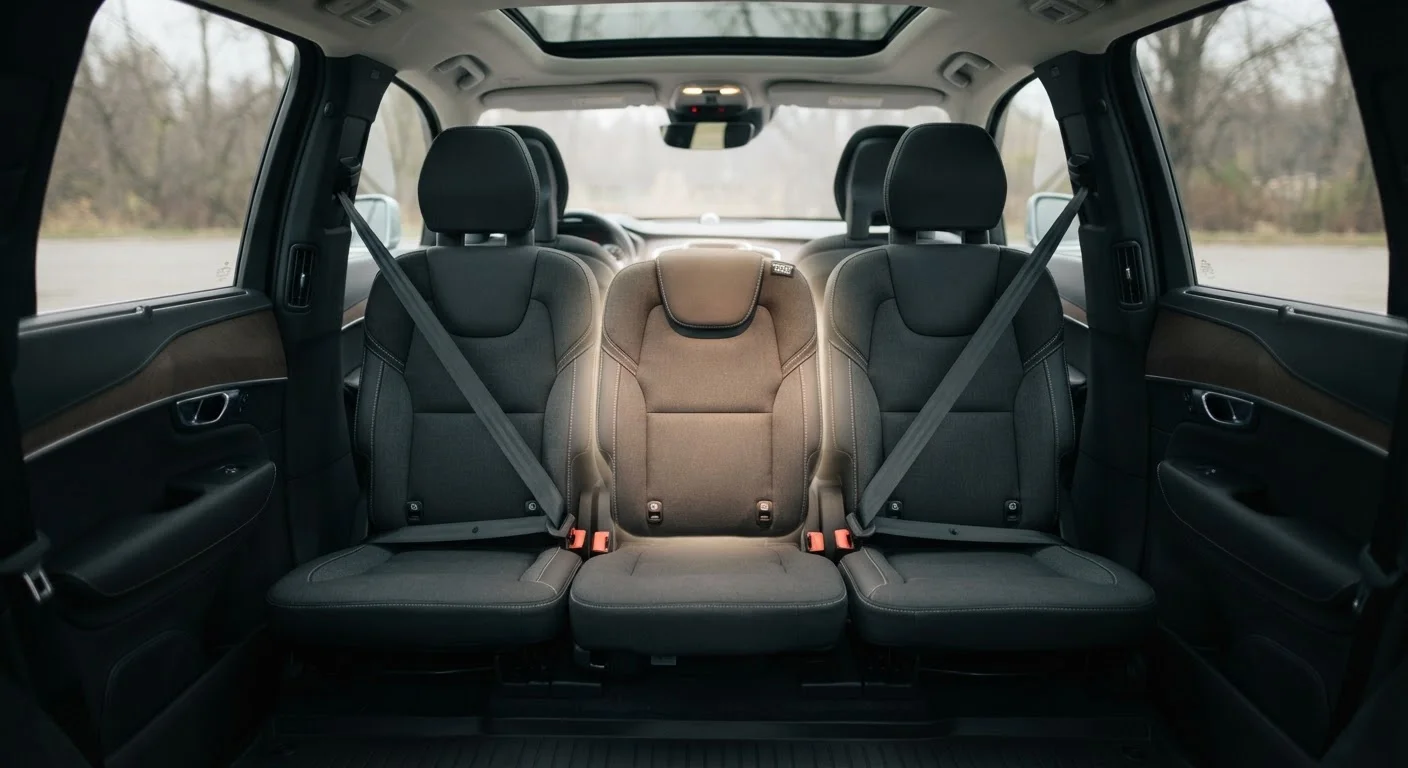
What the Crash Data Actually Shows
When researchers analyze real-world crash records, one pattern holds up across multiple studies: passengers seated in the center rear position sustain fewer fatal and serious injuries than those in other seats. A study published in Injury Prevention examining U.S. crash data found that children in the center rear seat had approximately 43% lower injury risk compared to children seated elsewhere in the vehicle.
The explanation is straightforward geometry. Every crash - whether a frontal collision, a side impact, or a rear strike - concentrates force at specific points on the vehicle's exterior. The center rear seat sits farther from all of those points than any other position. There is more crumple zone and structural material between that seat and whatever the car hits. That distance is protective.
Frontal crashes are by far the most common type of serious collision, and the rear of the cabin absorbs far less energy than the front in those events. Being rear-seated already helps. Being center rear adds an additional buffer from the lateral forces that accompany off-center frontal impacts and from side-impact crashes, which account for a significant share of occupant fatalities.
~43%
Lower injury risk in center rear seat for children
Reported in a peer-reviewed study published in the journal Injury Prevention analyzing U.S. crash data.
~38%
Of occupant fatalities involve side-impact crashes
According to NHTSA crash data, side impacts represent a substantial share of serious occupant injuries - a key reason distance from doors matters.
3-point belt
Required for center seat to be safer than outboard
Lap-only belts, still found in some older vehicle center positions, significantly increase abdominal and spinal injury risk in frontal crashes.
Why the Advantage Isn't Absolute
The center rear position's statistical edge comes with real-world conditions that can reduce or even reverse it. The most important variable is the restraint system.
If a car seat cannot be installed correctly in the middle position - because the belt geometry is wrong, the seat cushion is too soft or contoured, or the vehicle lacks a usable anchor - then a properly installed seat in an outboard position is likely safer. An incorrectly installed car seat in the "statistically safest" position is not safe. For guidance on what correct installation actually looks like, see common car seat installation mistakes.
Modern vehicles have also improved outboard rear seat protection substantially. Side curtain airbags, reinforced door structures, and improved seat belt pretensioners have all narrowed the gap. The safety advantage of the center seat is real but smaller than it was in older vehicle generations.
For adults, middle seat risk can actually increase in older vehicles equipped with a lap-only belt rather than a three-point shoulder-and-lap belt. A lap-only belt in a frontal crash significantly increases the risk of abdominal and spinal injury. Always confirm that the center seat has a three-point belt before treating it as the safer option for any occupant.
Check Your Vehicle's Owner Manual First
Not all center rear seats are created equal. Some vehicles explicitly note in the owner's manual that the center rear seat is not recommended for certain car seat types due to belt geometry or cushion construction. Reviewing both the vehicle manual and the car seat manual before committing to a position takes five minutes and can make a real difference.
Putting It Into Practice for Families
For families with one child, the guidance is simple: place the child in the center rear seat whenever the restraint installs correctly and securely there. Check that the car seat moves less than one inch at the belt path when tested at the base, and confirm the belt routes exactly as the car seat manual specifies.
For families with multiple children, prioritize the center seat for the youngest or smallest child, since younger children typically use car seats that are easier to install with a lap-and-shoulder belt, and smaller children are more vulnerable in crashes. Older children using booster seats or seat belts alone can generally occupy an outboard seat with lower incremental risk than an infant or toddler would face.
The direction a child faces also affects how crash energy is distributed across their body - something worth understanding alongside seating position. The physics of rear-facing versus forward-facing seats explains why orientation matters, particularly for younger children. And the right seat position is only one piece of the picture - using the right car seat stage for your child's size is equally critical to overall protection.
Frequently Asked Questions
Research consistently shows lower injury risk in the center rear position, but only when a properly fitting restraint system is correctly installed and used. If the middle seat lacks a suitable anchor point or has a belt that doesn't fit a car seat correctly, an outboard seat with LATCH may actually be safer in practice.
A widely cited study published in the journal Injury Prevention found that children in the center rear seat had roughly 43% lower injury risk than those seated elsewhere. However, this figure reflects averages across many crash types and should not be treated as a guarantee for any individual situation.
Yes, to a degree. Adult crash data also shows lower fatality risk in the center rear position. However, most adult middle seat positions lack dedicated head restraints and may have a lap-only belt in older vehicles, which introduces its own risk - always use a vehicle with a three-point belt in the center seat.
A car seat can be correctly installed using the vehicle's seat belt alone - LATCH is not required. What matters is that the seat belt routes correctly through the car seat's belt path and achieves less than one inch of movement at the install point. Check your car seat manual and vehicle owner's manual for guidance.
Side airbags meaningfully improve protection in side-impact crashes for outboard-seated passengers. They have reduced but not fully closed the statistical safety gap between the middle and outboard positions. Rear-seated children in properly installed car seats still benefit from the center position's distance from impact zones.
There is no age-based reason to move a child out of the center rear seat. The priority is always using the correct restraint for the child's size and ensuring it installs correctly in whichever seat they occupy. See guidance on each car seat stage for age and size transitions.
The content provided on our blog site traverses numerous categories, offering readers valuable and practical information. Readers can use the editorial team’s research and data to gain more insights into their topics of interest. However, they are requested not to treat the articles as conclusive. The website team cannot be held responsible for differences in data or inaccuracies found across other platforms. Please also note that the site might also miss out on various schemes and offers available that the readers may find more beneficial than the ones we cover.