

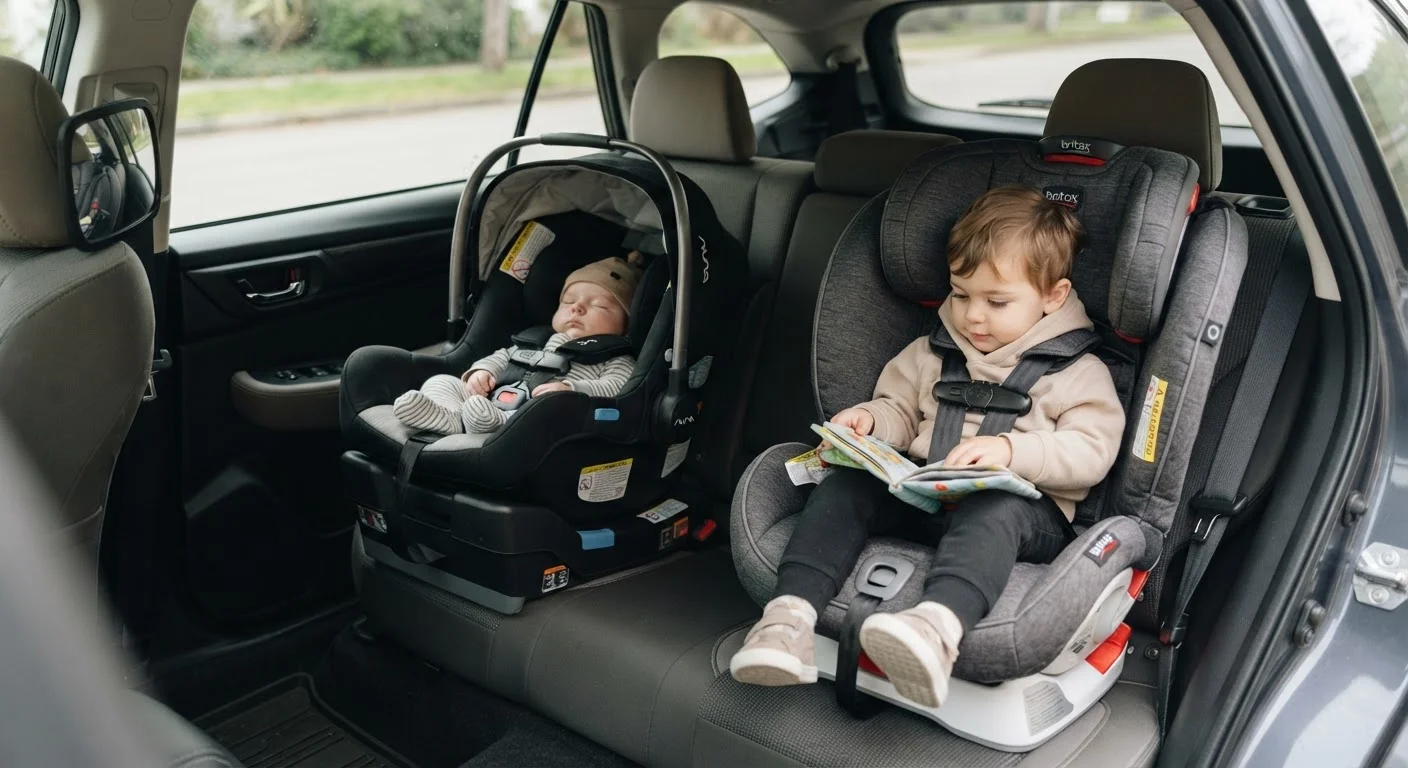
Option A
Rear-Facing Car Seats
The physics-first position for younger, smaller children.
Best for: Infants and toddlers who have not yet reached their seat's rear-facing height or weight limits.
Option B
Forward-Facing Car Seats
The next developmental stage once rear-facing limits are outgrown.
Best for: Children who have exceeded rear-facing limits and need a harness-secured forward-facing seat.
What Actually Happens in a Frontal Crash
The vast majority of serious car crashes involve a frontal collision - the vehicle decelerates rapidly while everything inside it continues moving forward. For an unrestrained occupant, this is catastrophic. For a restrained child, the outcome depends heavily on which direction they're facing and how forces travel through their body.
In a frontal crash, a rear-facing seat acts like a cradle. The shell of the seat absorbs the forward momentum and pushes back against the child's entire back surface - distributing deceleration forces across the shoulders, spine, and head simultaneously. Because the force is spread over a large area rather than concentrated at a few points, the stress on any single structure, including the fragile cervical spine (neck vertebrae), stays relatively low.
A forward-facing child experiences that same crash energy very differently. Their body is thrown forward into the harness straps, which concentrate force at the chest and hips. The head and neck - which are proportionally heavier in young children than in adults - continue moving forward independently, placing significant load on the neck. This is why pediatric safety organizations consistently recommend keeping children rear-facing as long as the seat's limits allow.
| Criterion | Rear-Facing | Forward-Facing |
|---|---|---|
| Force distribution in frontal crash | Spread across back, head, and neck as a unit | Concentrated at harness contact points |
| Head and neck protection | Head supported by seat shell; minimal independent movement | Head moves forward independently; neck absorbs load |
| Suited developmental stage | Infants through toddlers within seat limits | Children who have outgrown rear-facing limits |
| Transition trigger | Remain until seat's weight or height limit is reached | Begin when rear-facing limits are genuinely exceeded |
| Leg room concern | Not a safety issue; legs can be folded comfortably | More legroom, but not the reason to transition early |
| Primary safety mechanism | Seat shell absorbs and redistributes crash energy | Harness straps arrest forward motion of the body |
Why Young Children's Bodies Change the Equation
An adult's spine is fully developed, with bones that are dense and joints that are stable. A toddler's spine is a very different structure. Vertebrae are still partially cartilage, and the ligaments holding them together are more elastic. This is useful for normal growth but means the neck can stretch further in a crash than the spinal cord can safely tolerate - a pattern sometimes called "internal decapitation" in severe cases.
Rear-facing seats are specifically designed around this vulnerability. By supporting the head, neck, and torso as one unit against the seat back, they prevent the independent forward motion of a heavy head on a flexible neck. The physics are not complicated: you are preventing the head from outrunning the body.
As children grow, their musculature, bone density, and spinal stability all develop. The transition to forward-facing is appropriate once they physically outgrow a rear-facing seat - not before. See our stage-by-stage car seat guide for a breakdown of how age, weight, and height interact across the full progression.
Head-to-Head: How the Two Positions Compare
Both seat orientations are engineered to protect children - they simply handle crash physics differently and suit different developmental stages. The comparison below focuses on the mechanics, not on declaring one universally superior; position appropriateness depends entirely on the child's size relative to the seat's rated limits.
Side and Rear Crashes: A Different Dynamic
Most safety discussion focuses on frontal crashes because they're most common. In side impacts, the seat orientation matters less than the side-impact protection built into the seat shell itself and the vehicle's door structure. Rear impacts present yet another force pattern, where rear-facing seats can also perform well because the child's back is already against the shell. No single position eliminates all risk - certified seats used correctly reduce it significantly.
For families wondering about installation method alongside orientation, our article on ISOFIX vs. seatbelt-installed car seats explains how each anchor system works with both seat orientations.
Common Misconceptions That Put Children at Risk
"My child's legs are too long to stay rear-facing." Leg length is not a safety concern in a rear-facing seat. Children naturally fold or cross their legs, and pediatric orthopedic guidance does not identify this as a risk. The limits to watch are weight and height-to-headrest clearance, as printed on the seat itself.
"My child turned two, so it's time to flip them forward." Age-based guidance was phased out in favor of size-based limits precisely because children grow at very different rates. A two-year-old who fits comfortably within rear-facing limits gains no safety benefit from turning forward.
"Forward-facing is close enough in safety terms." For children within rear-facing limits, this is not supported by crash physics. The difference in how forces distribute across the body is meaningful, particularly in frontal crashes, which account for the majority of serious collision types.
If you're also concerned about whether your seat is correctly installed in the first place, our guide on common car seat installation errors covers the most frequent missteps and how to catch them.
~57%
Share of child car crash fatalities in frontal collisions
NHTSA data consistently shows frontal crashes as the most lethal collision type for child passengers, underscoring why front-impact force distribution matters most.
~46%
Car seats used with at least one significant error
Research cited by the American Academy of Pediatrics suggests nearly half of car seats are misused in ways that could reduce effectiveness regardless of orientation.
Making the Transition Safely
When a child genuinely outgrows a rear-facing seat - meaning they've hit the seat's maximum weight or their head is within an inch of the top of the shell - moving to a forward-facing harness seat is the correct step. At this point, the harness system becomes the primary restraint, and proper fit becomes critical.
The harness straps should sit at or just above the child's shoulders in a forward-facing seat, the chest clip should be at armpit level, and there should be no more than one finger's width of slack at the collarbone. A loose harness significantly reduces the protection offered in a crash, regardless of seat orientation.
Seat position in the vehicle also matters independently of seat orientation. Our article on why the middle rear seat is statistically the safest spot covers why placement in the vehicle interacts with restraint type.
This article is for general safety education purposes only. Always follow the manufacturer's instructions for your specific car seat and consult a certified Child Passenger Safety Technician (CPST) for guidance tailored to your child's needs.
The content provided on our blog site traverses numerous categories, offering readers valuable and practical information. Readers can use the editorial team’s research and data to gain more insights into their topics of interest. However, they are requested not to treat the articles as conclusive. The website team cannot be held responsible for differences in data or inaccuracies found across other platforms. Please also note that the site might also miss out on various schemes and offers available that the readers may find more beneficial than the ones we cover.