

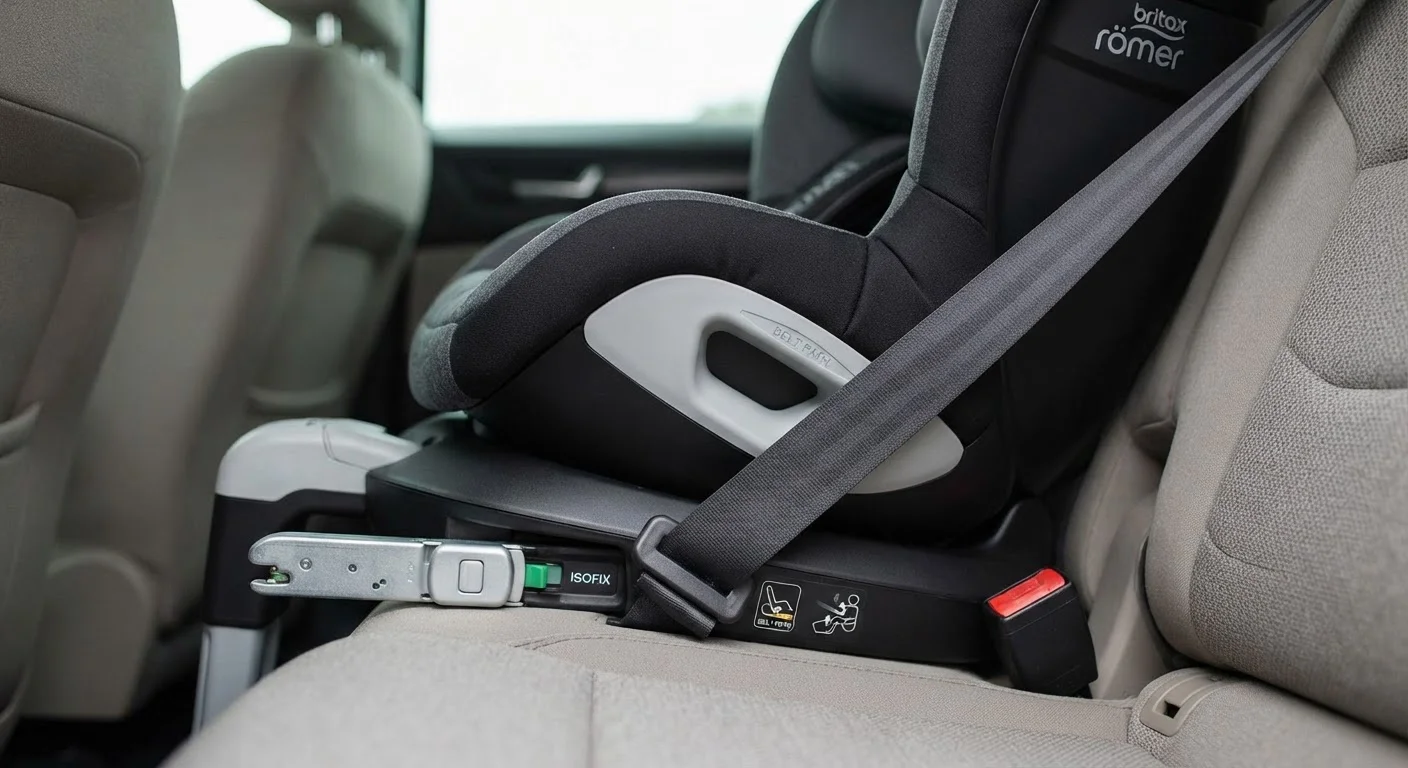
Option A
ISOFIX (LATCH)
The rigid, dedicated anchor system built into modern vehicles.
Best for: Families with ISOFIX-equipped vehicles who want a firm, low-error installation with compatible seats.
Option B
Seatbelt Installation
The universal, vehicle-agnostic method that works in virtually any car.
Best for: Families travelling in older vehicles, rental cars, or using seats not equipped with ISOFIX connectors.
How ISOFIX (LATCH) Actually Works
ISOFIX is the international standard name for a system known in the United States as LATCH - Lower Anchors and Tethers for Children. The concept is straightforward: instead of routing the vehicle's seatbelt through or around a car seat, ISOFIX uses dedicated metal anchors built into the vehicle's structure to connect rigidly to matching connectors on the car seat itself.
Most US vehicles manufactured after September 2002 are required to include lower LATCH anchors, typically located in the crease between the seat cushion and seatback. The car seat clips directly onto these anchors using either a rigid bar or a flexible strap with a latch hook. A top tether - an additional strap that attaches to an anchor point behind the seat - is used with forward-facing seats to limit head movement during a crash.
The main functional advantage of ISOFIX is rigidity. Because the seat connects directly to the vehicle's frame, there is very little movement between the car seat and the vehicle. This also simplifies the installation process, which helps reduce human error - though it does not eliminate it entirely. Always confirm the seat clicks firmly into both lower anchors and that there is less than one inch of movement at the belt path when you push and pull the seat.
One important limitation: US regulations set a combined weight limit (child weight plus car seat weight) for the lower anchor system - typically 65 pounds combined, though this can vary. Beyond that limit, manufacturers and regulators direct caregivers to use the seatbelt installation method instead. Check your car seat manual for the specific limit on your model. See our guide to car seat stages for context on how these weight thresholds relate to developmental milestones.
How Seatbelt Installation Works
Seatbelt installation uses the vehicle's own lap-and-shoulder belt to secure the car seat. Depending on the seat type and orientation, the belt either threads through a specific routing channel in the car seat shell or wraps around the outside of it - your car seat manual will specify exactly which path to follow, and using the wrong one can compromise protection.
For rear-facing seats, the seatbelt is typically routed through a channel at the front of the seat and locked in place. Many vehicles require the belt to be in a locked mode (sometimes called "lock-off" mode) to prevent it from loosening after installation. Some seats have a built-in lock-off mechanism; others require you to use the vehicle's emergency locking retractor (ELR) by pulling the belt all the way out and letting it retract, which engages a cinching mode.
For forward-facing seats installed with a seatbelt, the top tether should still be used if the seat and vehicle support it - this is an often-missed step that significantly reduces head excursion in a frontal crash.
The seatbelt method's key advantage is universality. It works in virtually every vehicle - older cars without LATCH anchors, rental cars, taxis, and situations where the LATCH weight limit has been exceeded. When done correctly with the belt pulled snug and the seat locked, it meets the same federal safety standards as ISOFIX installation.
| Criterion | ISOFIX (LATCH) | Seatbelt Installation |
|---|---|---|
| How it connects | Rigid metal anchors built into vehicle | Vehicle's lap-and-shoulder seatbelt |
| Vehicle compatibility | US vehicles made after Sept. 2002 | Virtually all vehicles |
| Weight limit | Combined limit (~65 lbs typical) | No lower-anchor weight cap |
| Top tether | Required for forward-facing seats | Strongly recommended if available |
| Error risk | Lower, but clips must fully engage | Higher if locked mode is skipped |
| Portability across vehicles | Anchor positions vary by vehicle | Consistent process across vehicles |
For families thinking about what happens after the car seat stage, our article on seatbelt fit for kids who've outgrown a booster covers what a proper belt fit actually looks like.
Installation Errors: The Risk That Applies to Both Systems
Neither ISOFIX nor seatbelt installation offers meaningful protection if the seat is incorrectly installed. Research and field studies - including data referenced by the National Highway Traffic Safety Administration (NHTSA) - have consistently found that a significant proportion of car seats on US roads are used with installation errors. Both systems require deliberate attention to get right.
Common errors with ISOFIX/LATCH include: not hearing or feeling both lower anchor clips fully engage, skipping the top tether on forward-facing seats, and exceeding the combined weight limit while still using the lower anchors.
Common errors with seatbelt installation include: not engaging the belt's locked mode, routing the belt through the wrong channel, and not pulling the belt tight enough before testing for movement.
When You're Not Sure, Get It Checked
Even experienced caregivers can make installation errors, particularly when switching vehicles or using an unfamiliar seat. NHTSA's SaferCar website includes a fitting station locator where certified Child Passenger Safety Technicians (CPSTs) can inspect your installation at no cost. Many fire stations and hospitals also host periodic car seat check events. A professional eye takes minutes and costs nothing - it's worth it.
Regardless of which system you use, the two-finger test is a useful final check: after installation, grip the car seat near the belt path and attempt to move it side to side and front to back. Movement greater than about one inch indicates the seat is not secured properly. If you're unsure, certified Child Passenger Safety Technicians (CPSTs) offer free or low-cost inspection events across the US - NHTSA's website maintains a locator for fitting stations.
For a broader view of crash dynamics and why seat positioning matters, see our article on forward-facing vs. rear-facing car seat physics.
The content provided on our blog site traverses numerous categories, offering readers valuable and practical information. Readers can use the editorial team’s research and data to gain more insights into their topics of interest. However, they are requested not to treat the articles as conclusive. The website team cannot be held responsible for differences in data or inaccuracies found across other platforms. Please also note that the site might also miss out on various schemes and offers available that the readers may find more beneficial than the ones we cover.