

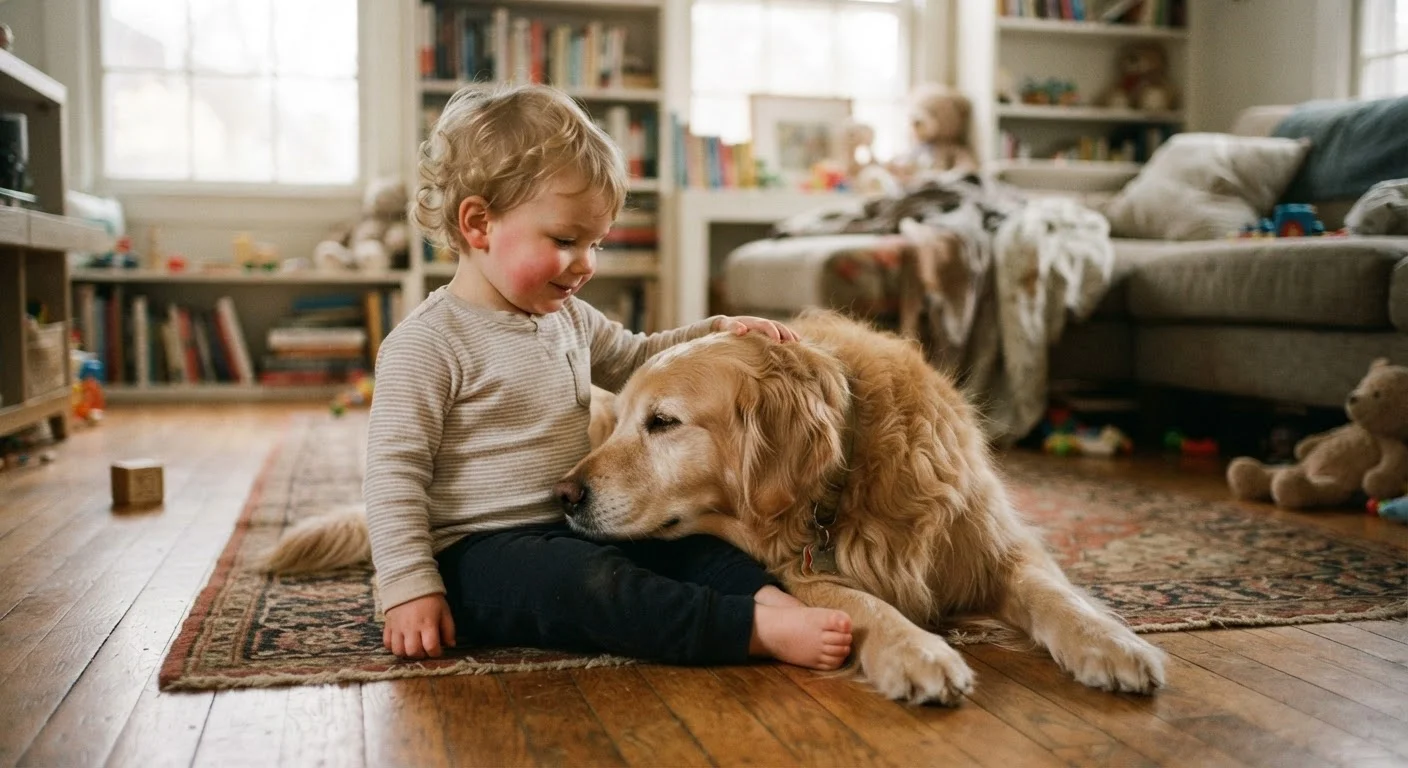
The Comfort Trap: Why Familiarity Can Lower Your Guard
When a dog has slept beside a toddler for two years without incident, it's natural to relax. When the family cat tolerates ear-pulls and costume dress-ups, parents begin to trust that history as a safety guarantee. This is what child safety researchers sometimes call the comfort trap - the gradual erosion of vigilance because nothing bad has happened yet.
The problem is that animal behavior isn't static. Pets experience stress, illness, hormonal shifts, and changes in their environment just as humans do. A dog recovering from a hip injury, a cat startled mid-sleep, or a rabbit cornered by an overly enthusiastic four-year-old may react in ways that contradict every prior interaction. According to the American Veterinary Medical Association, the majority of dog bites to children happen during everyday activities and often involve familiar animals - not strangers.
Understanding this risk doesn't mean living in fear. It means building habits that are consistent regardless of how trustworthy a pet seems. See our practical pet-proofing guide for a room-by-room look at shared-space safety.
Myth
If my pet has never bitten or scratched anyone, they never will.
Fact
Any animal can bite or scratch under the right (or wrong) circumstances - a pain response, a startle, or overwhelming stress can override years of gentle behavior.
A pet's history of tolerance is not a behavioral ceiling - it's a snapshot of past conditions. Animals don't make moral decisions; they respond to physical and emotional states. A dog that has never bitten may still bite if it steps on a bee, is woken abruptly, or has an undiagnosed injury that makes being touched painful. Vets frequently note that sudden behavior changes - including uncharacteristic aggression - can signal underlying health issues that have nothing to do with the child's behavior. Rather than treating a clean history as a guarantee, use it as motivation to maintain the conditions that made that history possible.
Myth
My pet loves my child - animals know not to hurt someone they're bonded to.
Fact
Bonding and bite inhibition are separate things; affection does not override fear, pain, or instinct in any animal.
Pets can be genuinely attached to the children in their household and still react defensively in stressful moments. A dog that greets a child with enthusiasm every morning may still snap if that same child falls on it, pulls it away from food, or startles it while it's in deep sleep. The bond is real - but it doesn't function as a safety switch. Treating the relationship as one that still requires structure and oversight honors the bond rather than straining it.
Myth
Children who grow up with pets automatically know how to behave around them safely.
Fact
Familiarity can actually reduce a child's caution around animals, increasing rather than decreasing risk without explicit ongoing guidance.
Children who grow up with pets often become less cautious over time, not more skilled. They may treat their own pet's tolerance as a universal rule and apply it to unfamiliar animals - a genuinely dangerous assumption. Safe behavior with animals is a teachable skill, not an absorbed trait. It requires age-appropriate, repeated instruction: how to approach, how to read body language, when to back away. Children under six have limited capacity to regulate their own behavior even when they understand the rules, which is why adult supervision remains essential regardless of how long the child and pet have coexisted.
Myth
Small pets like rabbits, guinea pigs, or cats are low-risk and don't need the same supervision as dogs.
Fact
Smaller animals can cause serious injuries and are often more stressed by child interaction than larger, more socially adaptable pets.
Scratches from cats or rabbits can cause significant tissue damage, and small animals are more likely to feel trapped or overwhelmed by a child's handling - precisely because they have less size and social conditioning to buffer the interaction. Cats communicate discomfort through body language that young children routinely miss, and their scratches - particularly to the face - can require medical attention. Rabbits, often marketed as low-maintenance starter pets, are prey animals that can bite hard and injure themselves fatally through stress-induced panic. The supervision standard should be consistent across species.
What Consistent Supervision Actually Looks Like
Supervision is frequently misunderstood as simply being in the same room. In reality, active supervision means maintaining visual contact and being close enough to intervene - not watching from the kitchen while a child and dog occupy the living room.
Pediatric and veterinary safety guidelines generally recommend that children under 10 not be left alone with any pet, regardless of species or temperament. This isn't a judgment on the animal - it reflects the developmental reality that young children don't reliably read warning signals or control their own movements.
~50%
Dog bites involving children under 13
The CDC has estimated that roughly half of dog bite injuries treated medically in the U.S. involve children, with the highest rates in the 5-9 age group.
77%
Bites from familiar dogs
Research published in veterinary and public health literature consistently finds the large majority of bites to children are inflicted by a dog known to the child, often a family or neighbor pet.
Pets communicate discomfort through body language long before they vocalize or act out. Flattened ears, whale eye (showing whites of the eyes), a tucked tail, lip licking, or moving away are all stress indicators that children may miss entirely. Teaching kids to recognize these signals - even imperfectly - is a meaningful layer of protection. Our guide on teaching children safe pet interaction covers age-appropriate strategies for this.
Practical supervision tools include baby gates to create pet-free zones, crates as voluntary retreats for dogs, and scheduled separate play times so neither the child nor the pet is constantly managing the other's presence. Consistency matters more than perfection.
It's also worth remembering that not every pet is the same fit for every family stage. As children grow and family dynamics shift, it's worth revisiting what traits make a pet genuinely kid-friendly for your current household. And to avoid a separate but related hazard, keep pet and child belongings clearly separated - our piece on pet toy and kids' toy mix-ups explains why the stakes are higher than most families realize.
This article is for general informational purposes only. For concerns about a specific animal's behavior or a child's safety, consult a licensed veterinarian or certified animal behaviorist.
The content provided on our blog site traverses numerous categories, offering readers valuable and practical information. Readers can use the editorial team’s research and data to gain more insights into their topics of interest. However, they are requested not to treat the articles as conclusive. The website team cannot be held responsible for differences in data or inaccuracies found across other platforms. Please also note that the site might also miss out on various schemes and offers available that the readers may find more beneficial than the ones we cover.