

Why the Mix-Up Happens - and Why It Matters
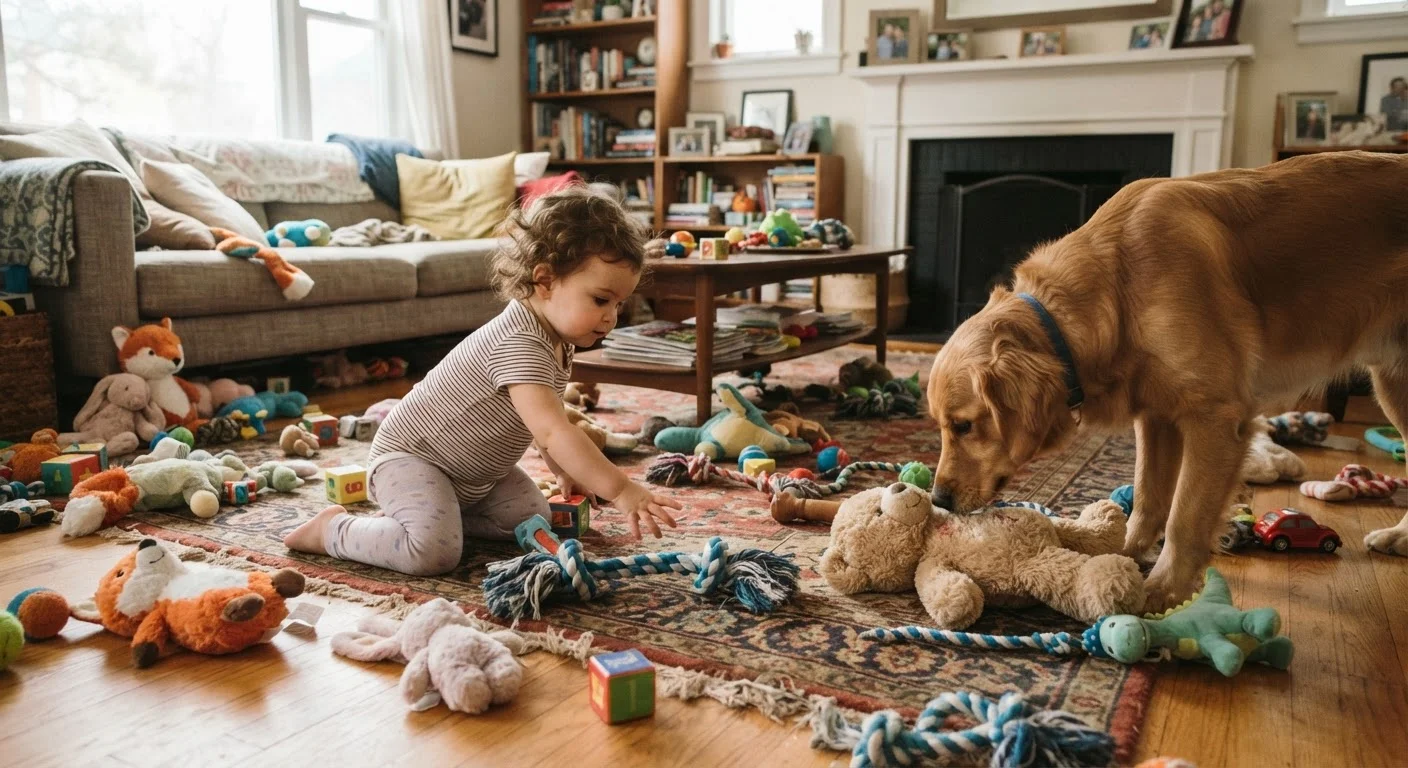
In most family homes, toy chaos is a given. A dog's knotted rope ends up under the couch cushion; a child's plush rabbit gets dragged into the dog's bed. It looks harmless - and that's precisely why it's easy to dismiss.
The problem isn't just hygiene (though saliva-covered, floor-dragged pet toys are genuinely unsanitary for small hands). The deeper issue is design intent. Manufacturers build toys for a specific user, and the materials, construction, and size thresholds reflect that user alone. When the toy ends up in different hands - or jaws - those built-in assumptions break down.
For families trying to manage shared spaces, understanding exactly where the risks lie is more useful than a blanket "keep everything separate" rule that real life rarely allows. See our practical guide to pet-proofing your home for a room-by-room approach to managing these overlaps.
The Specific Hazards in Each Toy Type
Rope Toys
Rope toys are among the most common dog toys in American homes - and among the most misunderstood. As they wear down through chewing, rope toys shed long, braided fibers. If a dog swallows enough of these, the fibers can cause a linear foreign body obstruction in the intestine - a serious, often surgical, veterinary emergency. For a curious toddler, those same loose strands are a choking hazard and, in longer pieces, a potential strangulation risk.
Catnip Pouches
Catnip pouches come in all shapes - fabric mice, crinkle bags, small pillows. The catnip herb itself is generally regarded as non-toxic to humans, but the construction of these toys is the issue. Many contain small pellets, crinkle material, or beads alongside the herb. For infants and toddlers who mouth everything they find, these components are genuine choking hazards. The stitching is also often light - designed to withstand a cat's swatting, not a child pulling at seams.
Stuffed Animals (Kids' Toys Used by Pets)
Children's stuffed animals feel soft and gentle, but they're engineering nightmares for a dog that chews. Plastic safety eyes, button noses, and decorative ribbons detach easily under pressure. Once swallowed, hard plastic pieces can cause intestinal injury or obstruction. Synthetic stuffing - when ingested in volume - adds further risk. The habits that quietly raise household risk often include allowing pets access to a child's toy pile without supervision.
~200,000
Toy-related ER visits for children annually
The U.S. Consumer Product Safety Commission estimates roughly 200,000 toy-related emergency department visits per year among children under 15 - a figure that covers children's toys alone, before accounting for pet toy mix-ups.
No federal standard
Pet toy safety testing requirement
Unlike children's toys, pet toys in the U.S. are not subject to mandatory federal safety testing for material toxicity or small-part hazards, according to the CPSC's regulatory scope.
Top cause
Foreign body ingestion in dogs
Foreign body ingestion - including toy parts and rope fibers - is among the most common reasons dogs require emergency veterinary care, according to veterinary internal medicine literature.
Small Plastic and Foam Toys
Building blocks, foam puzzle mats, and small figurines are designed with child-safety choking standards in mind - but those standards apply to children's use patterns, not a dog's bite force. Pets can break foam and thin plastic into jagged shards quickly, creating sharp ingestion hazards that the original toy design never anticipated.
The Regulatory Gap Families Should Understand
Children's toys sold in the U.S. must meet standards set by the Consumer Product Safety Commission (CPSC) and ASTM International (specifically ASTM F963), which cover paint toxicity, small-part size, and material safety thresholds designed to protect children who mouth objects.
Pet toys have no equivalent federal mandate. There is no regulatory body requiring pet toy materials to pass child-safe screening before hitting store shelves. That doesn't mean every pet toy is dangerous - many manufacturers voluntarily pursue quality standards - but it does mean parents cannot assume that a toy deemed safe for a dog to chew is also safe for a child to handle or mouth.
“Pet products, including toys, are not subject to the same pre-market safety requirements as children's products. Consumers should not assume that a toy safe for a pet meets the standards required for child safety.”
— Consumer Product Safety Commission, U.S. federal consumer safety regulatory agency
This regulatory gap is particularly relevant for dyes and surface coatings. Some pet toys use colorants not assessed for human ingestion safety. Children who mouth these items - as toddlers routinely do - may be exposed to compounds that were simply never evaluated for that scenario.
Practical Separation Strategies That Actually Work
Telling a three-year-old not to touch the dog's toys is a reasonable rule - and a mostly ineffective one on its own. Physical barriers and storage systems do the heavy lifting that rules alone cannot.
- Height separation: Store pet toys in bins or baskets placed above toddler reach, or in a dedicated pet area gated off from young children.
- Distinct containers: Use visually different bins - color-coded or clearly labeled - so older children can participate in sorting correctly.
- Regular audits: A weekly sweep of shared floor space to re-sort any toys that migrated between categories takes less than five minutes and prevents slow accumulation of mixed-toy piles.
- Supervised play zones: When very young children and pets share play space, supervise actively rather than relying on passive separation. The risks of assuming past behavior predicts future safety apply here - a toddler who hasn't touched a rope toy before will, eventually.
If budget is a concern, you don't need elaborate storage systems. Simple, consistent habits around where toys land after playtime matter more than the container they live in. Enrichment toys for pets don't have to be expensive either - our guide to DIY pet enrichment covers safe, low-cost options that reduce your pet's interest in raiding the kids' toy box.
This article is for general informational purposes. If you believe a child or pet has ingested a foreign object, contact a medical professional or veterinarian promptly.
Frequently Asked Questions
Not generally recommended. Pet toys are not tested for child safety standards, meaning dyes, adhesives, or small parts could be harmful if mouthed. Even brief contact warrants handwashing, and young toddlers should not have unsupervised access to pet toys.
Children's stuffed animals are not designed for chewing. Eyes, buttons, and plastic noses can detach and become choking hazards or cause intestinal blockages in dogs. Synthetic stuffing can also be problematic if swallowed in large amounts.
Catnip (Nepeta cataria) is generally considered non-toxic to humans, but catnip pouches designed for cats may contain small beans, herbs, or crinkle materials that are choking risks for infants and toddlers. Always keep catnip toys out of reach of young children.
Use clearly labeled bins stored at different heights - kids' toys accessible to children, pet toys in a location toddlers can't reach independently. Closed bins with lids add a practical barrier without requiring perfect rule-following from young children.
Pet toys often lack safety labeling, have stronger chemical smells, or show visible wear from chewing. Assign distinct colors or storage containers to each category, and audit shared spaces regularly to keep things sorted.
Yes. Rope toys fray with use, releasing long fiber strands. For pets, ingested fibers can cause linear foreign body obstructions - a serious veterinary emergency. For young children, loose fibers are a strangulation or choking concern.
The content provided on our blog site traverses numerous categories, offering readers valuable and practical information. Readers can use the editorial team’s research and data to gain more insights into their topics of interest. However, they are requested not to treat the articles as conclusive. The website team cannot be held responsible for differences in data or inaccuracies found across other platforms. Please also note that the site might also miss out on various schemes and offers available that the readers may find more beneficial than the ones we cover.