

Our Verdict
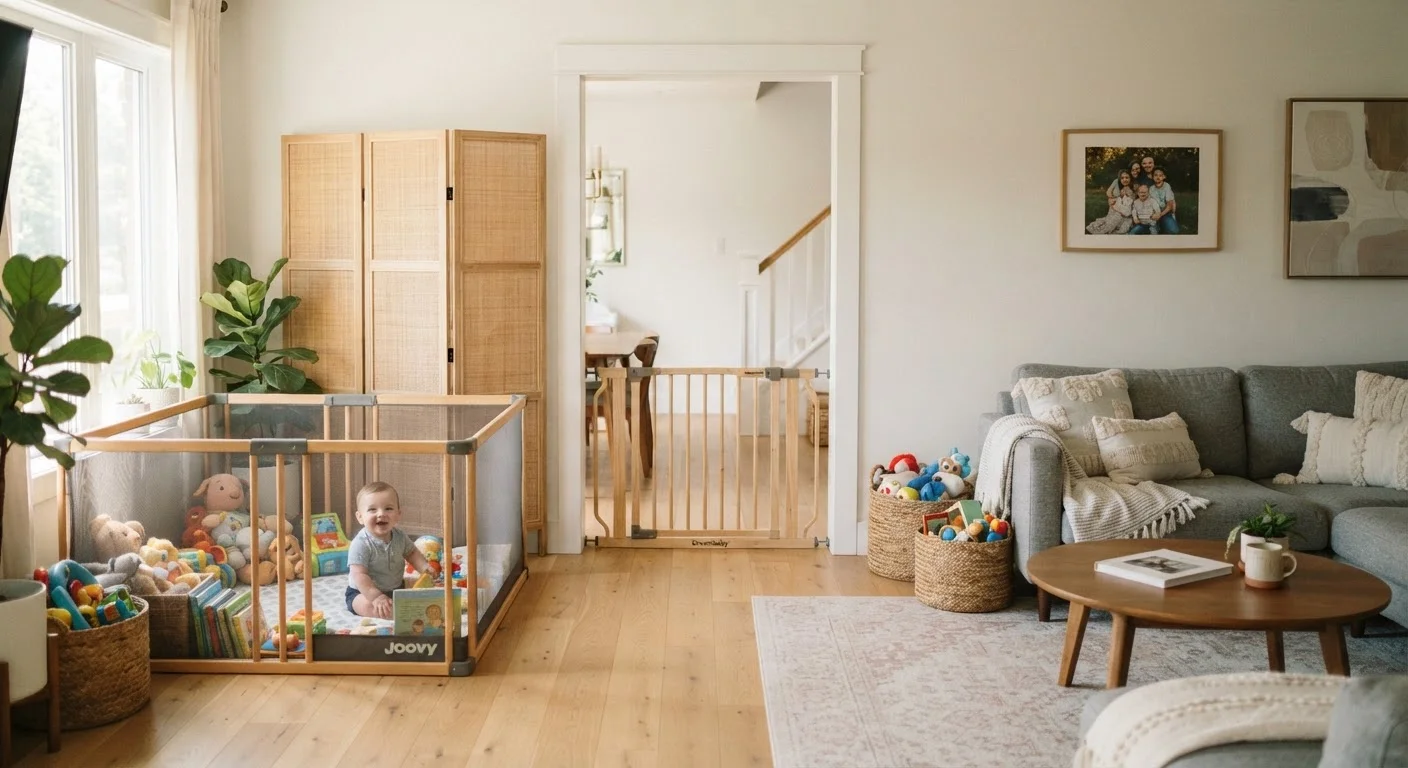
Gates, pens, and dividers each solve a slightly different problem. Gates handle permanent transition points like stairs and hallways most reliably. Pens create a supervised safe zone for a pet or young child within a room. Dividers manage visual and mild physical separation in open-plan spaces but offer the least containment. Most families with both pets and toddlers benefit from using more than one type.
| Best for | Recommended |
|---|---|
| Blocking stairways or doorways from toddlers and pets | Baby gate (pressure-mount or hardware-mount) |
| Giving a pet or young child a contained play area within a room | Playpen or exercise pen |
| Dividing open-plan spaces with older, calmer pets | Room divider or freestanding panel |
| Households needing daily setup and takedown flexibility | Freestanding or pressure-mount gate |
Why Physical Barriers Matter in Mixed Households
Sharing a home with both young children and pets creates a constant balancing act. A toddler who can reach a food bowl, a dog who wants to investigate the baby's play area, or a cat who claims the laundry room as a retreat - these everyday tensions are where physical barriers earn their keep.
The goal isn't to keep everyone separated permanently. It's to carve out reliable zones where each family member - two-legged or four - can be safe and comfortable without constant redirection. As explored in our article on creating safe zones for pets and toddlers, effective spatial boundaries protect both the child and the animal from stressful, unsafe encounters. The challenge is picking the right tool for each specific situation.
Baby Gates: Reliable for Fixed Transition Points
Baby gates are designed to block movement through doorways, hallways, and at the top or bottom of stairs. They come in two main configurations:
- Pressure-mount gates use tension to hold between two walls. They're quick to install and remove, but are not recommended for the top of stairs - a child pushing against one could dislodge it.
- Hardware-mount gates are screwed into wall studs and are significantly more secure. These are the appropriate choice for any stairway opening.
Gates work well for pets too, though a determined large dog or a cat that can leap may simply go over or through. Look for gates taller than 30 inches if you have an athletic animal. The main limitation: gates only work where there's a physical frame to attach to or brace against. Open-plan living areas with wide openings can require specialty extra-wide gates, which tend to be bulkier and more expensive.
| Baby Gate | Playpen / Exercise Pen | Room Divider | |
|---|---|---|---|
| Primary function | Block doorways and stairways | Contain child or pet within a zone | Partition open spaces visually |
| Installation required | Pressure or hardware mount | None - freestanding panels | None - freestanding |
| Stair safety suitability | Yes (hardware-mount only) | No | No |
| Containment strength | High (when properly mounted) | Moderate | Low |
| Portability / repositioning | Low to moderate | High | High |
| Works in open-plan rooms | Only with wide-gate models | Yes | Yes |
| Suitable for large/athletic pets | Tall models recommended | Limited - may escape | Not reliably |
Playpens and Exercise Pens: Containment Within a Room
Rather than dividing a room at a doorway, pens create a contained area inside a room. Baby playpens give toddlers a safe space to play while a parent steps away briefly. Exercise pens - originally designed for dogs - are modular panel systems that can be arranged in various shapes and sizes.
Pens are especially useful when you need to keep a pet away from a crawling infant or give a dog a secure spot during busy household moments. They require no installation and can be repositioned as your needs change. The downside is that they use floor space and may feel restrictive if kept up for extended periods. A young border collie or a climbing cat will likely find their way out of a standard pen, so realistic expectations matter here.
For families thinking about how to structure these spaces long-term, our guide on dividing your home into functional zones offers a useful planning framework.
Room Dividers: Flexible but Limited on Containment
Freestanding room dividers - folding panels, bookshelf dividers, or curtain-style systems - can visually and physically partition open spaces without permanent installation. They're appealing in rental homes or rooms where a gate simply can't attach to anything.
Their honest limitation: they offer the least containment of any barrier type. A curious toddler can push through a lightweight folding screen. Most pets can navigate around or under them without much effort. Where they genuinely help is in giving older, well-trained pets a clear visual boundary, or in discouraging casual wandering rather than stopping determined movement.
Dividers can complement a home organization system - pairing one with a baby gate at the doorway creates layered separation in a large room. For households balancing multiple people's habits and needs, organizing shared spaces for different needs covers how to make these systems stick over time.
Layer Your Barriers for Best Results
Many families find that combining barrier types solves gaps that no single option can. For example, a hardware-mount gate at the kitchen doorway paired with an exercise pen in the living room gives you both a hard stop and a contained safe zone. Think of each barrier as one layer in a broader household safety system rather than a standalone fix.
Matching the Barrier to the Situation
No single barrier type covers every scenario. A practical approach for most families:
- Use hardware-mount gates at any stairway - non-negotiable for households with toddlers or small pets.
- Use pressure-mount gates at interior doorways where rigid blocking is needed but stair risk isn't present.
- Use a pen to create a safe, supervised zone for an infant or pet within a shared living area.
- Use dividers to soften transitions or define areas in large open rooms, paired with another barrier where containment matters.
Child safety at home involves overlapping layers of protection. Physical barriers work alongside other household safety measures - for a broader look at how those fit together, see our overview of child safety locks and door restraints. The most important thing any barrier can do is buy you a moment - none replaces attentive supervision, especially with very young children and energetic animals sharing the same space.
The content provided on our blog site traverses numerous categories, offering readers valuable and practical information. Readers can use the editorial team’s research and data to gain more insights into their topics of interest. However, they are requested not to treat the articles as conclusive. The website team cannot be held responsible for differences in data or inaccuracies found across other platforms. Please also note that the site might also miss out on various schemes and offers available that the readers may find more beneficial than the ones we cover.