

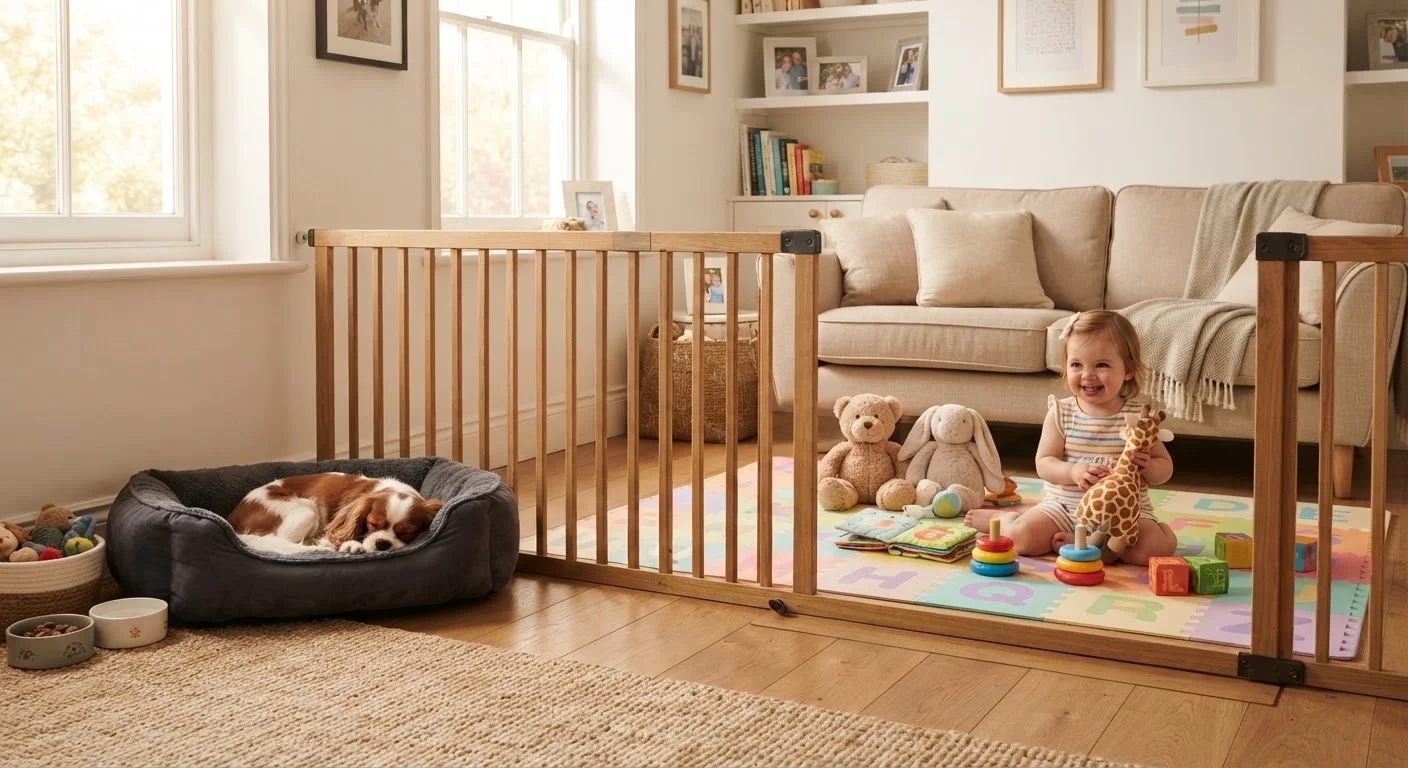
Why Both Pets and Toddlers Need Their Own Territory
When a toddler and a pet share the same square footage, both can end up stressed without the adults in the home fully realizing it. Toddlers don't yet understand animal body language - a dog tucking its tail or a cat flattening its ears is invisible social signaling to a child still figuring out gravity. At the same time, pets exposed to constant unpredictable movement, noise, and grabbing can develop anxiety, resource guarding, or avoidance behaviors that make shared living harder over time.
Creating defined zones isn't about keeping them apart forever - it's about giving each a reliable home base. A pet who knows they have an undisturbed retreat is more relaxed during shared time. A toddler with a clearly marked play area has a framework that makes behavioral limits easier to teach. The structure benefits everyone, including the adults trying to stay sane in the middle.
Introduce Changes Gradually for Pets
Animals can find sudden rearrangements stressful. Roll out new barriers or furniture shifts over several days, letting your pet investigate each change at their own pace. A calm pet adapts more reliably and is less likely to develop avoidance or anxiety behaviors around the new layout.
This approach also complements broader home organization thinking. While the focus here is safety and animal welfare, the underlying logic echoes what home organizers call zone-based design - a concept explored from a tidiness angle in our article on the zone method for home organization.
Tools and Setup You'll Need
Before working through the steps below, gather your materials and set realistic expectations about scope. Most families can create a functional dual-zone layout in an afternoon using readily available items - no renovation required. What matters most is consistency of placement, not the cost of the tools.
Pressure-mounted or hardware-mounted baby gate
Creates a physical boundary between pet and toddler zones in doorways or open-plan areas.
Pet crate or covered dog bed
Gives the pet a clearly defined retreat space they can enter and exit freely.
Non-slip area rug or foam play mat
Visually and physically defines the toddler's safe play area on hard floors.
Door latch or lever-handle lock
Keeps a designated room door securely closed to toddlers or pets without a full gate installation.
Pet water station with splash mat
Contains water spills within the pet zone so the toddler area stays dry and slip-free.
What you will need
If you're working within a smaller home, know that compact spaces can absolutely support safe zone separation - the boundaries simply need to be more deliberate. For more on making limited square footage work with animals and children, see our overview of pets that work well in small homes.
Supervision Cannot Be Replaced
Safe zones significantly reduce the chance of accidental contact between a pet and a toddler, but no physical barrier is foolproof. Toddlers climb, gates fail, and animals find unexpected routes. An adult should always be within earshot - and ideally line of sight - whenever pets and young children share a home environment.
Step-by-Step: Creating Your Safe Zones
Map your space before moving anything
Walk through your home and note where your pet naturally eats, sleeps, and retreats when stressed. Then observe where your toddler plays, crawls, or toddles most often. Sketch a rough floor plan - even on a notepad - marking these zones. Overlapping areas are your highest-priority problem spots to separate.
Choose the pet's dedicated retreat space
Select a low-traffic area - a laundry room corner, a section of a hallway, or a spare bedroom - where your pet can eat, drink, and rest undisturbed. This space should be accessible to the pet at all times but blocked from toddler entry. Place food bowls, the water station, and the pet's bed or crate here. For cat-owning families, the litter box placement deserves its own consideration - see our guide on litter boxes and toddler safety for specific placement strategies.
Install physical barriers at zone boundaries
Hardware-mounted gates are more secure than pressure-mounted versions for high-use thresholds, though they require drilling. Use a gate with a pet door insert if you want the animal to pass freely while keeping the toddler out. For open-plan rooms without doorways, freestanding play yards can define a toddler zone without permanent installation. Measure your opening width carefully before purchasing any barrier.
Set up the toddler's safe play zone
Within your toddler's designated area, use a foam play mat or area rug to visually anchor the space. Keep pet items - food, toys, bedding, and waste areas - completely out of this zone. Check the perimeter for pet hair accumulation, which can be an allergy and hygiene concern. Our complementary article on pet-proofing your home covers additional hazards worth addressing in this step.
Establish and reinforce behavioral boundaries consistently
Physical barriers work best alongside routine. Guide your toddler back to their zone calmly every time they breach the pet area - consistency matters more than any single correction. Simultaneously, reward your pet for retreating to their space when the toddler is active, rather than staying in shared areas seeking attention. Over time, both learn the pattern. For structured guidance on teaching respectful interaction, see our piece on teaching children to interact safely with the family pet.
Review and adjust as your toddler grows
A 14-month-old and a 2.5-year-old present very different challenges. Revisit your zone layout every few months as your toddler becomes more mobile and curious. Gates that worked at one height may need upgrading, and a pet who was calm may need a quieter retreat as household activity increases. Treat this as an evolving system, not a one-time setup.
Once your zones are established, keep an eye on how both your toddler and pet respond over the first two weeks. Some adjustment is normal. For a broader look at all the hazards worth addressing as your household evolves, the pet-proofing your home guide is a practical next read. Budget-conscious families can also find cost-effective care strategies across our affordable pet care resources.
The content provided on our blog site traverses numerous categories, offering readers valuable and practical information. Readers can use the editorial team’s research and data to gain more insights into their topics of interest. However, they are requested not to treat the articles as conclusive. The website team cannot be held responsible for differences in data or inaccuracies found across other platforms. Please also note that the site might also miss out on various schemes and offers available that the readers may find more beneficial than the ones we cover.