

Why One System Rarely Works for Everyone
In most family homes, at least one person carries the invisible weight of maintaining order while everyone else operates by different rules. One partner stacks mail on the counter; another needs a designated tray. A teenager tosses shoes near the door; a younger child loses track of their backpack entirely. The problem usually isn't laziness - it's that the existing system was designed around one person's habits rather than the household's actual range of needs.
Before buying a single bin or shelf, it helps to observe how each family member actually moves through the home. Where do items genuinely land? What routines already exist, even imperfect ones? Designing around real behavior - rather than trying to change it entirely - is what separates systems that stick from ones that collapse within a week. See how this same principle applies at the front door in our guide to entryway organization.
Best Practices for Shared-Space Organization
These strategies are designed for households where multiple habits, ages, and preferences collide daily. None require expensive products - most rely on clarity, consistency, and buy-in.
Assign every person a dedicated landing spot in shared rooms.
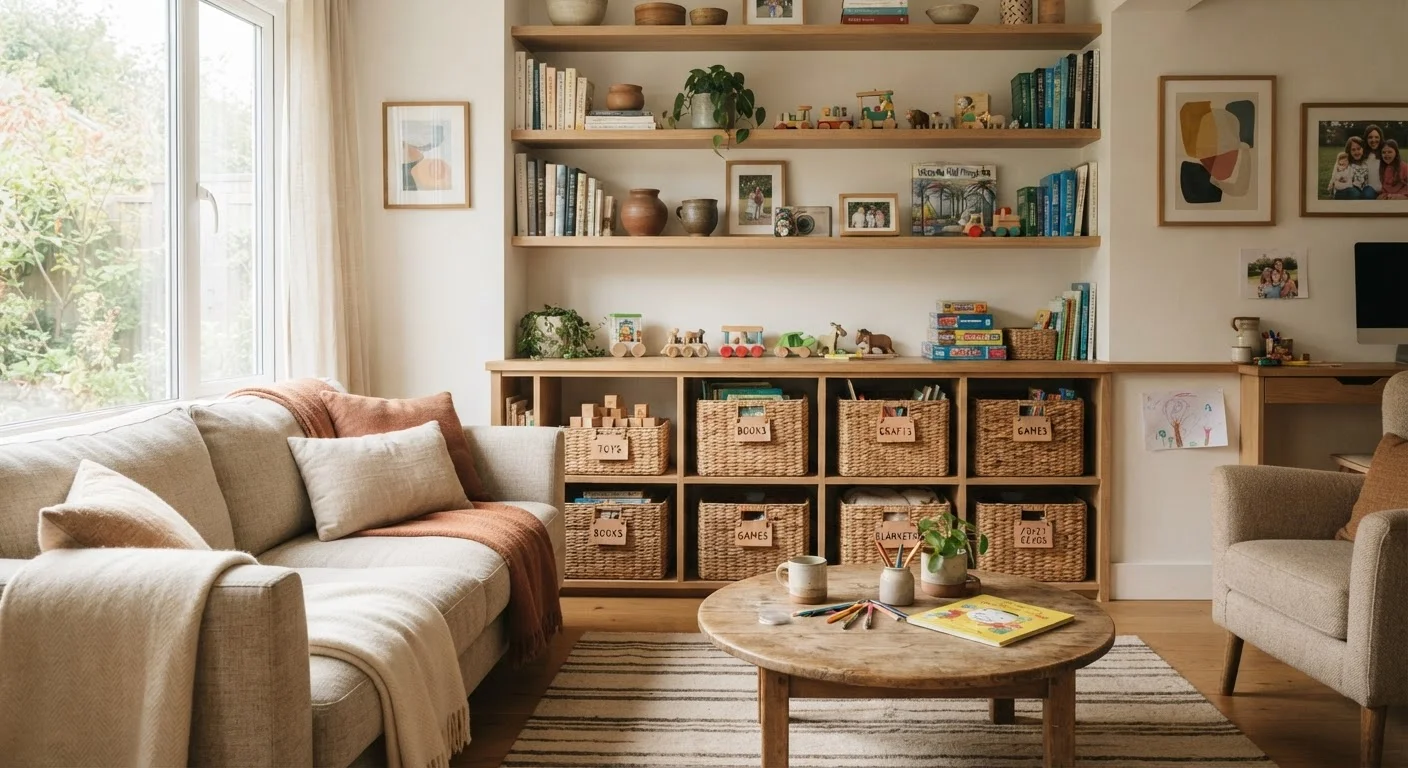
When belongings have no designated home, they spread across surfaces and create visual noise. Giving each family member a specific hook, shelf section, or basket eliminates the guesswork of where things belong and reduces friction during cleanup.
Design for your lowest-effort family member, not your most organized one.
Systems calibrated to the most disciplined person in the household will be abandoned by everyone else. When storage requires minimal steps - open bins rather than lidded boxes, visible rather than hidden - compliance goes up across the board.
Use visual cues and labels rather than relying on memory.
Verbal instructions fade; visual anchors persist. Labels - whether written, picture-based for young children, or color-coded - reduce the cognitive load of remembering where things go and make it easier for everyone to maintain the system independently.
Create buffer zones for items in transition.
Not everything is either in use or fully put away - some items exist in a middle state (library books being read, homework in progress, a project mid-completion). Without a designated landing spot for these transitional items, they become clutter. A defined buffer zone prevents this.
Establish a brief daily reset routine tied to an existing habit.
Sporadic deep-cleaning sessions are harder to sustain than short daily resets. Tying a five-minute tidy to something the household already does - after dinner, before bedtime - makes it automatic rather than effortful. For more on rules that prevent clutter returning, see household clutter-prevention rules.
Audit and adjust systems when they stop working, rather than abandoning them.
When a system fails, the instinct is often to give up on organizing altogether. In reality, most failures signal a mismatch between the system and actual behavior - a much smaller problem that can be corrected with a small tweak.
Getting the Whole Family On Board
Even the most thoughtful system will fail if it's imposed rather than co-created. Hold a brief family meeting - even 10 minutes - to explain the goal and invite input. Ask each person what bothers them most about the current setup and what would make it easier for them specifically. Children as young as four can participate meaningfully when options are simple and visual.
Frame new routines as experiments rather than permanent rules. "Let's try this for two weeks and see if it works" is far less threatening than "this is how it is now." When systems feel flexible and revisable, family members are more willing to try them. You can apply the same collaborative mindset to financial chores - the guide on splitting budgeting duties explores this well.
Maintaining Order Without Carrying It Alone
Long-term tidiness in a shared home depends less on any single organizing product and more on distributing the mental and physical load equitably. Rotating responsibility - so that no one person is always the one who resets the living room or clears the kitchen counter - prevents resentment and keeps everyone invested in the outcome.
Visual cues help enormously: a hook labeled with a child's name, a basket designated for one partner's reading materials, a drawer that belongs to no one and therefore holds shared-use items. The zone method offers a structured way to carve shared space into accountable areas. For handling the paper accumulation that no family fully escapes, see our room-by-room paper clutter plan.
Revisit your systems every few months. Families change - kids get older, schedules shift, new hobbies arrive. A system that worked last year may need adjusting now, and that's completely normal. The goal isn't a perfectly tidy home; it's a home that functions well for the people actually living in it.
Budget-Friendly Organizing Is Entirely Possible
You don't need to spend heavily to create functional systems. Repurposed containers, secondhand finds, and simple labels can do as much as costly products. Our low-cost storage approaches guide and organization myths article both challenge the idea that organizing requires a significant investment. Start with what you have before buying anything new.
The content provided on our blog site traverses numerous categories, offering readers valuable and practical information. Readers can use the editorial team’s research and data to gain more insights into their topics of interest. However, they are requested not to treat the articles as conclusive. The website team cannot be held responsible for differences in data or inaccuracies found across other platforms. Please also note that the site might also miss out on various schemes and offers available that the readers may find more beneficial than the ones we cover.