

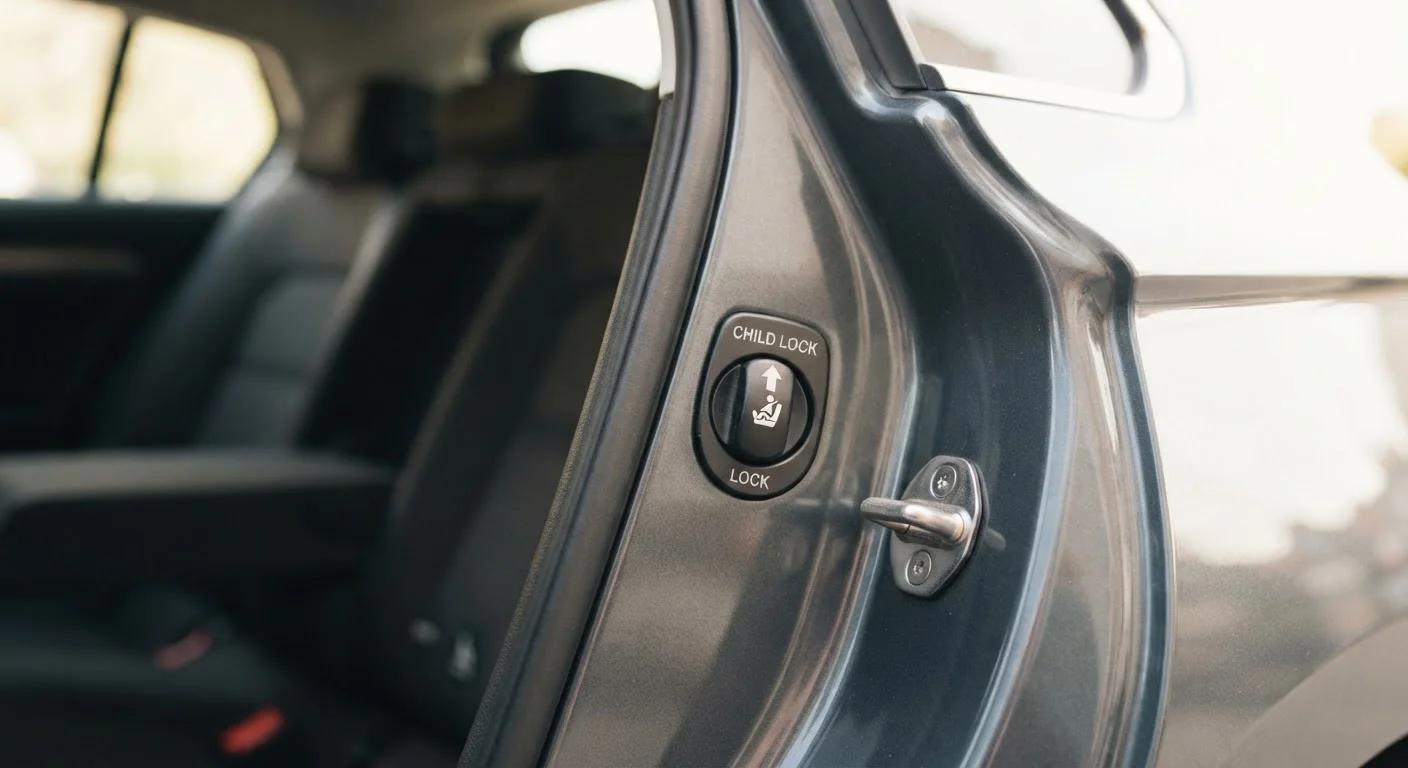
What Child Safety Locks Actually Do
The name can be misleading - child safety locks don't lock the door in the traditional sense. Instead, they disable the interior door handle on rear doors, so that pulling the handle from inside the cabin does nothing. The door can still be opened normally from outside.
This is a purely mechanical system on most vehicles. Engaging it typically requires opening the rear door and flipping a small lever or switch recessed into the door edge - a step many parents skip simply because they don't know it's there. Once set, the lock stays engaged until manually deactivated, regardless of whether the ignition is on or off.
The practical effect: a curious toddler pulling on the door handle while the car is moving - or while parked near traffic - cannot open the door. That's the whole point, and it's straightforward once you know where to look.
Check Every New-to-You Vehicle
If you switch vehicles - rental, borrowed, or newly purchased - open each rear door and look at the door edge for the child safety lock lever before putting children in the back seat. The mechanism looks different across manufacturers, so check the owner's manual if you can't locate it within a minute. Never assume a vehicle's child safety locks are already engaged.
Window Locks: The Feature Families Often Miss
Separate from door locks, most modern vehicles include a window lock - usually a single button on the driver's door panel - that disables the rear window switches for passengers in the back seat. With window lock engaged, children cannot lower rear windows beyond a set limit, or at all, depending on the vehicle.
This matters for two reasons. First, partially open windows create an entrapment hazard - children can lean out or get arms caught. Second, power windows generate significant closing force and can cause injury if a child operates them unsafely. Placing window control with the driver eliminates both risks.
Not every vehicle's window lock completely prevents window movement - some limit travel to a few inches rather than blocking it entirely. Check your owner's manual to understand exactly what your vehicle's window lock does. For families considering which vehicle features matter most, our guide to family car safety across vehicle types covers how these features vary across hatchbacks, SUVs, and people movers.
Door Restraints: A Less Common but Useful Feature
Some vehicles include door restraints - also called door check straps or door limiters - that prevent rear doors from swinging fully open. These aren't exclusively a child safety feature; they also protect doors from wind damage in parking lots. But they serve a useful secondary purpose: preventing a door from flinging wide open and striking pedestrians, cyclists, or other vehicles when a child pushes it open from a stopped position.
Door restraints are passive - they require no activation. They simply limit the arc of the door's swing. If you're evaluating a used vehicle and family safety is a priority, check that the door restraints on all rear doors are intact and functioning. A door that swings freely with no resistance may have a worn or broken restraint.
These mechanisms work best as part of a broader safety approach. Securing loose items in the cabin is another layer of protection - see our overview of unsecured cargo risks for context on why this matters during family travel.
Using These Features Correctly
All three features - door locks, window locks, and door restraints - are only effective when parents know they exist and use them consistently. Here's a practical baseline:
- Check child safety locks every time you change vehicles. If you rent, borrow, or buy a different car, find the rear door locks and confirm they're engaged before transporting children.
- Activate window lock before children board. The driver-side button is easy to miss. Make it part of your pre-trip routine alongside mirrors and seatbelts.
- Test, don't assume. After engaging child safety locks, ask an adult to try opening the door from inside to confirm it's working.
- Read your owner's manual. Lock placement and window lock behavior vary by manufacturer. Two minutes with the manual eliminates guesswork.
These features reduce risk - they don't eliminate the need for supervision, proper car seat installation, or age-appropriate safety conversations with children. They are one layer of a broader approach to keeping young passengers safe.
~50%
Parents unaware child safety locks need manual activation
Surveys by child passenger safety advocacy groups have found a significant portion of parents do not realize child safety locks must be manually engaged and are not automatically active.
Decades
US federal requirement for rear door child safety locks
Federal Motor Vehicle Safety Standards have mandated child safety locks on rear doors of US passenger vehicles for several decades, making them standard equipment on virtually all new cars.
1-2 min
Time to locate and engage child safety locks
Most parents who know where to look can locate, engage, and verify rear door child safety locks in under two minutes - a small investment for a meaningful safety gain.
Frequently Asked Questions
No. Child safety locks only disable the interior door handle. An adult can still open the rear door from the outside by pulling the exterior handle normally. This is by design - it lets parents open the door for children without removing the lock.
On the vast majority of vehicles, child safety locks are small levers or switches located on the edge of the rear door - visible only when the door is open. Consult your owner's manual for the exact location and how to engage them in your specific vehicle.
Yes. Child safety locks are a mechanical feature independent of the central locking system. Even if the doors are unlocked, a child safety lock will prevent the rear door from opening from the inside.
There is no universal age rule - it depends on the child's maturity and ability to understand traffic safety. Many families keep rear locks engaged until children consistently demonstrate they understand not to open car doors independently.
Typically, no. Window locks on most vehicles are controlled by a button on the driver's door panel, putting control entirely in the driver's hands. Children in the rear seat cannot override them.
Federal Motor Vehicle Safety Standards have required child safety locks on rear doors of passenger vehicles sold in the US for decades. However, parents are responsible for actually engaging them - the feature is present but not automatically active.
The content provided on our blog site traverses numerous categories, offering readers valuable and practical information. Readers can use the editorial team’s research and data to gain more insights into their topics of interest. However, they are requested not to treat the articles as conclusive. The website team cannot be held responsible for differences in data or inaccuracies found across other platforms. Please also note that the site might also miss out on various schemes and offers available that the readers may find more beneficial than the ones we cover.