

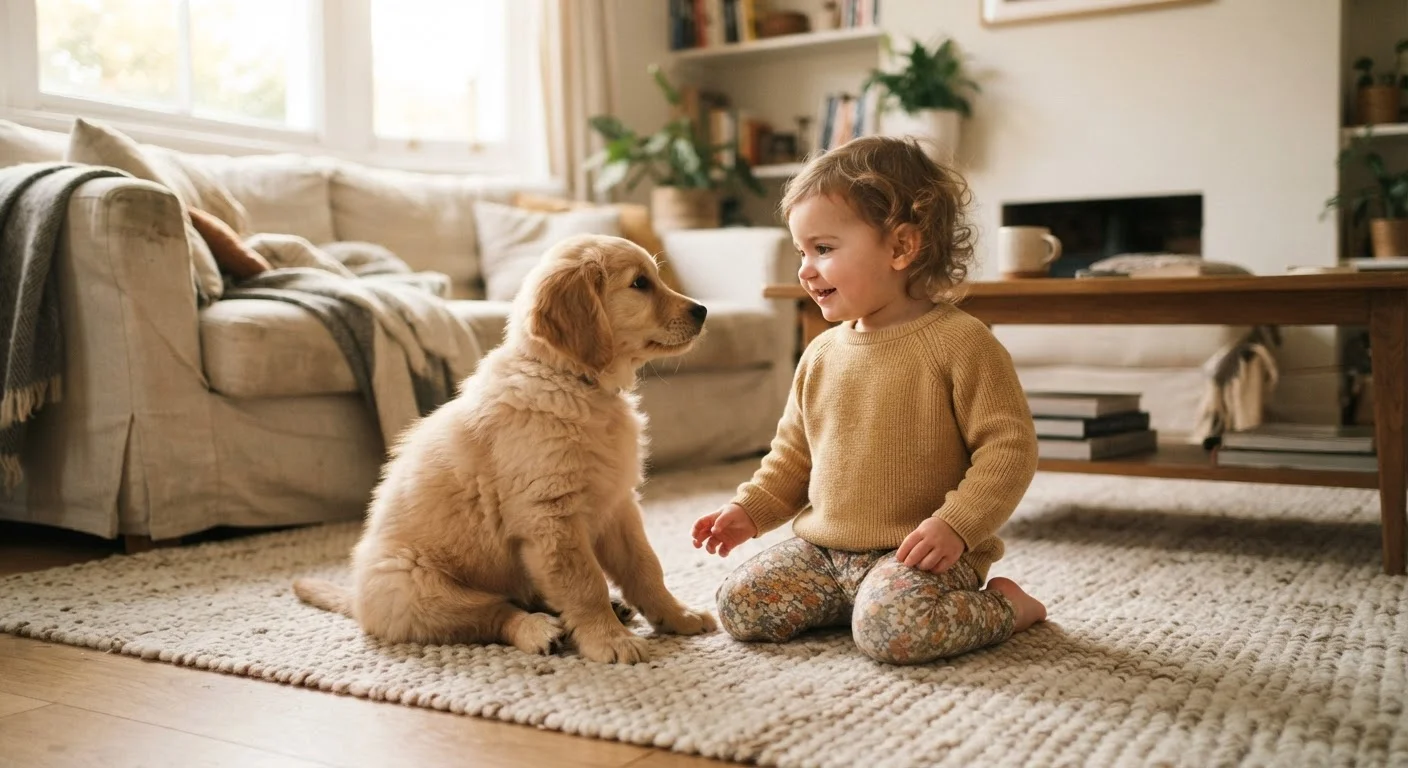
Why Timing Matters: Puppies and Young Children Together
Bringing a puppy home when you already have a young child - or welcoming a baby into a home with a new dog - is one of the most common, and most underestimated, transitions a family makes. Both puppies and toddlers are in critical developmental windows simultaneously, which creates both opportunity and risk.
Research in animal behavior consistently shows that puppies exposed to gentle, supervised handling by children during the socialization window (roughly 3-14 weeks of age) are more likely to grow into calm, child-tolerant adult dogs. Timing your puppy's arrival to align with a period of relative household stability - not a new baby, a move, or a job change - gives everyone the best possible start.
Families considering a rescue dog instead of a puppy face a different set of challenges. Our guide on introducing a rescue dog to a home with children walks through those specific considerations. For families starting with a puppy, the advantage is a clean behavioral slate - but that comes with the full weight of early training responsibility.
Safety First: Setting Up a Shared Home
Before your puppy crosses the threshold, your home needs a physical audit. Puppies chew, lunge, and investigate everything at floor level - exactly where children play. Hazards like small toys, electrical cords, cleaning supplies within reach, and unsecured trash cans pose risks to both species.
Designate a puppy-free zone where your child can play without supervision strain, and a child-free puppy retreat - a crate or gated area - where the dog can decompress. This two-zone approach is the single most effective structural change a family can make.
For a full room-by-room walkthrough, see our guide on pet-proofing your home when you have young children, which covers the spaces and habits families most commonly overlook.
Never Leave Puppy and Young Child Unsupervised
Even the most gentle puppy can react unpredictably when startled, hurt, or overstimulated by a child's fast movements. Direct, active supervision - not just being in the same room - is essential whenever a child under six and a puppy share a space. Passive supervision (glancing while on your phone) is not sufficient.
Never leave a puppy and a child under age six alone together, regardless of the puppy's temperament. According to the American Veterinary Medical Association, children under five account for a disproportionate share of dog bite injuries, and most incidents occur during unsupervised moments.
Training Your Puppy With a Child in the House
Puppy training is harder - and more urgent - in a household with young children, because a jumping 10-pound puppy becomes a jumping 50-pound dog faster than most families anticipate. Start with four non-negotiables: sit, stay, leave it, and off (meaning four paws on the floor). These commands are protective in everyday child-dog interactions.
Short, frequent training sessions (5-10 minutes, two to three times daily) suit both puppy attention spans and busy parenting schedules. Positive reinforcement - small food rewards paired with calm praise - is the approach recommended by the American Kennel Club and supported by behavioral science as the most effective and relationship-building method.
Teach the puppy its name and a reliable recall before it has free run of any space shared with your child - a puppy that comes when called is a puppy you can interrupt before a situation escalates.
Certified animal behaviorists consistently identify a reliable recall as the single most protective obedience behavior in multi-species households with young children.
Use baby gates to create managed transitions between spaces rather than relying on closed doors - gates let the puppy and child see and smell each other safely while preventing direct unsupervised contact.
Gradual sensory exposure through barriers supports the puppy's socialization while giving parents a physical safety buffer during high-energy moments.
Involve your child in training from the beginning, with age-appropriate roles. A four-year-old can hold a treat and say "sit" under your guidance. This builds the puppy's respect for the child as someone who gives commands, not just someone to chase or jump on.
See our article on what to do in the first two weeks for a day-by-day training framework suited to family homes.
Building Routines That Work for Everyone
Puppies and young children both thrive on predictability. A shared daily rhythm - consistent wake times, meals, play sessions, and nap or crate periods - reduces anxiety for both. When the puppy knows a nap follows lunch, it settles more quickly. When your child knows the puppy rests after breakfast, they learn to give the dog space.
Map out your existing child routine and slot puppy needs alongside it rather than in addition to it. Morning walk before school drop-off, crate time during homework hour, and an evening play session before the child's bath time is one model that many families find workable without adding significant burden.
Age-appropriate pet responsibilities can be folded into this routine early - even a three-year-old can refill a water bowl with supervision, building both responsibility and the child-pet bond.
Teaching Your Child to Interact Safely
Children need explicit, repeated instruction on how to behave around a puppy - they do not absorb this by observation alone. Core lessons include: always approach calmly, never disturb a sleeping or eating dog, pet from the side rather than reaching over the head, and stop play immediately if the puppy shows stiff body language or growls.
Growling is communication, not aggression. Teaching children to respect a growl - by stepping back calmly rather than punishing the dog - preserves the dog's warning system and prevents escalation to biting.
Our companion article on teaching children to interact safely with the family pet breaks down these lessons by developmental age, which is especially useful if you have children at multiple stages.
Managing Costs Without Cutting Corners
The first year with a puppy carries the highest costs: spay or neuter surgery, core vaccinations, microchipping, a crate, food, and ideally a puppy training class. For families already managing a child's expenses, this can feel steep. Prioritizing preventive veterinary care - vaccines, parasite control, early wellness visits - is the most cost-effective long-term strategy, as it avoids far more expensive emergency care later.
Pet insurance taken out during puppyhood (before conditions develop) can reduce financial unpredictability, though families should read policy terms carefully and consult their veterinarian about coverage options. For ongoing budget strategies, our hub on affordable pet care covers approaches that don't compromise animal welfare.
Realistic Expectations for the Long Haul
The first six months are the hardest. Puppies bite ("mouthing"), have accidents, chew belongings, and demand attention on their schedule - not yours. These behaviors are developmentally normal and resolve with consistent training, but they overlap with the demands of early childhood in ways that can exhaust even prepared families.
Set a clear internal benchmark: by 12 months, most dogs with consistent training reach a baseline of reliable house manners. By 18-24 months, the relationship between a well-trained dog and a child who has learned respectful interaction becomes genuinely reciprocal and joyful - one of the most meaningful bonds a child can develop.
Revisit your home setup periodically as both the puppy and child grow. What worked at six months may need adjustment at two years. Our resource on pet safety at home is a useful checkpoint as both develop new capabilities and mobility.
This article provides general educational information for families and is not a substitute for personalized advice from a licensed veterinarian, certified animal behaviorist, or child development professional. Always consult qualified professionals for guidance specific to your child's age and your dog's individual behavior.
The content provided on our blog site traverses numerous categories, offering readers valuable and practical information. Readers can use the editorial team’s research and data to gain more insights into their topics of interest. However, they are requested not to treat the articles as conclusive. The website team cannot be held responsible for differences in data or inaccuracies found across other platforms. Please also note that the site might also miss out on various schemes and offers available that the readers may find more beneficial than the ones we cover.