

Our Verdict
Free learning tools - digital and printable alike - offer genuine value for budget-conscious families when used with intention. The trade-offs around screen time are real but manageable with structure, co-viewing where appropriate, and a mix of on- and off-screen activities. No single approach fits every child or household.
Best for parents who want to supplement schooling at no cost and are willing to spend a few minutes evaluating tools and setting consistent boundaries around device use.
Why This Trade-Off Is Worth Thinking Through
Free educational tools have quietly become one of the most accessible resources available to families. Public libraries, school districts, and nonprofits now offer no-cost apps, websites, and printable materials covering everything from early literacy to middle-school math. For budget-conscious households, that's a meaningful shift.
But "free" and "educational" don't automatically mean "no trade-offs." Every hour a child spends on a device is time spent in a particular posture, in a particular kind of attention, with particular stimulation - and that warrants an honest look. This article lays out the genuine advantages and real considerations so families can make informed choices rather than defaulting in either direction.
For a practical starting point, see what parents need to know about free digital learning tools before committing to any single platform.
The Real Advantages of Free Learning Tools
The case for using free educational tools is strong when the tools are well-chosen and time-bound.
Zero cost removes a major barrier to supplemental learning
Quality educational content no longer requires paid subscriptions or tutoring fees. Public libraries, nonprofits, and government-funded platforms have made rigorous, curriculum-aligned materials freely available to any family with internet access.
Interactive formats can increase engagement and retention
Well-designed educational apps use immediate feedback loops - correct answers are confirmed instantly, errors are redirected - which research in learning science suggests can support skill retention better than passive reading alone.
Flexible pacing suits children with different learning speeds
Digital tools allow a child to repeat a concept as many times as needed without embarrassment or a teacher's schedule constraining them, which can benefit both children who need more time and those ready to move ahead.
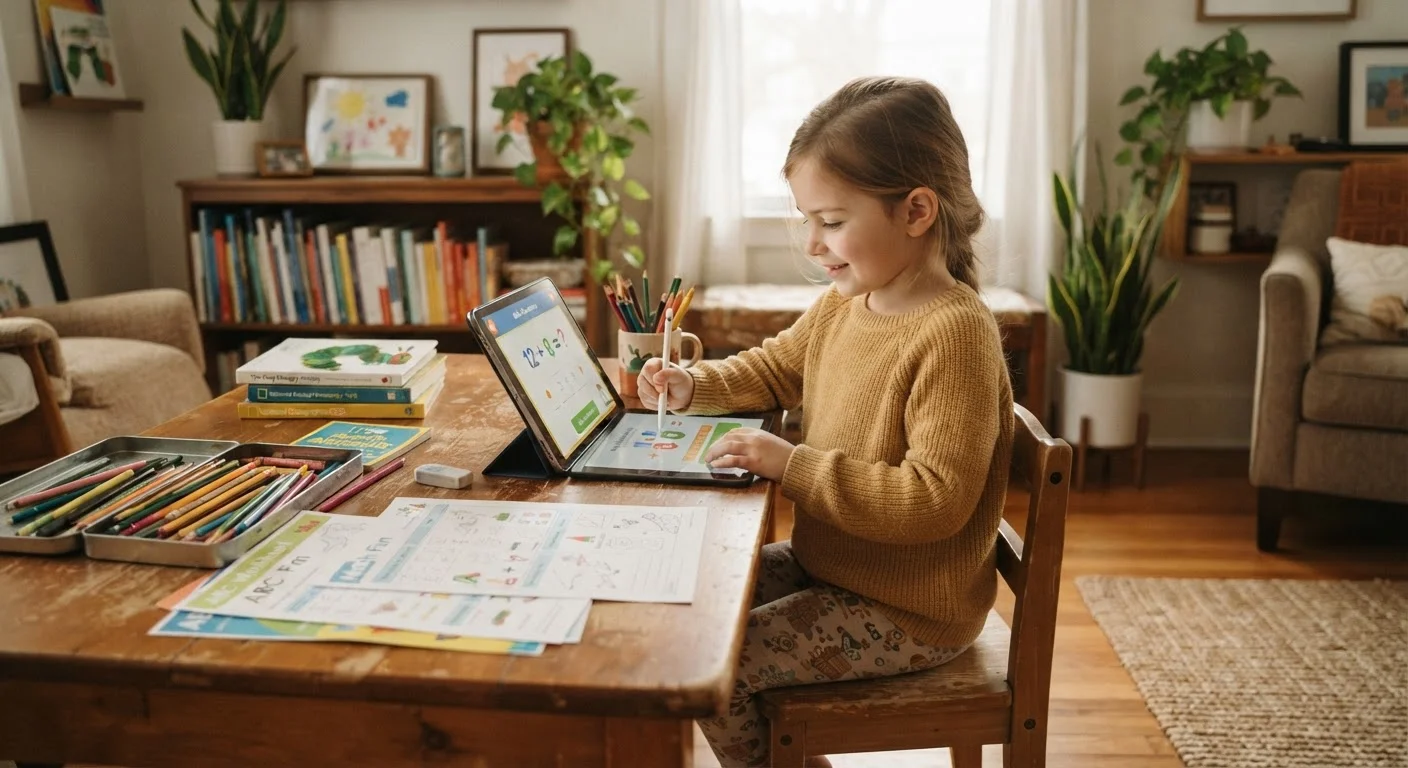
Printable alternatives extend learning without extra screen time
Many reputable educational sites offer free printable worksheets, games, and activity sheets that provide structured practice in reading, math, and critical thinking - entirely offline and at no cost.
Accessible across a wide range of devices and skill levels
Most free educational tools are browser-based or available on entry-level devices, meaning families don't need the latest hardware to participate. Many also include settings for different reading and language levels.
Printable resources deserve a separate mention. Worksheets, flashcard templates, and activity pages from reputable educational sources give children hands-on practice without adding screen time. Many families find a rotation - some digital sessions, some paper-based - works better than an all-or-nothing approach. See how to build a free home learning routine for a practical framework that incorporates both.
42%
US children using educational apps daily
According to Common Sense Media research, a substantial portion of school-age children in the US engage with educational apps as part of their regular routine, though frequency and quality vary widely by age group.
2-3x
Learning gains with caregiver co-engagement
Multiple studies in early childhood education have found that young children's learning from video and app-based content improves significantly when a parent or caregiver actively participates in the session.
The Considerations Parents Should Factor In
Screen time's effects on children are more nuanced than headlines often suggest, but they're not trivial either. The concerns worth holding onto are specific and actionable - not cause for alarm, but cause for thoughtfulness.
Not all 'educational' apps deliver measurable learning gains
The label 'educational' is self-applied by developers and not independently verified. Some apps prioritize engagement mechanics - streaks, badges, sounds - over genuine skill-building, which can make a child feel productive without meaningful progress.
Extended screen use can disrupt sleep, especially in evenings
Blue light from screens and cognitively stimulating content close to bedtime are associated with delayed sleep onset in children, according to broadly cited pediatric sleep research. The timing of screen-based learning sessions matters.
Free apps often carry advertising or in-app purchase prompts
Many no-cost apps are supported by advertising revenue or designed to encourage paid upgrades. Children may encounter ads that are not age-appropriate, or experience frustration when content is paywalled mid-session.
Passive or solo screen use offers fewer benefits than active engagement
Young children especially tend to learn more from screen-based content when a caregiver co-views and discusses it with them. Unsupervised use of even well-designed tools can drift toward passive consumption rather than active learning.
Screen time accumulates across contexts, not just learning sessions
Educational screen time adds to - rather than replacing - recreational use, social media exposure, and video content. Parents tracking total daily screen exposure may find educational apps tip a child past recommended daily limits.
It's also worth noting that screen habits in the household affect everyone. If you're finding that late-night device use is disrupting your own sleep, what's happening neurologically and what helps is a useful companion read. And for a deeper look at how children's screen habits connect to physical health markers, the current evidence on screen time and children's physical health offers a fair, research-informed overview.
Screen Time Guidelines Are a Starting Point, Not a Rule
Major pediatric health organizations publish general screen time guidelines, but these are designed as starting points for discussion - not rigid rules that apply identically to every child. A child with a disability, a highly structured learning routine, or limited alternative enrichment options may have different needs. If you have specific concerns about your child's development or screen use patterns, a pediatrician or child development specialist is the right person to consult. This article is for general informational purposes only and is not medical advice.
How to Make Free Tools Work Without Overdoing Screen Time
The families who get the most out of free learning tools tend to share a few common habits: they preview tools before handing them to a child, they set a clear time frame, and they occasionally sit alongside their child during use - especially with younger kids.
Before downloading anything new, run it through a quick check. A parent's evaluation checklist can help you assess whether an app is genuinely educational, age-appropriate, and free of manipulative design patterns. Similarly, what research actually says about educational apps is worth a read if you've ever suspected that a popular app wasn't delivering real learning.
Finally, tools alone don't create progress - habits do. Habits that help children actually progress walks through how to build consistency around free resources so children move forward rather than just staying occupied.
The content provided on our blog site traverses numerous categories, offering readers valuable and practical information. Readers can use the editorial team’s research and data to gain more insights into their topics of interest. However, they are requested not to treat the articles as conclusive. The website team cannot be held responsible for differences in data or inaccuracies found across other platforms. Please also note that the site might also miss out on various schemes and offers available that the readers may find more beneficial than the ones we cover.