

Why the 'Educational' Label Means Less Than You Think
Walk through any app store and thousands of titles carry the word "educational" in their description. For parents trying to support learning at home without spending a fortune, that label feels reassuring. The problem: no regulatory body in the U.S. independently verifies that claim before an app reaches your child's screen.
Research published in child development and educational psychology literature consistently finds a wide gap between apps marketed as educational and those that produce genuine learning gains. A notable analysis by researchers at the Joan Ganz Cooney Center found that the majority of top-selling "educational" apps for young children targeted entertainment over skill-building, and very few were designed in collaboration with learning scientists or curriculum specialists.
Understanding what the evidence actually says - rather than what a product description claims - puts you in a far stronger position to choose tools that genuinely help. See our overview of free digital learning tools for a practical starting framework.
Myth
If an app is in the 'educational' category of the app store, it has been reviewed and certified for learning quality.
Fact
App store categories are self-assigned by developers. No independent authority verifies educational claims before publication.
App stores sort titles based on developer-submitted metadata. There is no vetting process that confirms a product actually teaches what it claims. A puzzle game with alphabet letters can be filed under 'Education' just as legitimately as a rigorously designed phonics program. Parents should treat the category label as a starting point for investigation, not a seal of approval.
Myth
The more interactive and colorful an app is, the more a child will learn from it.
Fact
High stimulation can actually interfere with learning. Research calls this the 'seductive details effect,' where flashy features distract from core content.
Cognitive load research, including work by educational psychologist Richard Mayer, identifies a consistent pattern: when irrelevant sounds, animations, and visual effects compete for attention, children retain less of the intended lesson. Effective educational design is deliberate about removing distractions, not adding them. An app that feels almost boring to an adult may be doing exactly the right thing cognitively.
Myth
Free educational apps are always lower quality than paid ones.
Fact
Price is not a reliable indicator of educational quality. Many high-quality free tools are produced by universities, public libraries, and nonprofits.
Some of the most rigorously designed learning tools available to U.S. families - including those from public broadcasting, state library systems, and university extension programs - are completely free. Conversely, a paid app with a high download count may rely entirely on repetitive drilling with no adaptive feedback. Evaluate design and evidence, not price.
Myth
Children learn just as much from an app alone as they do when a parent engages alongside them.
Fact
Research consistently shows that adult co-engagement significantly increases what children learn and retain from digital tools.
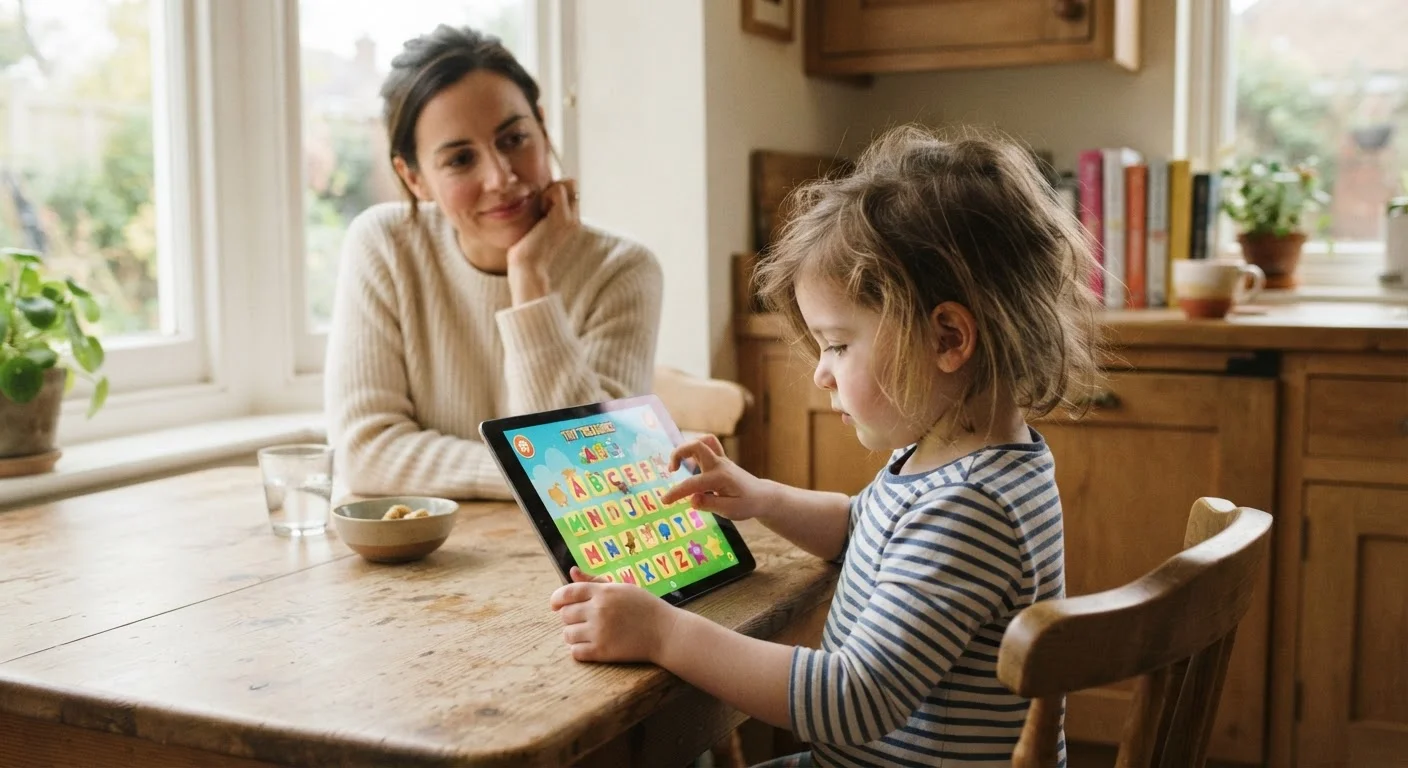
Studies in early childhood media literacy, including research cited by the American Academy of Pediatrics, find that children - especially those under age seven - transfer knowledge from screen-based activities most effectively when a caregiver participates, asks questions, and connects content to familiar contexts. An app is a tool; the adult using it with the child is a critical part of the learning system.
Myth
If a child is engaged and enjoying an app, they must be learning from it.
Fact
Engagement and learning are related but not the same thing. An app can hold a child's attention through rewards and entertainment while producing little actual skill development.
Many apps are deliberately designed to maximize time-on-app through variable reward schedules - the same mechanism used in games and social media. A child can spend 30 minutes happily earning stars and badges while practicing no transferable skill. Look for apps where the engagement comes from mastering the content itself, not from collecting digital prizes unrelated to learning objectives.
What Good Learning Apps Actually Look Like
The research doesn't conclude that apps can't support learning - it identifies the specific design features that make the difference. Effective apps tend to share a handful of characteristics: they require active responses from the child (not just tapping to advance animation), they provide targeted, corrective feedback, they adapt difficulty based on performance, and their content maps to a recognized curriculum framework.
Apps developed with input from early childhood educators or cognitive scientists - and that make that process transparent - are more likely to produce measurable outcomes. When evaluating a free app, look for a published methodology, an advisory board with educator credentials, or independent review from organizations such as Common Sense Media.
~80%
Top children's apps lacking evidence-based design
A review by the Joan Ganz Cooney Center found that the vast majority of best-selling children's educational apps were not developed with input from developmental or learning experts.
2x
Learning retention with parent co-viewing
Research in early childhood media studies suggests children can retain roughly twice as much content from digital tools when a parent actively engages alongside them versus passive solo use.
Equally important is your role as a parent. Studies consistently show that co-engagement - sitting with your child, asking open-ended questions about what they're doing, and connecting app content to real-world experiences - can substantially amplify learning. An app used passively while a parent is in another room produces far less retention than the same app used as a shared activity.
For a structured way to assess any app before downloading, the parent's evaluation checklist offers a quick, reliable process. And if your child's enthusiasm fades quickly, understanding why engagement drops can help you course-correct before giving up on a genuinely useful tool.
Finally, don't overlook free printable resources. For skills like letter formation, number sense, and reading fluency, well-designed printable worksheets and activity sheets can match or exceed app-based practice - with zero screen time and no hidden in-app purchases. The habits that help children progress apply equally to print and digital tools. Also consider the broader trade-offs covered in our piece on screen time and free learning tools.
The Label Doesn't Make It Educational
Before letting any free app become part of your child's regular routine, spend five minutes researching who built it and why. Look for a named curriculum advisor, an evidence page, or an independent review. If none of those exist, the app may be entertainment dressed up as learning - and that's worth knowing before it takes up screen time.
The content provided on our blog site traverses numerous categories, offering readers valuable and practical information. Readers can use the editorial team’s research and data to gain more insights into their topics of interest. However, they are requested not to treat the articles as conclusive. The website team cannot be held responsible for differences in data or inaccuracies found across other platforms. Please also note that the site might also miss out on various schemes and offers available that the readers may find more beneficial than the ones we cover.