

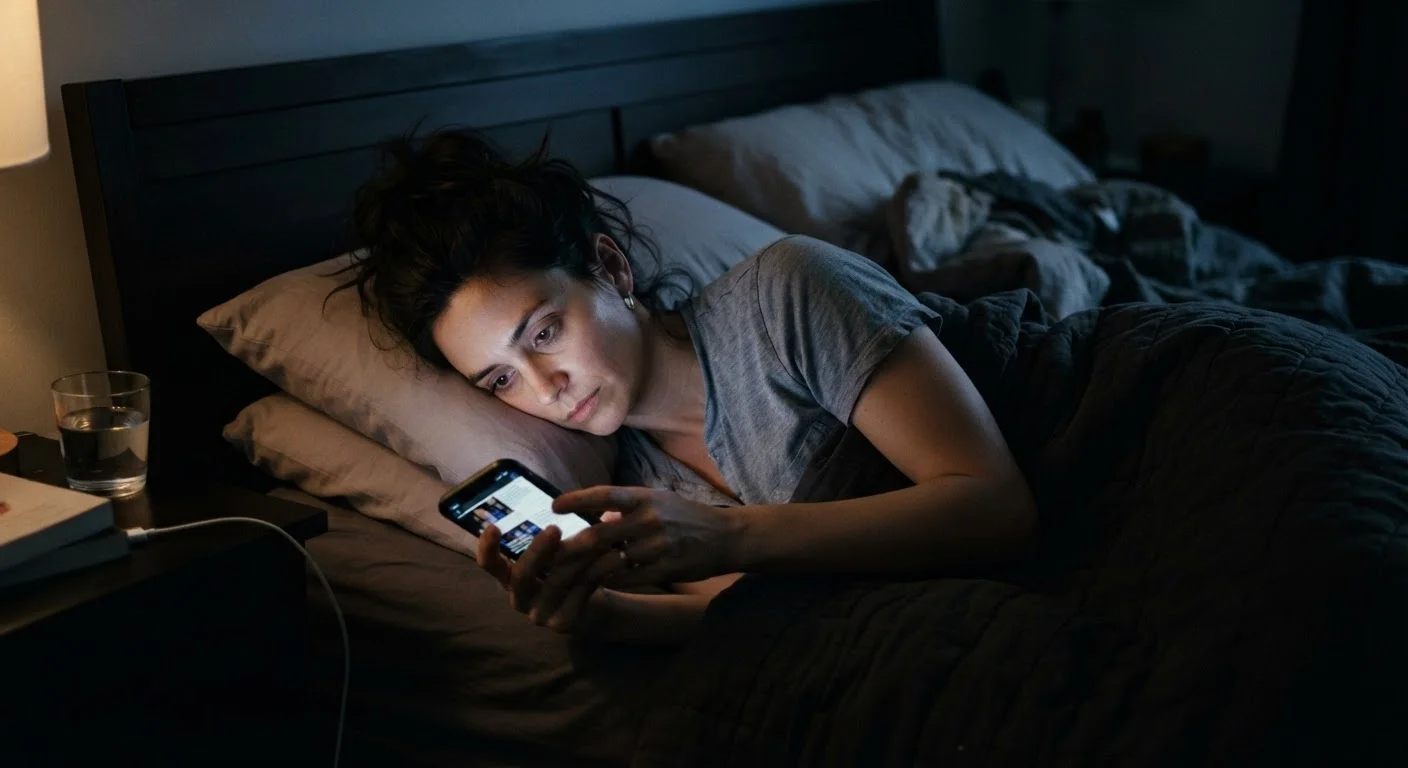
Why Nighttime Scrolling Feels So Hard to Stop
For most parents, the hour after the kids go to sleep is the only truly unstructured time in the day. No one needs anything. The phone becomes a portal to the adult world - news, social connection, entertainment, or simply silence with something easy on the screen. That need is completely understandable.
But the brain doesn't experience scrolling as rest. Engaging content triggers alertness, and the light from the screen is actively working against your body's readiness for sleep. The more exhausted you are, the more tempting the phone becomes - and the more sleep you stand to lose. It becomes a self-reinforcing cycle that many parents recognize immediately.
Understanding the neurological mechanism isn't about blame. It's about having the information to make a choice that actually helps. See also: why parents are often the last to rest and what that pattern does to the body over time.
What Blue Light Actually Does to Your Brain at Night
Your body's sleep-wake rhythm is regulated by a hormone called melatonin, produced by the pineal gland when darkness signals the end of the day. This process is sensitive to light - specifically to short-wavelength, high-energy visible light in the blue spectrum, which is emitted in significant amounts by modern screens.
When your eyes detect this light in the evening, your brain interprets it as daytime and delays melatonin release. Research published in sleep medicine literature has consistently shown that even relatively short exposure to screen light within one to two hours of bedtime can push melatonin onset back by 30 to 90 minutes. That translates directly into later sleep onset, less total sleep time, and - critically for parents - reduced slow-wave and REM sleep, which are the most restorative stages.
90 min
Maximum melatonin delay from evening screen use
Sleep medicine research has found that evening blue light exposure can delay melatonin onset by up to 90 minutes, depending on intensity and duration of exposure.
~70%
Adults using screens within an hour of bedtime
National Sleep Foundation surveys have consistently found that a large majority of American adults use an electronic device in the hour before bed.
1-2 hrs
Recommended screen-free window before sleep
Leading sleep researchers and organizations such as the American Academy of Sleep Medicine generally recommend avoiding screens for at least one to two hours before bedtime.
The content itself compounds the problem. Emotionally engaging material - whether it's news, social media, or streaming - activates the brain's reward and alertness pathways at the same time the light is suppressing sleep readiness. You end up caught between a body that's genuinely tired and a brain that's been chemically nudged toward wakefulness.
Realistic Adjustments That Don't Require Giving Up Your Evening
The goal isn't to eliminate your only downtime - it's to protect the sleep that makes tomorrow possible. A few practical, low-cost adjustments can make a real difference:
- Set a soft cutoff. Aim to put the phone down 30 to 60 minutes before your target sleep time. Even 20 minutes helps. A phone charger placed outside the bedroom removes the temptation passively.
- Enable night mode early. Most devices allow automatic scheduling for warm-display settings. Turn it on at least two hours before bed, not just at bedtime.
- Replace scrolling with a low-stimulation alternative. Reading a physical book, light stretching, or a podcast with eyes closed can fulfill the need for downtime without the neurological cost of a bright screen.
- Use the phone's grayscale setting. Converting your screen to black and white reduces visual reward and makes scrolling noticeably less compelling - a surprisingly effective friction technique.
For parents building a broader evening routine, our end-of-day wellness check offers a simple structure that benefits the whole household, not just the kids.
The Charger-Outside-the-Bedroom Rule
One of the simplest and most consistently effective changes is charging your phone outside the bedroom overnight. It removes the passive temptation to reach for it before sleep and first thing in the morning. A basic alarm clock - inexpensive and widely available - can replace the phone's alarm function so you don't need to keep the device nearby.
Sleep Quality vs. Duration: Why Both Are Affected
Many parents assume that as long as they get enough hours, quality doesn't matter much. In reality, fragmented or light sleep is far less restorative than fewer hours of deeper, uninterrupted sleep. Blue light disruption affects both: it pushes back sleep onset (reducing duration) and disrupts architecture (reducing quality).
If you've ever slept eight hours after late-night scrolling and still felt groggy, this is likely why. The deeper stages of sleep - where memory consolidation, cellular repair, and emotional regulation happen - are compressed when melatonin onset is delayed. For more on this distinction, sleep quality vs. sleep duration explores what the science says about which factor matters more for exhausted parents.
This article is for general informational purposes only and is not a substitute for professional medical advice. If you are experiencing persistent sleep difficulties, please consult a qualified healthcare provider.
Frequently Asked Questions
Most sleep researchers suggest stopping screen use at least 30 to 60 minutes before bed, though some recommend up to 90 minutes for those who are particularly sensitive. Even reducing brightness and enabling night mode in the final hour can help if a full cutoff isn't realistic.
Night mode reduces blue light emission but doesn't eliminate it entirely. Studies suggest it can lessen - not fully prevent - melatonin suppression. It's a useful harm-reduction step, but pairing it with earlier screen cutoff times is more effective.
Screen content - especially social media, news, or engaging videos - activates the brain's dopamine and alertness systems at the same time blue light suppresses sleep signals. The result is a kind of artificial second wind, even when your body is genuinely tired.
The evidence on blue light glasses is mixed. Some studies show modest benefits; others find minimal effect on sleep onset. They may help certain individuals, but they're not a substitute for reducing screen time before bed.
Parents are disproportionately affected because late-night screen use often fills a genuine need for decompression and adult time after caregiving duties end. Understanding that need is important - addressing it doesn't mean giving up downtime, but finding alternatives that don't cost sleep.
If you're consistently struggling to fall asleep, stay asleep, or feel rested despite limiting screens, speak with your healthcare provider. Persistent insomnia can have underlying causes that require professional evaluation.
The content provided on our blog site traverses numerous categories, offering readers valuable and practical information. Readers can use the editorial team’s research and data to gain more insights into their topics of interest. However, they are requested not to treat the articles as conclusive. The website team cannot be held responsible for differences in data or inaccuracies found across other platforms. Please also note that the site might also miss out on various schemes and offers available that the readers may find more beneficial than the ones we cover.