

Why Routine Makes Free Tools Actually Work
Free educational platforms are widely available, but access alone rarely translates into learning progress. The missing ingredient is structure. Research on habit formation consistently shows that behaviors anchored to a predictable time and context become automatic far more quickly than those left to happen whenever. For children especially, a reliable daily routine reduces the negotiation overhead that parents often find most exhausting.
This matters for digital learning tools in particular. Without a schedule, children drift toward easier, more entertaining activities on the same device. A deliberately designed routine creates a clear boundary between learning time and leisure time - and signals to children that the two are different activities, even if the device looks the same. For a broader look at how screen time interacts with free learning tools, our article on weighing screen time trade-offs is worth reading alongside this guide.
Free educational website or app
Provides structured, curriculum-aligned practice in core subjects at no cost.
Printable worksheets
Offer offline, screen-free reinforcement of skills practiced digitally.
Physical or digital timer
Keeps learning sessions focused and helps children transition between activities.
Weekly schedule template (printed or digital)
Gives children a visible structure so they know what to expect each day.
Notebook or learning journal
Encourages children to write down questions, new words, or things they found interesting.
The steps below walk you through building a practical, no-cost daily learning schedule from scratch - one that is realistic for busy families and adaptable as your child's needs change.
What you will need
Step-by-Step: Building Your Home Learning Routine
Free Doesn't Mean Effortless
Free tools require parental setup, vetting, and occasional troubleshooting - they're not plug-and-play solutions. Before handing a device to your child, spend 10-15 minutes exploring any new platform yourself. Check what data is collected and whether the free tier is genuinely sufficient for your child's level. For a deeper look at evaluating options, see our guide to free digital learning tools.
Assess your child's current needs and available time
Before choosing any tool, spend five minutes identifying the subjects where your child needs the most support and the time slots realistically available on weekdays. Consider energy levels - most children focus better in the morning or just after school than late evening. Note which subjects align with school expectations right now, and flag any specific gaps such as times tables, reading fluency, or writing structure.
Choose two or three free platforms matched to age and subject
Resist the urge to sign up for everything at once. Select one platform for maths, one for literacy or reading, and optionally one broader resource for science or general knowledge. Our quick reference guide by age group can help you identify which widely available platforms suit different stages. Stick to genuinely free tiers rather than expiring trials.
Map out a simple weekly schedule block by block
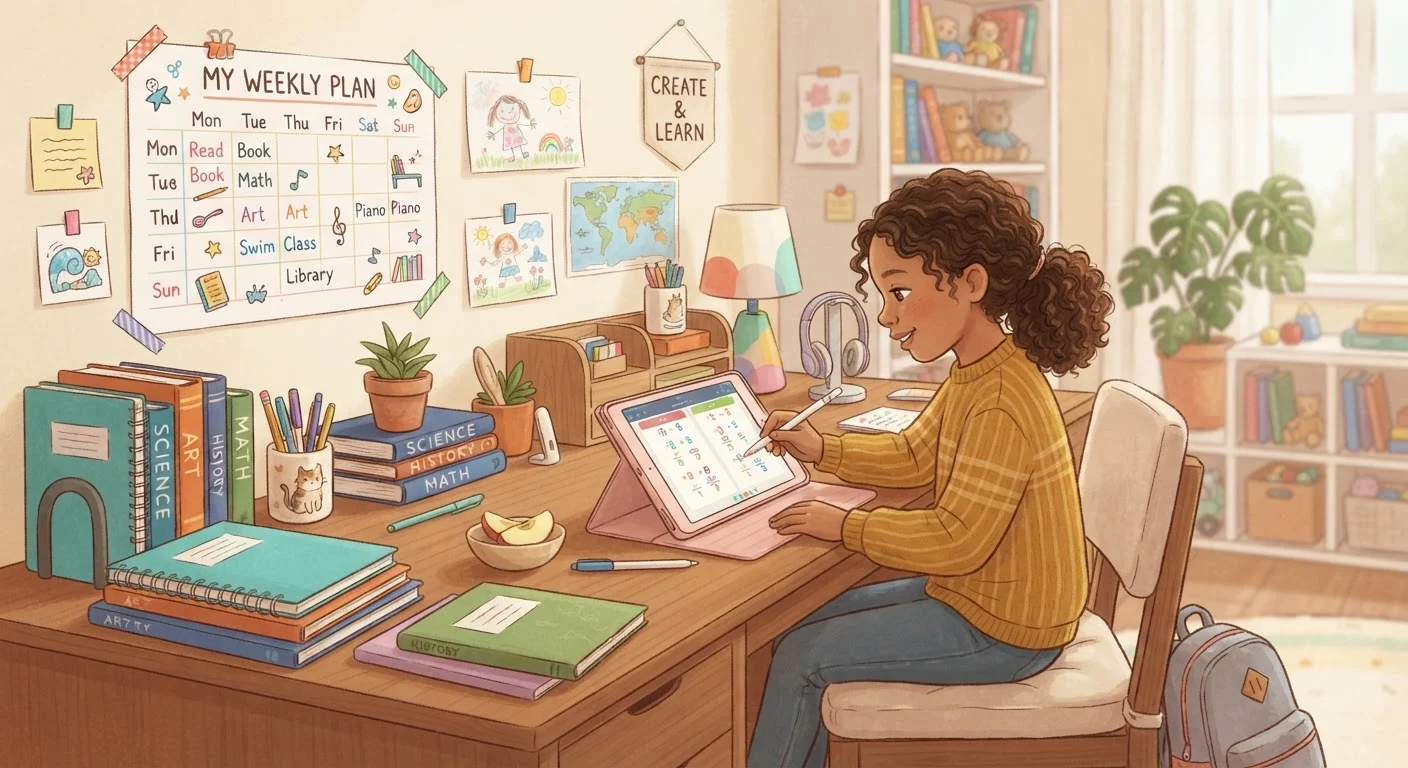
Use a printed or digital weekly grid and assign no more than two learning blocks per day. Each block should be 20-30 minutes - enough to practice without causing fatigue. Alternate subjects across days so children aren't doing maths every single session. Label each block with the subject, platform, and whether it's digital or a printable activity. Pin the schedule somewhere visible; children respond well to predictability.
Example structure for a school-age child:
- Mon/Wed/Fri: 25 min maths platform + 5 min review
- Tue/Thu: 20 min reading/literacy platform + 10 min printable activity
Set up accounts and test everything before day one
Create accounts on your chosen platforms using a parent email address. Walk through the first activity yourself to check difficulty level and confirm the free content is sufficient. Adjust the in-app level settings if the default is too easy or too hard - most platforms allow this. Also confirm that any parental controls or privacy settings are configured appropriately for your child's age.
Introduce the routine to your child with their input
Show your child the weekly schedule and explain what each session involves. Where possible, let them choose the order of activities within a block - small choices build buy-in. Emphasize that learning at home is separate from leisure screen time. If your child has specific learning needs, our article on free resources for children with learning differences covers adapted tools worth reviewing alongside this setup.
Run the first week and track what actually happens
Follow the schedule for a full week before making changes. Keep brief notes - even a quick phone memo - on which sessions went smoothly, which tools your child engaged with, and where resistance or distraction appeared. This data is more reliable than first impressions and will inform a more targeted adjustment in week two.
Review and refine the routine weekly
At the end of each week, spend ten minutes reviewing your notes. Swap out any platform that isn't engaging your child, shift time blocks if energy levels aren't matching up, and gradually increase session length as your child builds stamina. For subject-specific habit building beyond the routine itself, building consistent study habits across different subjects offers practical strategies. The goal is a routine that runs with minimal friction - which typically takes two to three weeks of iteration.
Watch for Gamification That Stalls Progress
Many free educational apps use reward loops - badges, streaks, coins - that can keep children busy without meaningful learning. If your child spends 20 minutes collecting virtual rewards but avoids harder exercises, reconsider how that app fits into the routine. Aim for platforms where challenge increases as skills grow. Our article on habits that actually help covers this in detail.
If you're deciding between printable worksheets and app-based sessions for individual subjects, our comparison of printable vs. app-based learning resources can help you think through the trade-offs by learning style and subject type.
Parents looking for the complete picture of zero-cost home learning - beyond just the daily routine - will find our guide to supporting your child's learning without spending a useful companion reference. For subject-specific digital tool suggestions, our free maths tools for primary-age children article is a practical starting point.
The content provided on our blog site traverses numerous categories, offering readers valuable and practical information. Readers can use the editorial team’s research and data to gain more insights into their topics of interest. However, they are requested not to treat the articles as conclusive. The website team cannot be held responsible for differences in data or inaccuracies found across other platforms. Please also note that the site might also miss out on various schemes and offers available that the readers may find more beneficial than the ones we cover.