

Our Verdict
No single budget approach wins across every situation. Repurposed containers cost nothing and work well short-term, but secondhand finds tend to last longer and look more consistent. Free cardboard dividers shine inside drawers but aren't ideal for high-humidity areas. Mixing all three methods - guided by what you already have and what your space demands - produces the most practical results without unnecessary spending.
| Best for | Recommended |
|---|---|
| Families with almost no organizing budget | Repurposed containers |
| Those wanting durability without full retail prices | Secondhand finds |
| Organizing drawers and small compartments quickly | Cardboard dividers |
| Mixed households with varying storage needs | Combination approach |
Why Expensive Organizers Aren't the Answer
Walk into any home goods store and it's easy to believe that an organized home requires a full set of matching bins, labeled baskets, and drawer inserts. In reality, the research on household organization consistently points to one factor that matters most: having a designated place for each item - not how much the container cost.
As we explore in our look at common organizing myths, the idea that you need matching containers is one of the most persistent and expensive misconceptions in home organization. For budget-conscious families, this is liberating: the goal is workable systems, not showroom aesthetics.
Below, we compare three practical low-cost approaches - repurposed containers, cardboard dividers, and secondhand finds - so you can choose the right tool for each area of your home.
| Repurposed Containers | Cardboard Dividers | Secondhand Finds | |
|---|---|---|---|
| Cost | Free | Free | Low (usually under $5/item) |
| Durability | Low to moderate | Low | Moderate to high |
| Best use case | Pantry, dry shelving | Drawers, small compartments | Open shelves, closets |
| Moisture resistance | Varies (glass: yes, cardboard: no) | Poor | Generally good |
| Customizability | High | Very high | Limited by availability |
| Visual consistency | Low | Low | Moderate |
| Time to implement | Immediate | 15-30 minutes | Depends on sourcing |
Repurposed Containers: Zero-Cost and Surprisingly Versatile
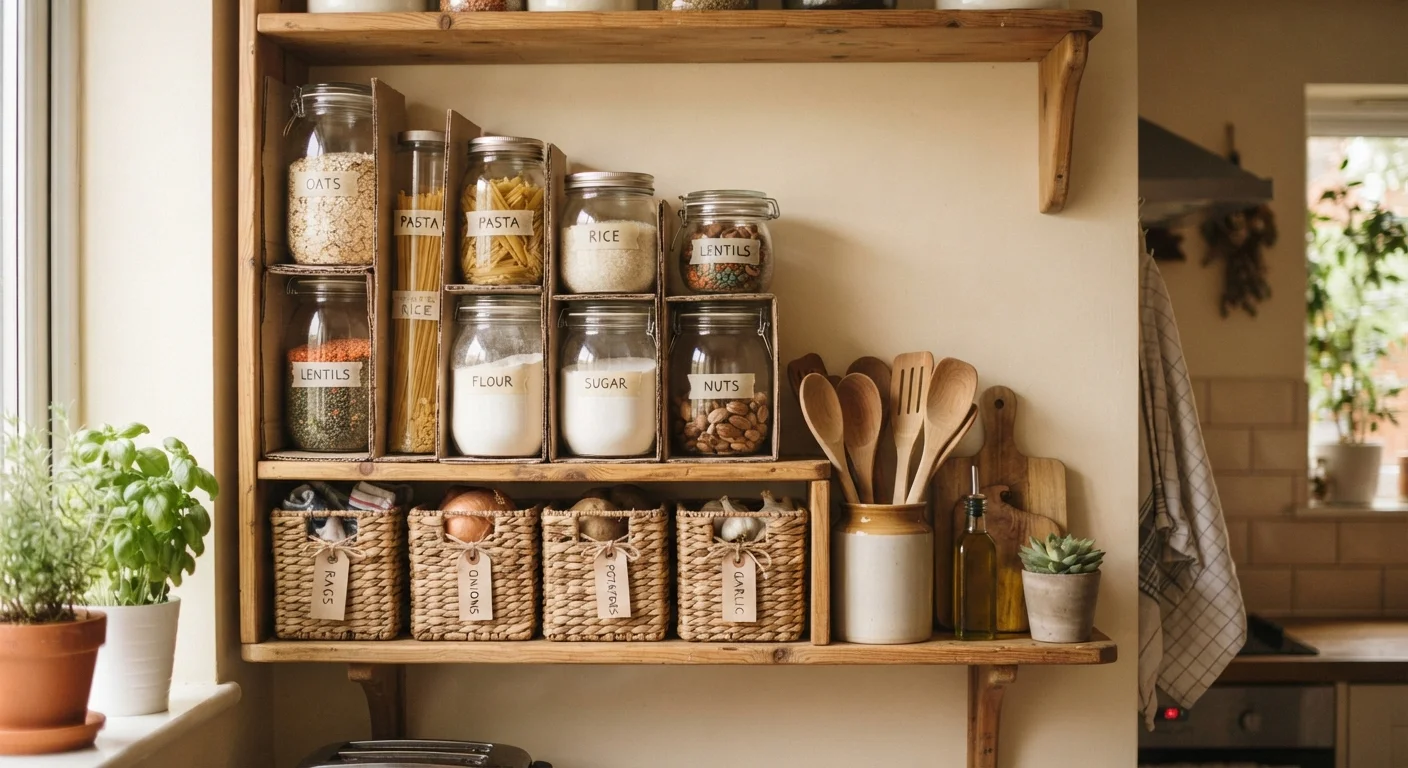
Repurposed containers include anything you already own: shoeboxes, glass pasta jars, cereal boxes cut down to size, tin cans with smoothed edges, and produce baskets. The cost is zero, and the range of uses is wider than most families realize.
- Glass jars work well for pantry staples, small bathroom items, and craft supplies.
- Shoeboxes are ideal for under-bed storage or grouping like items inside larger cabinets.
- Cereal box inserts - cut to about half height - corral small items inside junk drawers.
The main trade-off is longevity. Cardboard-based repurposed containers degrade with moisture and heavy use, making them less suited to bathrooms, garages, or spaces that see constant in-and-out handling. For dry, low-traffic storage, though, they're hard to beat on value.
Label Everything, Regardless of Container
Whether you're using a mason jar, a repurposed shoebox, or a thrifted basket, a simple handwritten label dramatically increases how consistently your family will put items back in the right place. Use painter's tape and a marker for a removable, adjustable label on almost any surface. Consistency in labeling matters more than consistency in container style.
Cardboard Dividers: The Underrated Drawer Fix
Cardboard dividers are cut from flaps of shipping boxes or grocery packaging and slotted together without glue to create a grid inside a drawer. They take about 15 minutes to make and cost nothing if you save delivery boxes.
They excel at organizing utensil drawers, junk drawers, and children's art supply storage. Because they're custom-cut, they fit any drawer exactly - unlike purchased inserts that rarely match real drawer dimensions.
Their weakness is durability in humid environments and under significant weight. They're also not visually polished, which matters if the drawer is frequently seen by guests. If you want something sturdier and slightly more presentable, secondhand options are worth considering. For maximizing every inch of your space, also explore using vertical space - a strategy that works equally well on a zero budget.
Secondhand Finds: Durability at a Fraction of Retail
Thrift stores, garage sales, and online community exchange groups frequently carry wicker baskets, wooden crates, plastic bins, and glass canisters - often in good condition - for a fraction of their original retail price. These items are typically sturdier than bargain-bin alternatives and can last for years.
The practical challenge is inconsistency: you can't always predict what will be available, and sizes vary. This makes secondhand solutions better for flexible storage areas like pantry shelves, linen closets, and garage shelving than for spaces requiring uniform, fitted containers.
If you're weighing whether open or closed storage makes more sense alongside these containers, our comparison of open shelving vs. closed cabinets walks through the trade-offs for busy family homes.
~$0
Average cost of repurposed container storage
Using items already in the home - jars, boxes, and tins - eliminates upfront organizing costs entirely.
50-80%
Typical savings vs. retail at thrift stores
Secondhand household goods are commonly priced well below original retail, though this varies by location and item condition.
Matching the Approach to Your Household
The most effective organizing systems are the ones your family will actually maintain. As covered in our guide to organizing shared spaces, systems need to account for different habits across family members - not just the tidiest person in the house.
A few practical guidelines for choosing your approach:
- Start with what you have. Audit your home for reusable containers before purchasing anything. Most households have more usable storage material than they realize.
- Match durability to traffic. High-use zones like entryways and toy areas benefit from the sturdier secondhand finds. Low-traffic areas like attic storage are perfect for repurposed boxes.
- Keep it consistent within zones. Mixing approaches room-by-room is fine; mixing too many styles within a single small area creates visual noise that makes items harder to find.
- Replace as needed, not all at once. Budget organizing is iterative. Swap out a worn cardboard divider for a thrifted container when you find one - there's no need for a complete system overhaul.
For more context on how organizing fits within broader household financial decisions, the family budgeting hub offers practical frameworks for managing everyday expenses.
The content provided on our blog site traverses numerous categories, offering readers valuable and practical information. Readers can use the editorial team’s research and data to gain more insights into their topics of interest. However, they are requested not to treat the articles as conclusive. The website team cannot be held responsible for differences in data or inaccuracies found across other platforms. Please also note that the site might also miss out on various schemes and offers available that the readers may find more beneficial than the ones we cover.