

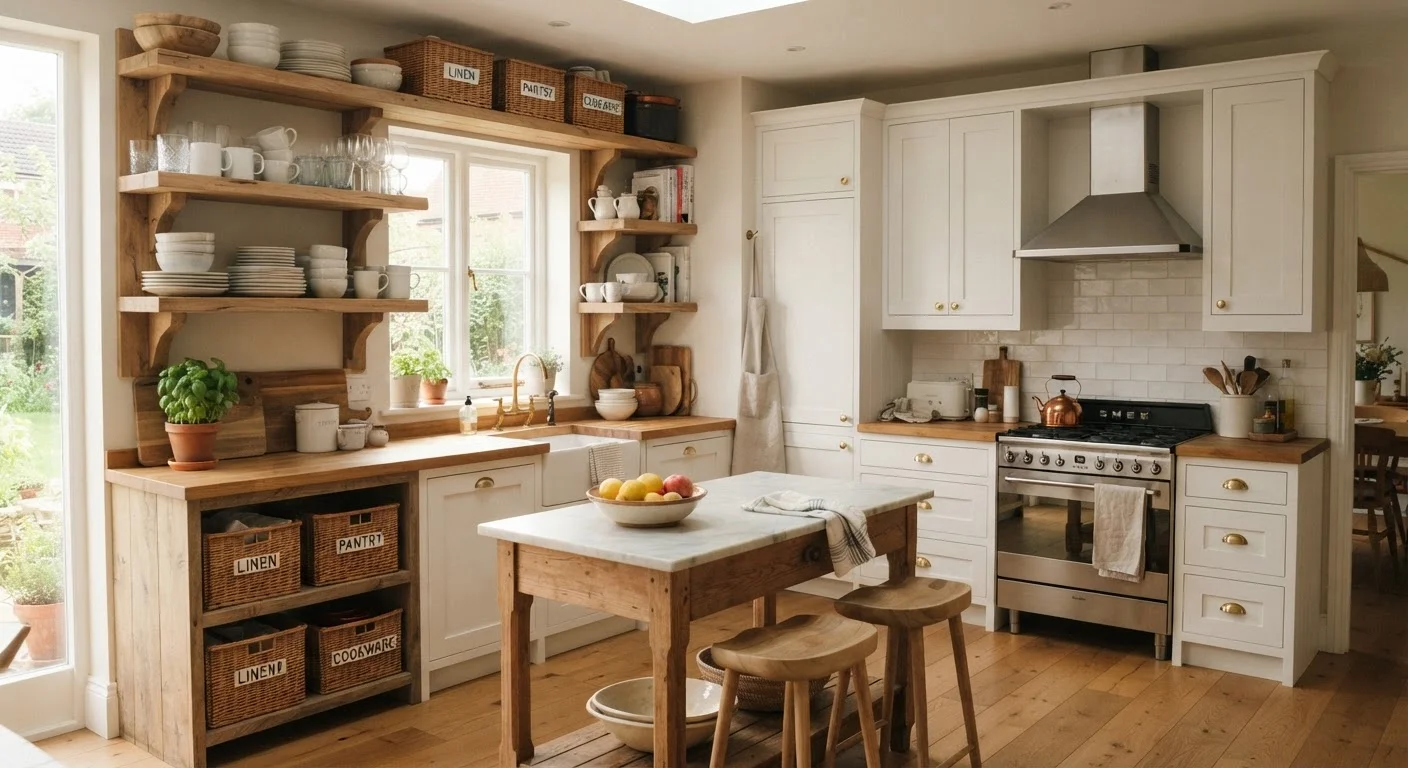
Option A
Open Shelving
The visible, accessible approach to home storage.
Best for: Families who stay tidy consistently and want quick, grab-and-go access to frequently used items.
Option B
Closed Cabinets
The contained, clutter-hiding workhorse of family homes.
Best for: Busy households that need to hide everyday mess quickly and maintain a calm visual environment.
The Core Trade-Off Every Family Needs to Understand
The debate between open shelving and closed cabinets often gets framed as a style question - minimalist versus traditional, modern versus cozy. For families, that framing misses the point entirely. The real question is which system your household can actually maintain given how you live day to day.
Open shelving puts everything in plain sight. That visibility is both its greatest strength and its most demanding requirement. When shelves are organized, a room looks intentional and airy. When they're not - and in a busy family home, that happens fast - the disorder is equally on display. Closed cabinets, by contrast, are forgiving. Shove things in, close the door, done. The trade-off is that what's hidden can become forgotten or buried.
Neither approach is objectively superior. The right answer depends on your family's real habits, not aspirational ones. Before committing to either, it's worth examining the practical strengths and weaknesses of each.
Open Shelving: What Works and What Doesn't
Open shelves shine in spaces where items are used frequently and returned consistently. A shelf holding everyday plates, glasses, and a few pantry staples works well when family members are reliable about putting things back in the same spot. The grab-and-go convenience is genuine - no reaching for handles, no doors swinging into narrow kitchens.
The maintenance reality, though, is significant. Open shelves collect dust and grease in kitchens far faster than closed storage. Items pushed to the back get forgotten. And if different family members have different ideas about where things belong, open shelving turns disagreements into visible, public ones. See our guide to organizing shared spaces for strategies on getting everyone using the same system.
Cost is one genuine advantage. A set of wall-mounted shelves typically requires fewer materials and less labor than full cabinetry - a meaningful consideration for families working within a tight home organization budget. The low-cost storage approaches comparison covers affordable shelf options worth considering.
| Criterion | Open Shelving | Closed Cabinets |
|---|---|---|
| Upfront cost | Generally lower | Generally higher |
| Ease of access | Immediate, no doors | Requires opening doors |
| Dust & grease buildup | Accumulates quickly | Mostly contained inside |
| Child safety | Limited - items visible and reachable | Strong - latches available |
| Tolerance for clutter | Low - disorder is visible | High - mess is hidden |
| Flexibility | Easy to reconfigure | More fixed once installed |
| Maintenance effort | Higher - needs regular tidying | Lower daily effort |
Closed Cabinets: The Practical Case for Doors
For most busy families, closed cabinets are the more forgiving system. Doors hide the inevitable imperfection of daily life - mismatched containers, half-empty boxes, the cereal that got put back in the wrong place. That containment reduces visual noise, which research in environmental psychology links to lower stress levels at home.
Cabinets also offer meaningful safety advantages for households with young children. Cleaning products, sharp utensils, and medications can be stored behind latched or locked doors, keeping them genuinely out of reach rather than simply placed up high. This is a practical necessity many families with toddlers don't fully appreciate until they switch from open storage.
The downsides are real too. Cabinets cost more to install and are harder to reconfigure as needs change. They can also become disorganized in ways that are harder to notice - the "out of sight, out of mind" effect means things get pushed to the back and forgotten. Interior organizers like pull-out trays or drawer dividers help, though they add to the overall cost. If you're stocking a pantry cabinet, our family pantry staples checklist can help you organize what goes inside more intentionally.
Making the Hybrid Approach Work
Most family homes don't have to choose exclusively. A hybrid layout - open shelves for a curated set of everyday items, closed cabinets for everything else - captures the convenience of each style while minimizing the downsides of both.
A practical rule of thumb: use open shelving for items you reach for at least once a day and that come in consistent, visually tidy packaging or containers. Reserve closed storage for anything irregular, bulky, rarely used, or potentially hazardous. In a kitchen, that might mean open shelves for mugs and everyday plates, and cabinets for pots, pans, pantry overflow, and cleaning supplies.
The same logic applies beyond the kitchen. In a hallway, an open shelf for keys and bags works well alongside a closed cabinet for shoes and outerwear. In a living room, open shelves can display books and a few intentional objects while cabinets corral media equipment, games, and the miscellaneous items that accumulate in every family space. If you've already got a designated catch-all spot, our junk drawer guide explores how to make those informal storage zones work rather than fighting them.
Whichever mix you choose, the system only works long-term if everyone in the household understands and uses it. Consistency - not perfection - is the goal.
The content provided on our blog site traverses numerous categories, offering readers valuable and practical information. Readers can use the editorial team’s research and data to gain more insights into their topics of interest. However, they are requested not to treat the articles as conclusive. The website team cannot be held responsible for differences in data or inaccuracies found across other platforms. Please also note that the site might also miss out on various schemes and offers available that the readers may find more beneficial than the ones we cover.