

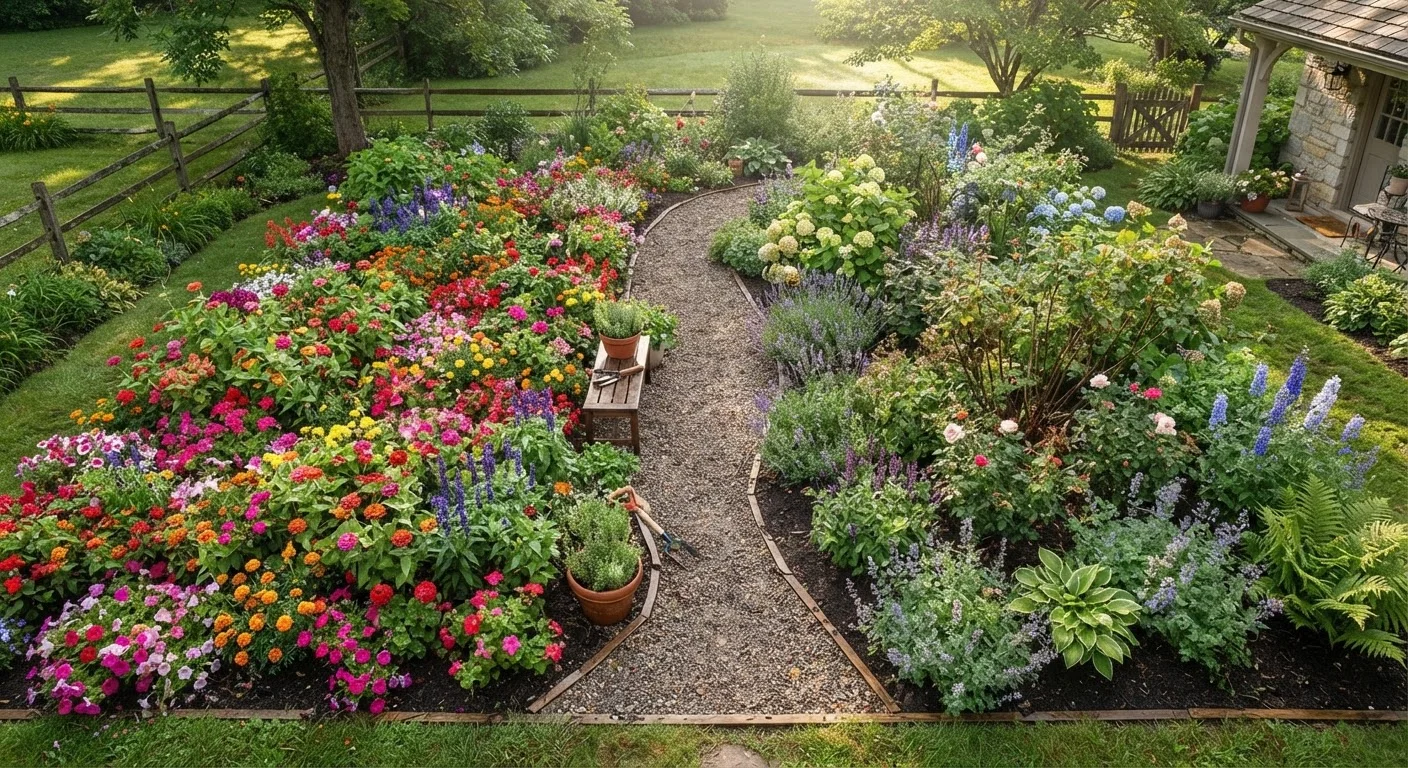
Option A
Annual Plants
The flexible, high-impact option for seasonal color.
Best for: Families who want bold, season-long flowers or vegetables with the freedom to change their garden layout each year.
Option B
Perennial Plants
The long-term investment that pays dividends every season.
Best for: Families who want a lower-maintenance garden that fills in and improves on its own year after year.
What Makes a Plant Annual or Perennial?
The simplest way to understand this distinction is through a plant's life cycle. Annual plants germinate, grow, flower, set seed, and die all within a single growing season. They put enormous energy into producing seeds before they go, which is why many annuals bloom prolifically for months. Common examples include marigolds, zinnias, basil, and most vegetable crops.
Perennial plants, by contrast, live for three or more years. Their above-ground growth often dies back in winter, but the root system survives and sends up fresh growth each spring. Coneflowers, hostas, black-eyed Susans, and daylilies are classic perennials found in family gardens across the US.
There's also a middle category worth knowing: biennials, which complete their cycle over two years. Plants like foxglove and parsley fall here, though they're often treated as annuals in practice. For most family gardening decisions, the annual vs. perennial distinction covers the majority of choices you'll face.
If you're just getting started, see our guide to starting a home garden on a budget for foundational steps before deciding which plant types to prioritize.
Comparing Cost, Effort, and Flexibility
For budget-conscious families, the financial picture matters as much as the horticultural one. Here's how the two types stack up across the dimensions that affect your time and wallet most.
| Criterion | Annual Plants | Perennial Plants |
|---|---|---|
| Life span | One growing season | Three or more years |
| Upfront cost | Lower per plant | Higher per plant |
| Long-term cost | Higher (replant every year) | Lower (plants return and spread) |
| Bloom duration | Often all season until frost | Typically a defined bloom window |
| Seasonal labor | High - replant each spring | Low - divide every few years |
| Design flexibility | High - change layout each year | Lower - plants stay put |
| Food gardening suitability | Excellent - most vegetables are annuals | Limited - mainly herbs and some fruits |
| Establishment time | Fast - productive within weeks | Slower - roots develop over 1-2 seasons |
Annuals tend to cost less per plant at the nursery, but that expense repeats every single season. Over five years, a flower bed replanted annually can cost significantly more than an equivalent bed stocked with perennials - even though the perennials required a larger upfront outlay. Perennials also multiply over time: many spread by root division or self-seeding, giving you free plants to fill gaps or share with neighbors.
On the effort side, annuals demand more seasonal labor - pulling spent plants, amending soil, and replanting each spring. Perennials need dividing every few years and some seasonal cleanup, but the day-to-day workload is generally lower once they're established. That establishment period - typically one to two growing seasons - is important to factor in: perennials often look modest in their first year while their roots develop.
For a related decision that affects both cost and effort, our raised beds vs. in-ground plots comparison covers how your garden structure affects plant performance and long-term expense.
Building a Garden That Balances Both
Few experienced gardeners rely exclusively on one type. The most practical and visually appealing family gardens use perennials as the structural backbone - providing reliable form and foliage year after year - while annuals fill in the gaps with seasonal color, edibles, or variety.
A sensible approach for families on a budget:
- Invest in perennials for permanent beds. Borders along fences, foundation plantings, and any spot where you don't want to dig every year are ideal for perennials. Choose varieties suited to your USDA hardiness zone to ensure they actually return.
- Use annuals in containers and rotating spots. Containers, window boxes, and vegetable patches are natural homes for annuals since you're already amending and refreshing that soil regularly.
- Grow annuals from seed to cut costs. Many annuals - zinnias, sunflowers, and most vegetables - are straightforward to start from seed, reducing per-plant cost considerably. Our seeds vs. seedlings guide can help you decide when that trade-off makes sense.
- Divide perennials to expand for free. Once established, clump-forming perennials like hostas and ornamental grasses can be divided every three to four years, giving you new plants at no additional cost.
Check Your Hardiness Zone Before Buying Perennials
A plant labeled as a perennial at your local nursery may not survive winter in your specific region. The USDA Plant Hardiness Zone Map divides the US into zones based on average annual minimum temperatures. Always check a perennial's zone rating against your location before purchasing - a plant hardy to Zone 7 won't reliably return in a Zone 5 winter. Your local cooperative extension office is a reliable, free resource for region-specific plant recommendations.
Tracking what you plant, where, and how it performs is one of the most underrated habits in gardening. Our guide to keeping a garden journal explains what to record and why it helps you make smarter decisions each season.
The content provided on our blog site traverses numerous categories, offering readers valuable and practical information. Readers can use the editorial team’s research and data to gain more insights into their topics of interest. However, they are requested not to treat the articles as conclusive. The website team cannot be held responsible for differences in data or inaccuracies found across other platforms. Please also note that the site might also miss out on various schemes and offers available that the readers may find more beneficial than the ones we cover.