

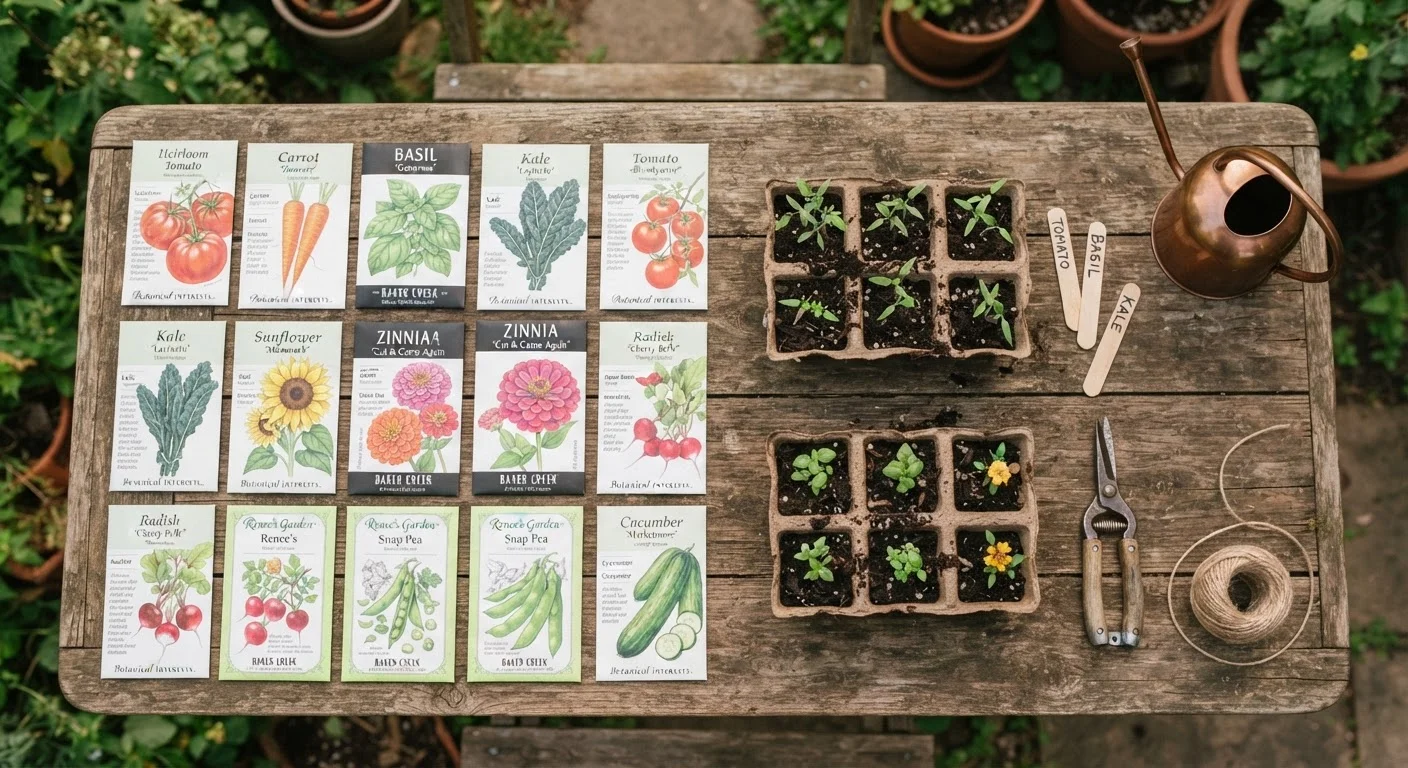
Our Verdict
Neither seeds nor seedlings win outright - the right choice depends on the crop, your experience level, and how much time you can invest before planting day. Seeds reward patience and cut costs considerably at scale, while seedlings are a dependable shortcut that can rescue a short growing season. Most home gardeners benefit from using both.
| Best for | Recommended |
|---|---|
| Families gardening on a tight budget with time to nurture starts indoors | Seeds |
| New gardeners or those with a short frost-free window | Seedlings |
| Direct-sown crops like root vegetables and legumes | Seeds |
| Slow-maturing crops such as tomatoes, peppers, and eggplant | Seedlings |
The Real Cost Difference Between Seeds and Seedlings
For budget-conscious families, the price gap between seeds and seedlings is hard to ignore. A single packet of tomato seeds - containing 20 to 50 seeds - typically costs a fraction of what you'd pay for just one or two transplants at a garden center. At scale, that difference multiplies quickly across an entire vegetable bed.
That said, seeds aren't free to grow. Starting them indoors requires seed-starting mix (a finer, sterile growing medium - not the same as regular potting soil), small containers or trays, and a light source adequate for healthy germination. If you lack a bright south-facing window, a basic grow light adds to the upfront investment. Spread across several seasons, those costs become negligible; but in year one, the savings over seedlings may be smaller than expected.
Seedlings, on the other hand, carry a built-in labor premium - someone has already done the germination work for you. For transplants of slow-maturing crops like peppers or celery, that convenience has real value, especially if you live in a region with a short growing season and can't afford to lose weeks to a failed germination attempt.
| Seeds | Seedlings | |
|---|---|---|
| Upfront cost per plant | Very low (cents per seed) | Higher ($2-$6+ per transplant) |
| Variety selection | Extensive - hundreds of cultivars | Limited to what retailers stock |
| Time investment | High - 6-10 weeks of indoor care | Minimal - plant soon after purchase |
| Germination failure risk | Moderate, especially for beginners | Low - most risk already passed |
| Equipment needed | Trays, grow medium, light source | None beyond standard garden tools |
| Best for short growing seasons | Only if started well in advance | Yes - provides immediate head start |
| Suited for direct-sown crops | Yes - preferred method | Generally not recommended |
For context on how your garden setup affects these decisions, see our guide to raised beds vs. in-ground plots - soil type and bed depth influence which starts thrive.
Which Crops Belong in Which Category
Not every plant gives you a free choice. Crop biology and root sensitivity largely determine whether seeds or transplants make more sense.
Start these directly from seed
- Root vegetables (carrots, beets, parsnips, radishes) - transplanting disturbs taproots and stunts growth
- Legumes (beans, peas) - they germinate quickly and dislike root disturbance
- Squash and cucumbers - fast-germinating and grow poorly if transplant shock delays them
- Leafy greens (spinach, lettuce, arugula) - inexpensive, fast-sprouting, and easy to succession-sow
Strong candidates for seedlings
- Tomatoes, peppers, and eggplant - require 6-10 weeks of indoor growth before outdoor temperatures allow planting
- Broccoli, cauliflower, and cabbage - benefit from a head start, particularly in short-season climates
- Celery - notoriously difficult to germinate and slow to establish
Understanding which plants fall into which camp is the most practical seed-versus-seedling decision you'll make. Forcing a taproot crop into a transplant situation wastes money and usually fails.
Timing, Convenience, and Failure Risk
Seeds demand precise timing. Most vegetables started indoors need a specific number of weeks before your last frost date to reach transplant size - get that window wrong in either direction and the seedlings either get leggy (spindly and weak from insufficient light) or aren't ready when outdoor conditions allow planting. Tracking your local frost dates and counting backward is a learnable skill, but it adds planning overhead that seedlings eliminate.
Seedlings bought at a reputable garden center are typically hardened off - gradually acclimated to outdoor conditions - or at least close to it. That means less babying after planting. For families with unpredictable schedules, the convenience of skipping the 6-8 weeks of indoor tending is genuinely worthwhile, even at a higher per-plant cost.
Failure rate is also worth acknowledging honestly. Seeds can fail to germinate due to old seed stock, incorrect temperature, inconsistent moisture, or damping off (a fungal condition that kills seedlings at the soil line). New gardeners often experience at least one frustrating germination failure before developing reliable technique. Seedlings shift that risk upstream - by the time you buy them, the most fragile developmental stage is already complete.
If you're growing food in containers, these timing considerations become even tighter - see our honest look at container gardening trade-offs for more detail on how limited soil volume affects plant starts.
A Practical Strategy for Most Home Gardeners
The most cost-effective and resilient approach for the average family garden is a deliberate mix. Direct-sow crops that prefer undisturbed roots; buy transplants for slow-starting crops you rely on for a substantial harvest; and use seeds for anything you're willing to experiment with or grow in volume.
As your seed-starting skills develop, you can shift more purchases toward packets - the savings compound over multiple seasons, and you gain access to a far wider variety of cultivars than garden centers typically stock. Seed libraries operated by many public libraries also allow families to access seeds at no cost, which lowers the entry barrier considerably.
Thinking longer-term about your garden's plant mix? Our guide to annuals vs. perennials explains how choosing perennial edibles or flowers can reduce how many seeds or seedlings you need to buy each year - a meaningful consideration for any household watching its garden budget.
The content provided on our blog site traverses numerous categories, offering readers valuable and practical information. Readers can use the editorial team’s research and data to gain more insights into their topics of interest. However, they are requested not to treat the articles as conclusive. The website team cannot be held responsible for differences in data or inaccuracies found across other platforms. Please also note that the site might also miss out on various schemes and offers available that the readers may find more beneficial than the ones we cover.