

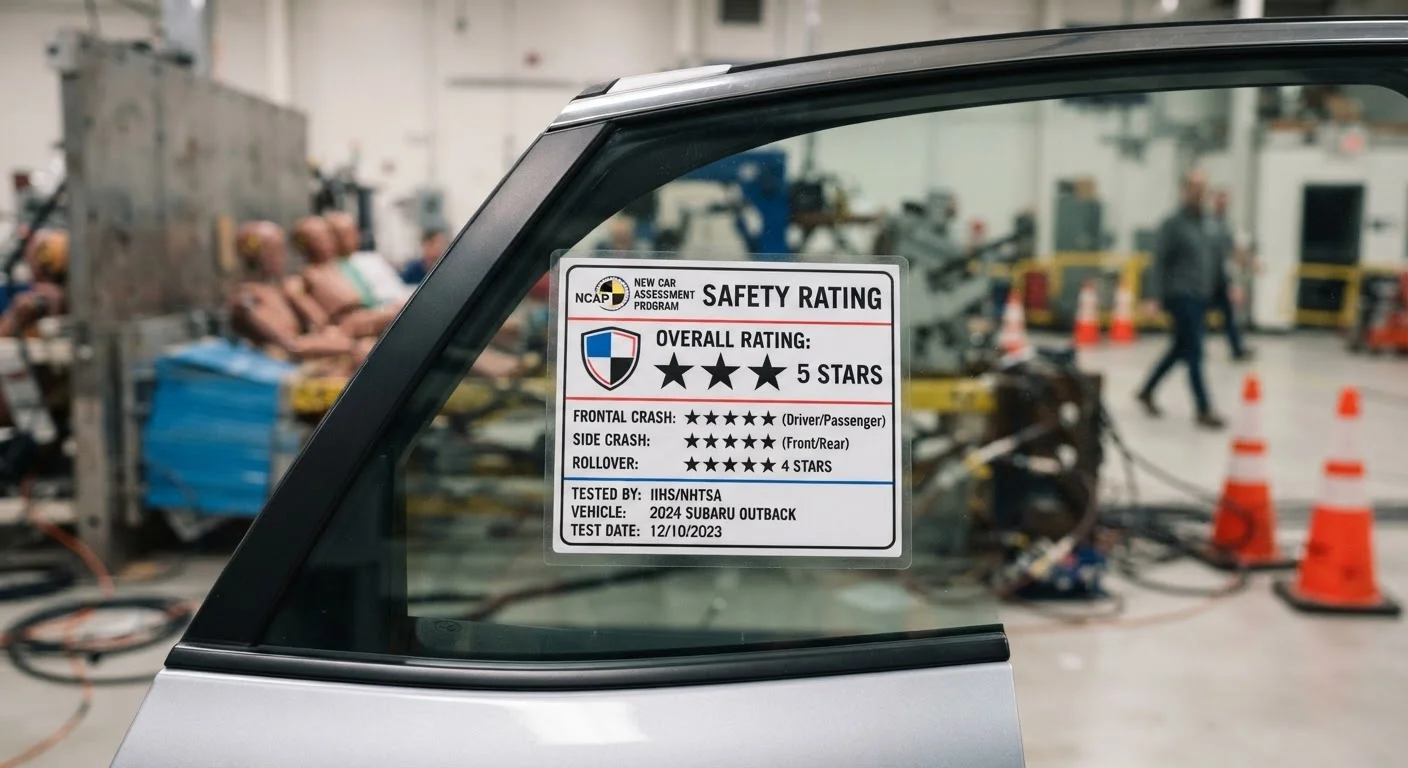
How Crash Test Ratings Work
Crash test ratings are produced by independent safety organizations that subject vehicles to controlled, repeatable collisions. In the United States, two bodies publish ratings most families encounter: the National Highway Traffic Safety Administration (NHTSA) and the Insurance Institute for Highway Safety (IIHS). Internationally, programs like Euro NCAP and ANCAP (used in Australia and New Zealand) run comparable evaluations.
Each program tests vehicles against a defined set of crash scenarios - typically frontal, side, and rollover situations - and scores them on how well the vehicle structure and restraints protect occupants. NHTSA uses a one-to-five star scale. IIHS awards ratings of Good, Acceptable, Marginal, or Poor across individual test categories, then issues an overall designation like Top Safety Pick or Top Safety Pick+. ANCAP and Euro NCAP use a zero-to-five star system similar to NHTSA's.
The tests are genuinely rigorous. Instrumented crash-test dummies measure forces on the head, chest, and legs, and engineers analyse how much the vehicle's cabin deformed on impact. A high rating reflects real engineering decisions that reduce injury risk in crashes matching the tested scenarios.
What the Ratings Don't Cover
A five-star rating or a Top Safety Pick+ designation is meaningful - but it describes performance in specific laboratory conditions, not every situation your family might face on real roads. Here's where the picture gets incomplete.
Vehicle-to-vehicle compatibility
Crash tests are run against fixed barriers or standardized structures, not against other vehicles. When a compact car and a large SUV collide, the size and weight difference matters significantly - and no rating captures that dynamic directly. This is worth keeping in mind when comparing vehicles of very different sizes. See our guide to safety across vehicle types for more on what body type differences mean in practice.
Real-world speed variation
Tests are conducted at standardized speeds - IIHS's small overlap rigid barrier test, for example, uses 40 mph. Crashes at higher speeds, different angles, or involving multiple impacts are not evaluated. A vehicle that performs well at the test speed may behave differently in a more severe collision.
Child occupant positioning
Most crash test dummies represent average adult occupants. Child-specific dummy assessments exist in some programs but are not uniformly applied across all tests. A vehicle's structural rating doesn't automatically tell you how well it protects a rear-facing infant or a forward-facing toddler in a car seat. For that, you need to look at car seat installation ease ratings and child restraint compatibility - which ANCAP, IIHS, and NHTSA publish separately. Our explainer on car seat physics covers how crash forces affect children differently.
Ratings Vary by Model Year and Trim
Safety organizations test specific model year vehicles in specific configurations. A redesigned model - or even a mid-cycle update - may not carry the same rating as the prior version. Always look up the rating for the exact model year you're considering, and note which trim level was tested. This is especially relevant for active safety features, which are sometimes optional on lower trims.
Driver assistance technology scoring
Ratings are increasingly tied to the presence of active safety technology - automatic emergency braking, lane-keeping assist, blind-spot monitoring. A vehicle that scores highly partly because of these systems may rate differently in a future model year if the technology is changed. Always check which trim level was tested, since base models sometimes omit features that earned the high rating.
Using Ratings Wisely as a Family
Crash test ratings should be one input in your decision-making, not the only one. Here's a practical way to use them.
- Check the specific trim: Ratings apply to the tested configuration. Confirm the trim level you're considering matches what was evaluated.
- Look at individual test scores, not just the overall rating: A vehicle might score well overall but show a Marginal result in a side pole impact or a small overlap frontal test - scenarios that occur in real crashes.
- Cross-reference NHTSA and IIHS: The two programs use different test methodologies. A vehicle can earn five NHTSA stars and still receive a lower IIHS rating, or vice versa. Using both gives a fuller picture.
- Factor in real-world maintenance: Even a highly rated vehicle becomes less safe when tyres are underinflated or warning lights are ignored. See how tyre pressure affects safety and how to read dashboard warning lights for the basics every driver should know.
- Don't let a high rating override common sense: Speeding, distracted driving, and improperly installed car seats are responsible for a large proportion of child injuries in crashes - none of which any rating system accounts for. For a reality check on assumptions many families carry, see common car safety myths fact-checked.
Crash test ratings are a useful, evidence-based tool. Treat them as a floor - a minimum standard to look for - rather than a guarantee of safety in every scenario your family might encounter.
The content provided on our blog site traverses numerous categories, offering readers valuable and practical information. Readers can use the editorial team’s research and data to gain more insights into their topics of interest. However, they are requested not to treat the articles as conclusive. The website team cannot be held responsible for differences in data or inaccuracies found across other platforms. Please also note that the site might also miss out on various schemes and offers available that the readers may find more beneficial than the ones we cover.