

Our Verdict
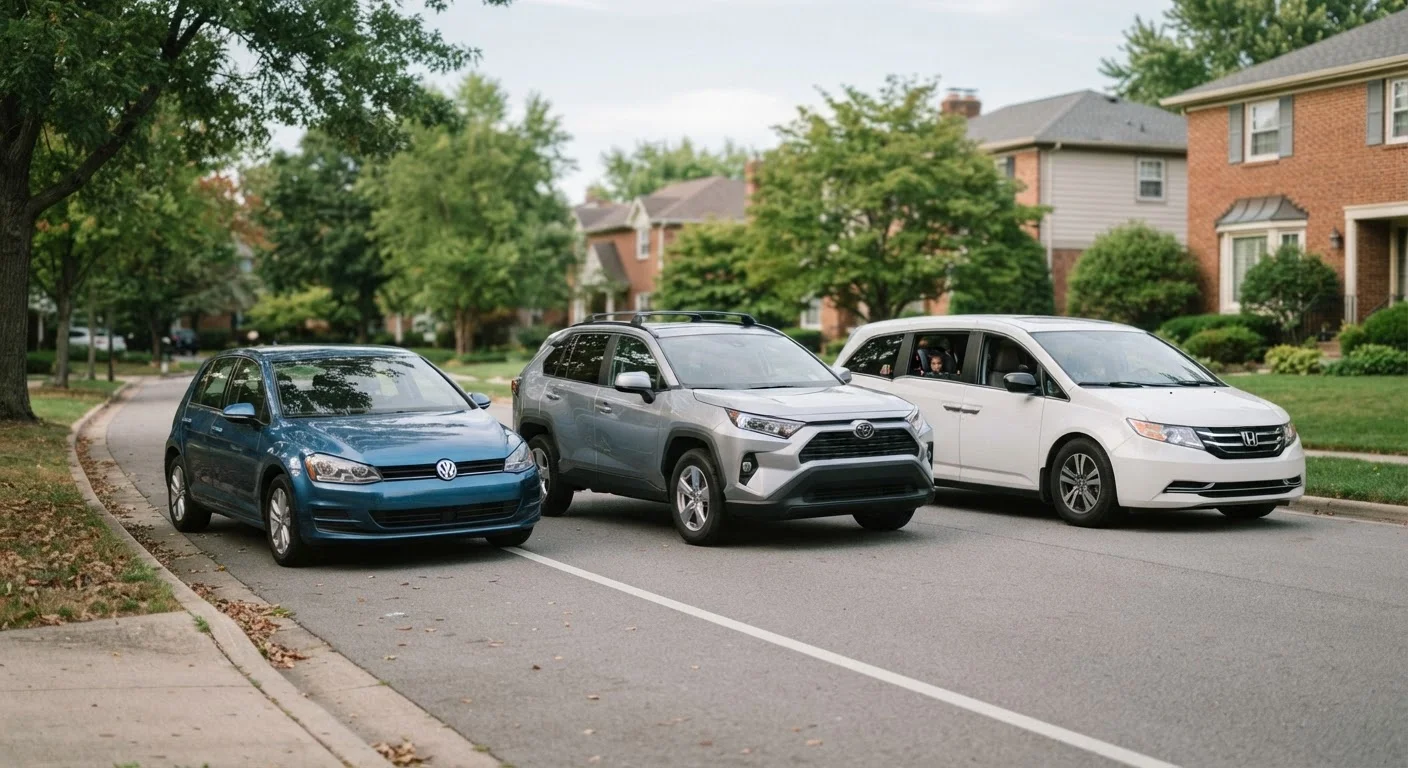
Each vehicle type offers genuine safety advantages and real trade-offs. Hatchbacks can earn top crash ratings and suit smaller families well; SUVs offer space and modern safety tech but require awareness of rollover risk and visibility limitations; people movers prioritise passenger capacity and access but vary widely in crash performance. The right choice depends on your family's size, driving environment, and which specific vehicle earns strong independent safety ratings.
| Best for | Recommended |
|---|---|
| Smaller families prioritising fuel efficiency and proven crash safety | Hatchback |
| Families needing space, all-weather capability, and wide safety tech availability | SUV |
| Larger families or those frequently transporting multiple children | People Mover |
Why Vehicle Type Actually Matters for Family Safety
When families shop for a vehicle, safety is almost always near the top of the list. But "safe" means different things depending on whether you're comparing crash structure, visibility, child seat compatibility, or active technology. Body type - hatchback, SUV, people mover - shapes all of these factors in different ways.
Understanding those differences helps you ask better questions and interpret crash ratings more clearly. As our guide on what crash test ratings actually tell you notes, a five-star score doesn't capture everything a family needs to know. Body type is part of that fuller picture.
| Hatchback | SUV | People Mover | |
|---|---|---|---|
| Crash test consistency | Many earn top ratings | Varies; check specific model | More variable; verify per model |
| Rollover risk | Lower (lower center of gravity) | Higher historically; ESC helps | Moderate; ESC standard |
| Car seat installation ease | Can be tight in compact cabins | Generally good space | Easiest - flat floors, wide doors |
| Rear-seat space for families | Limited for multiple car seats | Good to generous | Largest capacity |
| Driver visibility / blind spots | Typically good rear visibility | Larger front and side blind zones | Rear visibility varies |
| Active safety tech availability | Available; less standard on base trims | Widely available, often standard | Available; check trim level |
| Third-row safety | Not applicable | Present in 3-row versions; check ratings | Standard; verify crash test coverage |
Hatchbacks: Compact, Capable, and Often Underestimated
Hatchbacks are frequently dismissed as "starter cars," but many consistently earn top scores from the Insurance Institute for Highway Safety (IIHS) and the National Highway Traffic Safety Administration (NHTSA). Their lighter weight and lower center of gravity reduce rollover risk - a genuine structural advantage.
The trade-off is interior space. Installing rear-facing infant seats or bulky convertible car seats in a compact rear seat can be genuinely difficult. LATCH anchor points (the lower anchors used to secure car seats without a seat belt) may be harder to access in tighter cabins. Families with multiple children in car seats should physically test fit before purchasing.
Rear visibility in hatchbacks tends to be better than in many SUVs, and their smaller footprint makes urban parking and maneuvering easier. For families with one or two young children who do most of their driving in suburban or city environments, a well-rated hatchback is a legitimate safety choice - not a compromise.
SUVs: Space and Technology With Trade-Offs to Understand
SUVs have become the default family vehicle for good reason: they offer more seating space, easier child seat installation in many cases, and often come loaded with advanced driver-assistance systems (ADAS) - technologies like automatic emergency braking (AEB), rear cross-traffic alert, and blind-spot monitoring that meaningfully reduce collision risk.
But SUVs carry real safety considerations that are sometimes glossed over. Their higher center of gravity historically raised rollover risk, though electronic stability control (ESC) - now federally mandated - has significantly reduced this. Their larger front ends and higher hood lines create larger blind zones in front of and around the vehicle, which is particularly relevant when children are near the car. Backup cameras, now required on all new US vehicles, help with the rear - but front and side blind spots remain a concern worth discussing with your family.
In multi-vehicle crashes, an SUV's greater mass can shift injury risk toward occupants of smaller vehicles. This is worth acknowledging: choosing a heavier vehicle improves your own family's odds in some collision types while affecting others on the road.
For guidance on how your children should be seated within any vehicle, see why the middle rear seat is statistically the safest position.
Always Verify the Specific Model's Rating
Body type gives you a starting framework, but crash performance is determined vehicle by vehicle - not category by category. Before settling on any vehicle, look up its specific NHTSA star ratings and IIHS ratings, including the small overlap front test, which has revealed meaningful differences between otherwise similar-looking vehicles. A few minutes on iihs.org or nhtsa.gov can clarify a lot.
People Movers: Maximum Capacity, Variable Safety Profiles
People movers - minivans and large multi-purpose vehicles - are purpose-built for carrying families. Their low, flat floors make loading children and car seats genuinely easier than most alternatives. Sliding rear doors reduce door-swing injuries in parking lots, a practical but underappreciated safety feature.
The challenge is that crash performance varies more widely in this category. Some people movers earn strong IIHS and NHTSA ratings; others do not. The category is not as uniformly well-rated as top-performing compact SUVs or hatchbacks, so independent verification of a specific model's scores is essential before purchase.
Third-row seating - standard in people movers - introduces an additional consideration: in rear-end collisions, third-row occupants face greater exposure because there is less vehicle structure behind them. Families regularly transporting children in the third row should check whether that row is included in the crash test protocol for a vehicle they're considering.
For families making the broader decision about how many vehicles to run, our breakdown of one car vs. two covers the practical and financial trade-offs in detail.
Car Seat Compatibility Across Vehicle Types
Regardless of body type, how well your car seats install in your vehicle is a critical safety factor. The NHTSA recommends using LATCH anchors up to the weight limits specified by both the car seat and vehicle manufacturers - beyond those limits, the seat belt installation method is required.
Rear seat depth (front-to-back legroom behind the front seats) matters for rear-facing seat installation; some hatchbacks require the front seat to be pushed uncomfortably forward. SUVs and people movers generally offer more rear seat depth, which helps - but LATCH anchor accessibility in deeper seat cushions can ironically be harder. Physically checking the installation before you buy the car is not overcautious; it is practical.
Our full guide on car seat stages from birth to booster explains what each developmental stage requires in terms of seat type and positioning - and understanding the physics of rear-facing vs. forward-facing seats helps clarify why installation direction matters so much in a crash.
This article provides general safety education and is not a substitute for professional advice. Always verify vehicle and car seat specifications with manufacturers and check current ratings from NHTSA and IIHS before making purchasing decisions.
The content provided on our blog site traverses numerous categories, offering readers valuable and practical information. Readers can use the editorial team’s research and data to gain more insights into their topics of interest. However, they are requested not to treat the articles as conclusive. The website team cannot be held responsible for differences in data or inaccuracies found across other platforms. Please also note that the site might also miss out on various schemes and offers available that the readers may find more beneficial than the ones we cover.