

Why Tyre Pressure Is a Safety Issue, Not Just a Maintenance Detail
Most drivers think of tyre pressure as a fuel-economy concern - something that might squeeze a few extra miles out of a tank. That's true, but it undersells what's really at stake. Tyre pressure directly affects how a vehicle steers, brakes, and responds in an emergency. An underinflated tyre flexes more with every rotation, builds up heat, and can fail suddenly at highway speeds. That's not a minor inconvenience; it's a blowout risk.
The National Highway Traffic Safety Administration (NHTSA) has consistently identified tyre-related failures as a significant factor in road crashes. While no single statistic captures every scenario, the underlying physics are straightforward: a tyre that isn't holding the right amount of air isn't making proper contact with the road, and that changes everything from stopping distance to cornering stability.
For families carrying kids and cargo, those margins matter more - not less. A vehicle that's heavier and taller (think minivans and SUVs) is already more sensitive to handling changes. Correct tyre pressure is part of what keeps that vehicle predictable when it counts. See the Family Car Safety hub for related guidance on keeping passengers protected on the road.
What Underinflation and Overinflation Actually Do
Both extremes cause problems, which surprises some drivers who assume that more air is always safer.
~1 PSI
Pressure lost per 10°F temperature drop
According to the U.S. Department of Energy, tyre pressure falls by roughly 1 PSI for every 10-degree Fahrenheit decrease in ambient temperature.
0.5%
Fuel economy loss per underinflated PSI
The U.S. DOE estimates fuel economy drops by about 0.5% for every 1 PSI that tyres fall below the recommended pressure across all four wheels.
25%
Underinflation threshold for most TPMS alerts
NHTSA notes that most factory-fitted tyre pressure monitoring systems are only required to warn the driver when pressure drops 25% below the vehicle manufacturer's recommended level.
Underinflation causes the tyre sidewalls to flex excessively under load. That flexing generates heat, weakens the tyre structure over time, and increases rolling resistance - meaning the engine burns more fuel just to maintain speed. The tread edges wear faster than the centre, which shortens tyre life and creates uneven grip.
Overinflation does the opposite: the tyre becomes too rigid. The contact patch (the area of tyre touching the road) shrinks to the centre of the tread. That reduces grip, makes the ride harsher, and leaves the tyre more vulnerable to impact damage from potholes or road debris. A rock at highway speed can crack or puncture an overinflated tyre more easily than one at the correct pressure.
The tyre rotation, balancing, and alignment guide explains how these related services help maintain even tyre wear once pressure is correctly managed.
How to Check and Adjust Tyre Pressure Correctly
The process is simple, but there are two common mistakes families make: checking warm tyres and inflating to the number on the sidewall.
Check Pressure Before You Leave Home
Always measure tyre pressure before driving, not after. Even a short trip raises tyre temperature and temporarily inflates the reading by several PSI. Checking cold - ideally in the morning before the first drive of the day - gives you an accurate picture of what's actually in the tyre.
Check cold. Drive less than a mile before measuring, or check before you leave home. Heat from driving temporarily increases pressure by 4-6 PSI, which can make a low tyre look fine.
Use the door jamb sticker, not the tyre. The sticker inside the driver's door (or sometimes the fuel cap door) shows the manufacturer's recommended pressure for your specific vehicle. The number on the tyre sidewall is the maximum the tyre can safely hold - a different figure entirely.
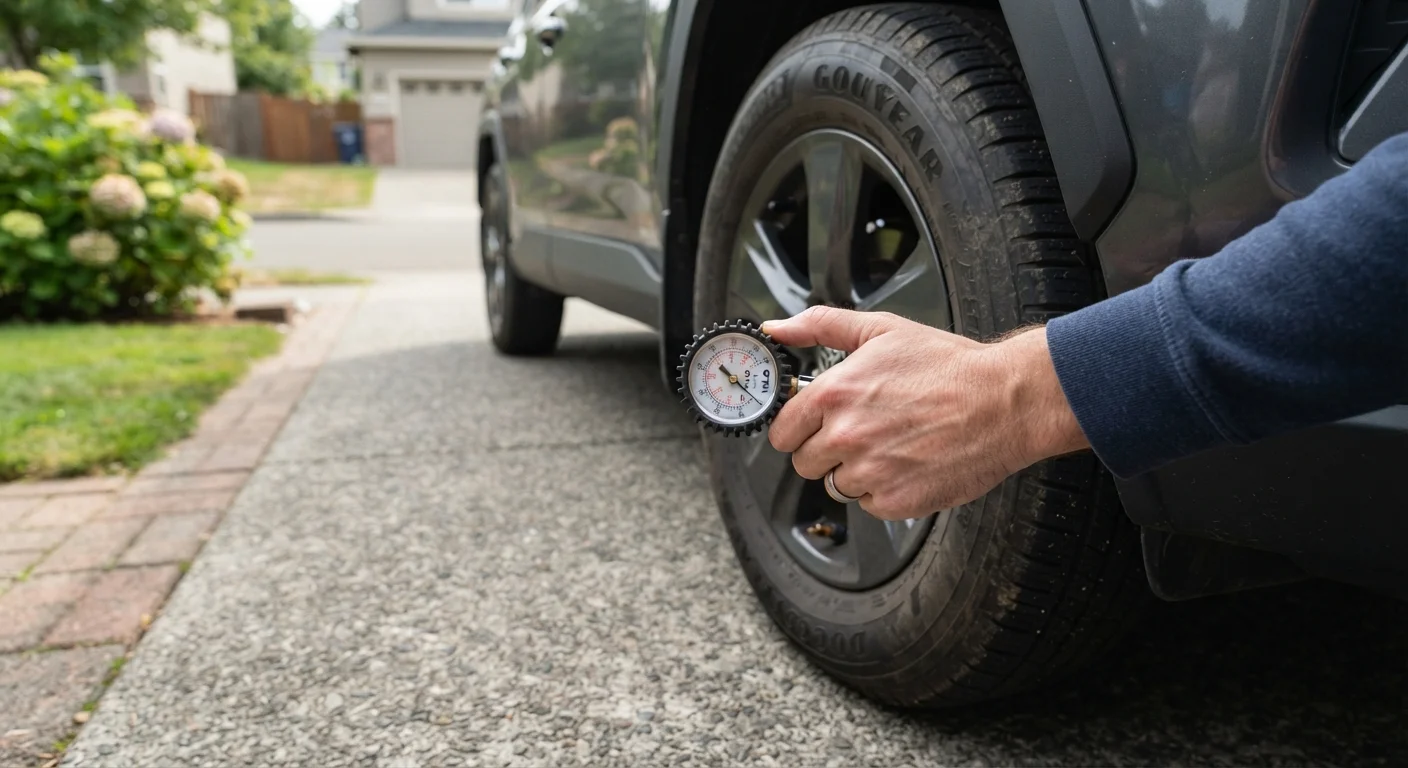
To check: remove the valve cap from the tyre stem, press a pressure gauge firmly onto the valve, and read the result. Compare it to your door sticker. Add air if needed (most gas station pumps or a portable compressor work fine), or release a small amount using the pin inside the valve cap if you've overinflated.
Check all four tyres - and don't forget the spare. Pressure also drops naturally in cold weather; a rough guideline from the U.S. DOE is approximately 1 PSI lost for every 10°F drop in temperature. This means a tyre that was fine in September may be noticeably low by January.
Building Pressure Checks Into Your Family's Routine
The barrier isn't knowledge - it's habit. Most families know they should check tyre pressure but don't have a trigger that makes it automatic. A few approaches that work well:
- Monthly reminder: Tie it to something that already happens, like the first of the month or a regular errand. It takes under two minutes.
- Before road trips: Make it part of your pre-departure checklist alongside packing and car seat checks. The pre-drive safety walkthrough covers this and other quick checks worth doing before a long drive.
- Seasonal check: Do an extra check when outdoor temperatures change significantly - autumn and spring are natural points.
If your vehicle has a tyre pressure monitoring system (TPMS), understand that it's a warning tool, not a substitute for regular checks. Most TPMS lights only activate when a tyre is significantly underinflated - sometimes 25% below the recommended level - by which point handling is already compromised.
Staying consistent with this one habit feeds into broader cost savings too. Properly inflated tyres last longer and reduce fuel costs - both of which add up meaningfully over years of family driving. The tyre care basics guide connects pressure to the wider picture of tyre longevity and running costs.
Frequently Asked Questions
Checking once a month and before any long road trip covers most situations. Pressure can drop gradually even without a puncture, so regular checks catch problems before they affect safety or fuel economy.
The recommended pressure is printed on a sticker inside the driver's door jamb or in the owner's manual. The number moulded onto the tyre sidewall is the maximum pressure the tyre can hold - not the target you should inflate to.
Yes. Most gas stations have air pumps with built-in gauges, though accuracy varies. A small handheld gauge (available at auto parts stores for a few dollars) gives a reliable reading you can use anywhere.
It does. The U.S. Department of Energy notes that underinflated tyres increase rolling resistance, which means the engine works harder and burns more fuel. Keeping tyres properly inflated is one of the simplest fuel-saving habits.
Overinflation causes the centre of the tread to bulge and bear most of the load, wearing that section faster and reducing grip. It also makes the ride harsher and the tyre more vulnerable to damage from road hazards like potholes.
Possibly. Many vehicles have a higher recommended pressure for fully loaded conditions, listed separately on the door jamb sticker. Check your owner's manual - this is especially relevant for minivans, SUVs, and trucks used for family travel.
The content provided on our blog site traverses numerous categories, offering readers valuable and practical information. Readers can use the editorial team’s research and data to gain more insights into their topics of interest. However, they are requested not to treat the articles as conclusive. The website team cannot be held responsible for differences in data or inaccuracies found across other platforms. Please also note that the site might also miss out on various schemes and offers available that the readers may find more beneficial than the ones we cover.