

Start here
Why Tyres Matter More Than Most Drivers Realise
Next
Tyre Pressure: The Easiest Win for Safety and Fuel Costs
Then
Reading Tyre Wear: What the Tread Is Telling You
When you're ready
Rotation and When to Replace
Why Tyres Matter More Than Most Drivers Realise
Tyres are the only part of your vehicle that actually touches the road. Everything else - brakes, suspension, engine power - works through them. Yet for most families, tyres only get attention when one goes flat or a warning light appears on the dashboard.
That reactive approach costs money. Worn or poorly maintained tyres increase fuel consumption, shorten tread life, and - most seriously - extend braking distances at exactly the moment you need the car to stop quickly. A vehicle loaded with kids and luggage for a weekend trip is heavier than the manufacturer's base test weight, making tyre condition even more critical. Understanding the basics puts you in control of both safety and running costs. For a broader look at car expenses that families tend to overlook, see our guide to overlooked vehicle costs.
Tyre pressure (PSI)
PSI stands for pounds per square inch - the unit used to measure how much air is inside a tyre. Too little or too much affects safety and fuel economy.
Tread depth
The measurement of how much rubber remains in the grooves of a tyre. Greater depth means better water dispersal and shorter stopping distances.
TPMS
Tyre Pressure Monitoring System - a sensor built into most modern vehicles that triggers a dashboard warning when tyre pressure drops significantly below the recommended level.
Wheel alignment
The adjustment of the angles at which your tyres meet the road. Poor alignment causes tyres to wear unevenly and can make the vehicle pull to one side.
Tyre rotation
Moving each tyre to a different position on the vehicle on a regular schedule so that all four tyres wear evenly over time.
Rolling resistance
The energy a tyre uses just to roll along the road surface. Higher rolling resistance means the engine has to work harder, which burns more fuel.
Tyre Pressure: The Easiest Win for Safety and Fuel Costs
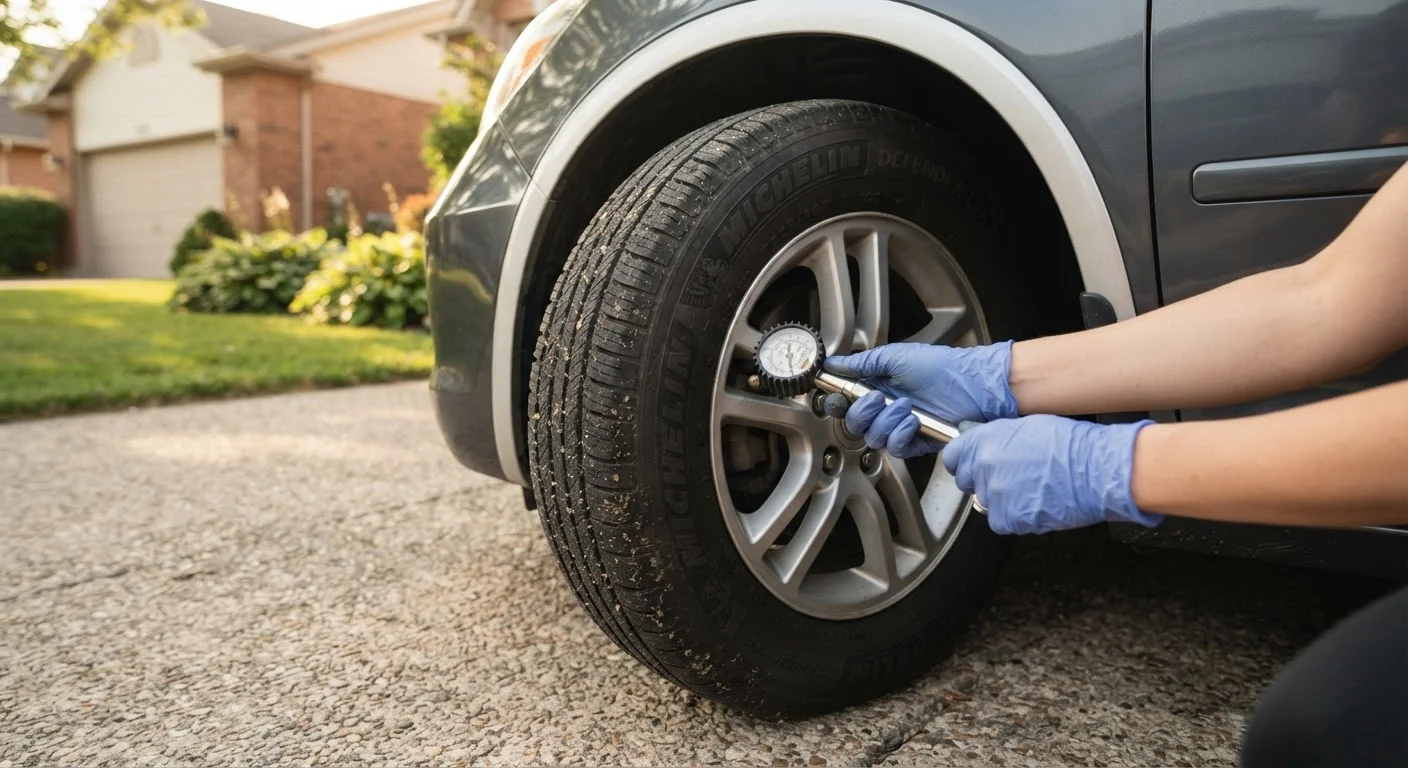
Correct tyre pressure is the single highest-return maintenance habit available to drivers. It takes about three minutes with an inexpensive gauge and has measurable effects on fuel economy, tyre lifespan, and handling.
Where to find the right pressure: Look at the sticker inside the driver's door jamb or in your owner's manual. The number moulded into the tyre sidewall is the maximum pressure the tyre can hold - not the target for your vehicle. Using the wrong figure is a common and costly mistake.
When to check: Measure pressure when tyres are cold - meaning the vehicle has been parked for at least three hours or driven fewer than a mile. Heat from driving artificially inflates the reading. Temperature also matters season to season: as outdoor temperatures drop, so does tyre pressure.
Invest in a quality tyre gauge
Digital gauges are generally more accurate and easier to read than the pencil-style stick gauges. Keep one in your glove box so pressure checks happen consistently rather than only when you happen to be near an air station. Checking at home on cold tyres gives you the most accurate reading.
If your vehicle has a TPMS warning light, treat it as a prompt to check pressure manually rather than a precise readout - the system typically only triggers when pressure is already 25% below the recommended level. For a plain-language guide to dashboard warning lights, see our warning lights reference.
Reading Tyre Wear: What the Tread Is Telling You
Tread depth determines how well your tyres channel water away from the contact patch. Less tread means longer stopping distances on wet roads. The wear pattern also acts as a diagnostic tool - it tells you whether your tyres, alignment, or suspension need attention.
- Centre wear: Tread worn mostly in the middle suggests the tyre has been consistently overinflated.
- Edge wear: Both outer edges worn while the centre is fine typically indicates chronic underinflation.
- One-sided wear: Tread worn significantly more on one edge points to a wheel alignment problem - not the tyre itself.
- Cupping or scalloping: Uneven, wavy wear across the tread surface can indicate a worn shock absorber or strut.
A simple way to check remaining depth: insert a quarter into the tread groove with Washington's head facing down. If you can see the top of the head, the tread is at or below 4/32 inch - the point at which many safety organisations recommend replacement, even if legal minimums haven't technically been reached.
Unusual wear patterns are also worth connecting to fuel costs. Misalignment forces tyres to scrub against the road at a slight angle, increasing rolling resistance and wasting fuel. Our article on fuel efficiency habits covers how rolling resistance fits into the bigger picture of what drains your tank.
Rotation and When to Replace
Tyre rotation means moving each tyre to a different position on the vehicle on a regular schedule. Because front and rear tyres carry different loads and perform different jobs - especially on front-wheel-drive vehicles - they wear at different rates. Rotating them evens out that wear so all four tyres reach the end of their useful life at roughly the same time, rather than forcing you to buy two replacements every couple of years.
A common rotation interval is every 5,000-7,500 miles, though your owner's manual may specify something different. Many families find it convenient to rotate tyres when getting an oil change, since the wheels are already being worked on. For a deeper look at what rotation, balancing, and alignment each accomplish, see our dedicated explainer.
Knowing when to replace: Age matters as well as wear. Most tyre manufacturers and safety bodies suggest considering replacement after six years regardless of tread depth, because rubber compounds degrade over time. The manufacture date is moulded into the tyre sidewall as a four-digit code - the first two digits are the week, the last two are the year (for example, 2319 means the 23rd week of 2019).
Don't mix tyre types on the same axle
Fitting one all-season tyre and one summer tyre on the same axle creates handling imbalances that can make the vehicle unpredictable in an emergency manoeuvre. If you need to replace a tyre, match the type and ideally the model of the existing tyre on the same axle. When in doubt, consult a qualified tyre professional.
Budgeting for tyres as a planned expense - rather than an emergency one - is one of the habits that separates families who stay ahead of car costs from those who don't. For more on separating car maintenance fact from costly fiction, see our guide to car maintenance myths.
Frequently Asked Questions
Once a month is a reasonable habit for most family drivers. You should also check pressure before any long road trip and after significant temperature swings, since tyre pressure drops roughly 1 PSI for every 10°F fall in temperature.
Yes. According to the U.S. Department of Energy, tyres that are underinflated by just 1 PSI can reduce fuel economy by around 0.2%. Across four tyres that are consistently low, the cumulative effect adds up over thousands of miles.
Most US states require a minimum tread depth of 2/32 of an inch. However, safety organisations generally recommend replacing tyres at 4/32 inch, particularly in wet conditions, because stopping distances increase significantly below that threshold.
It does. Front tyres on front-wheel-drive vehicles wear faster because they handle both steering and power delivery. Regular rotation evens out wear across all four tyres, extending their collective lifespan and helping you avoid replacing one or two tyres prematurely.
Most compact spare tyres ('donuts') are designed for limited use - typically up to 50 miles at speeds no greater than 50 mph. Check your owner's manual for the specific limits on your spare, and get the proper tyre repaired or replaced as soon as possible.
Vibration felt through the steering wheel or seat at highway speeds often points to a wheel balancing issue. If your vehicle drifts to one side or the steering wheel sits off-centre on a straight road, that suggests an alignment problem. Our article <a href="/car-ownership/car-maintenance/tyre-rotation-balancing-and-alignment-what-each-one-does">on tyre rotation, balancing, and alignment</a> explains the differences in detail.
The content provided on our blog site traverses numerous categories, offering readers valuable and practical information. Readers can use the editorial team’s research and data to gain more insights into their topics of interest. However, they are requested not to treat the articles as conclusive. The website team cannot be held responsible for differences in data or inaccuracies found across other platforms. Please also note that the site might also miss out on various schemes and offers available that the readers may find more beneficial than the ones we cover.