

Our Verdict
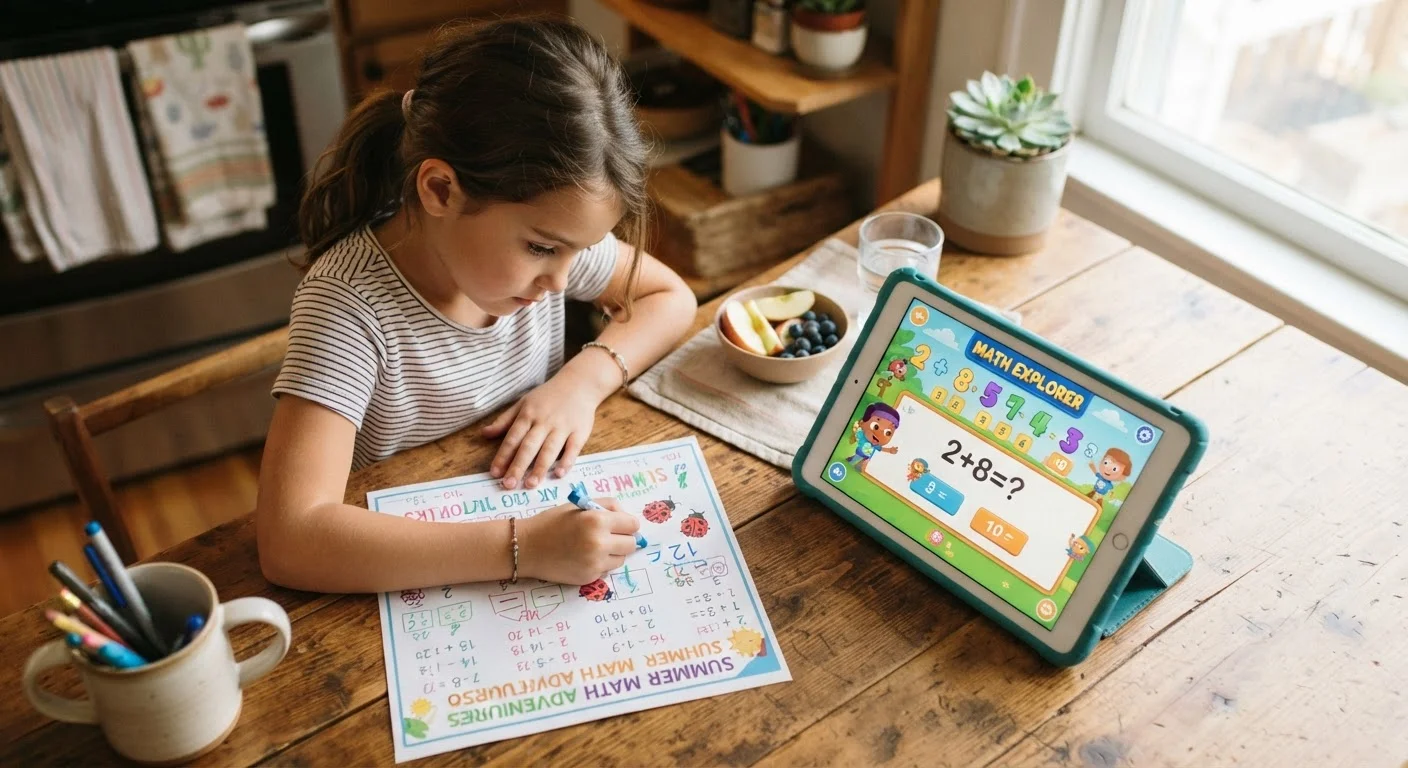
Printable resources and educational apps each bring distinct strengths to home learning. Printables are ideal for handwriting practice, focused offline work, and younger learners still building screen boundaries. Apps shine when children need immediate feedback, interactive practice, or motivation through variety. For most families, a blended approach - using free tools from both categories strategically - is the most effective and sustainable path.
| Best for | Recommended |
|---|---|
| Younger children and early learners building foundational skills | Printable resources |
| Children who need adaptive difficulty and immediate feedback | App-based learning |
| Families with limited or unreliable internet access | Printable resources |
| Parents looking to supplement printables with engaging practice | Blended approach (both) |
What Each Format Actually Offers
Before comparing the two, it helps to be clear about what each format brings to the table. Printable resources - worksheets, activity pages, flashcard templates - are static documents you download and print. They require no device after printing, work offline, and produce something tangible a child can hold and mark up with a pencil.
App-based learning tools are interactive digital programs accessed on a tablet, phone, or computer. The best free options adapt to a child's progress, provide instant feedback, and use varied formats - games, quizzes, videos - to maintain engagement. For a closer look at how to evaluate these tools, see our guide to free digital learning tools.
Both categories include genuinely free options - not just trials or limited demos. Public libraries, state education departments, and nonprofit organizations publish printable packs at no cost. Reputable educational platforms offer free tiers that cover core content without requiring a subscription.
| Printable Resources | App-Based Learning | |
|---|---|---|
| Cost | Many free via libraries and edu sites | Many free tiers available |
| Internet required | No (after downloading/printing) | Usually yes |
| Handwriting development | Strong - pencil-on-paper practice | Limited - mostly tapping |
| Instant feedback | None - parent must review | Yes - built into most apps |
| Adaptive difficulty | Not applicable | Available in many free apps |
| Distraction risk | Very low | Moderate - notifications, ads |
| Best age range | All ages, especially early learners | Works well from age 4+ |
| Parent time required | Higher - finding, printing, reviewing | Lower - app manages pacing |
Where Printables Have the Edge
Printed materials excel in specific situations that apps simply cannot replicate. Handwriting practice is the clearest example - forming letters and numbers on paper engages motor skills in ways that tapping a screen does not. Research in cognitive science consistently links handwriting to stronger memory encoding, particularly for younger learners.
Printables also remove the distraction risk that comes with connected devices. A worksheet doesn't send notifications, autoplay videos, or redirect a child to something shinier. For children who struggle with focus, a quiet table and a pencil can be more productive than any app. This connects to broader findings on active recall and how children retain information.
Finally, printables are genuinely accessible to families without reliable internet. Once downloaded and printed, they require nothing else - no Wi-Fi, no battery, no login.
Getting the Most from Free Printables
Many public library websites offer free, printable activity packs organized by grade and subject - check your local library's digital resources page before purchasing anything. State education department websites also publish standards-aligned printables at no cost. Laminating frequently used sheets (like handwriting guides or multiplication grids) lets children reuse them with a dry-erase marker, extending their value significantly.
Where Apps Have the Edge
App-based tools offer capabilities that printables cannot match. The most significant is immediate, personalized feedback. When a child answers incorrectly on a worksheet, they may not find out until a parent reviews it later. A well-designed app flags the error instantly and often explains why - which accelerates correction.
Many free educational apps also adjust difficulty in real time based on a child's responses. This means a child who has mastered addition is automatically challenged with subtraction, while a child still consolidating foundational steps gets more targeted practice - without any manual intervention from a parent.
Engagement is another genuine advantage. For subjects children find dry or difficult, interactive formats can lower the emotional barrier to starting. That said, engagement alone doesn't guarantee learning. Before downloading, use our parent's app evaluation checklist to assess whether a tool is truly educational or simply entertaining.
Making Them Work Together
The most practical approach for most families isn't choosing one format - it's using each where it performs best. A simple framework: use printables for foundational and motor-skill work (spelling, handwriting, maths drills), and use apps for review, exploration, and engagement (reading comprehension, vocabulary games, science concepts).
Subject also matters. Reading instruction, for instance, benefits from the tactile experience of following text on a page, making printables particularly valuable for early readers. For subject-specific guidance, explore our subject-by-subject help hub for targeted strategies. For maths, adaptive apps that respond to a child's pace can complement the pencil-and-paper practice that builds number fluency - see our piece on matching maths approaches to how your child thinks.
For families ready to build a consistent routine around both formats, our guide to setting up a free home learning routine offers a practical walkthrough. The goal is a balanced schedule that uses both tools intentionally, not just whatever is easiest to reach for.
The content provided on our blog site traverses numerous categories, offering readers valuable and practical information. Readers can use the editorial team’s research and data to gain more insights into their topics of interest. However, they are requested not to treat the articles as conclusive. The website team cannot be held responsible for differences in data or inaccuracies found across other platforms. Please also note that the site might also miss out on various schemes and offers available that the readers may find more beneficial than the ones we cover.