

The Real Definition of Clutter
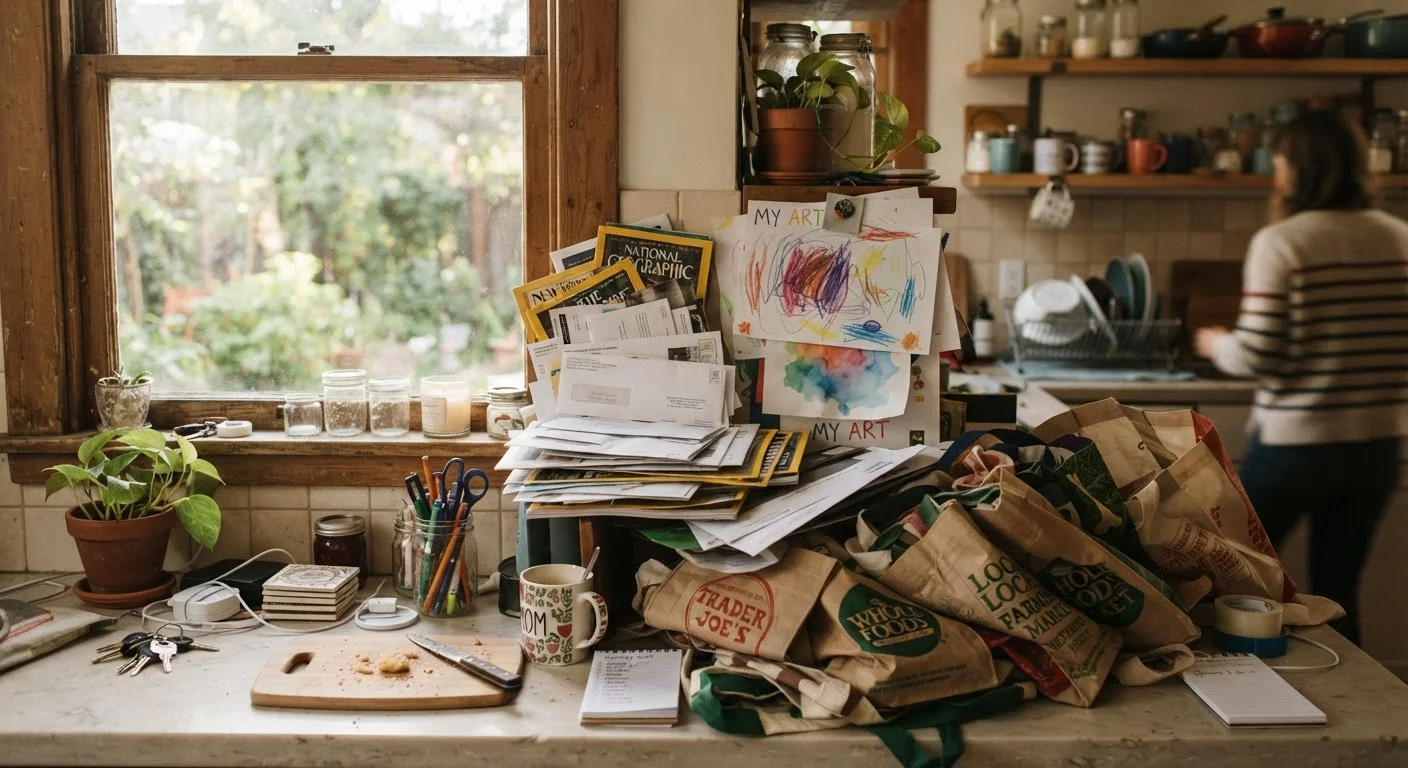
Most people assume clutter is a volume problem - that having too many things is the issue. But that framing misses what's actually happening. Clutter is what forms when objects don't have a clear, consistent place to go and no reliable decision gets made about them.
Think about the pile on the kitchen counter: a permission slip, a phone charger, a reusable bag, and some batteries. None of those items are inherently junk. But together, they form clutter because each one is waiting for a decision or a home that doesn't yet exist.
This distinction matters because it changes how you approach the problem. If clutter were purely about quantity, the solution would always be to own less. Sometimes that helps. But many families declutter dramatically and still find their surfaces filling back up within weeks - because the underlying system hasn't changed.
Clutter Isn't Always Visible
Digital clutter - overfull email inboxes, unsorted photo libraries, files scattered across a desktop - follows the same pattern as physical clutter: items without a home and decisions that have been deferred. While this article focuses on the physical home environment, the same root causes apply. Recognizing this can help families see organization as a broader habit rather than a one-time project.
Why Clutter Builds Up: Four Root Causes
Understanding why clutter accumulates is the first step toward stopping the cycle. Most clutter traces back to one or more of these patterns:
- No designated home for the item. If something doesn't have a specific, logical place it belongs, it will land wherever is convenient - usually a flat surface.
- The designated home is inconvenient. Storage that's hard to reach or doesn't match how the household actually moves gets ignored. Items end up where it's easiest to set them down.
- Decisions get deferred. Mail, school notices, and items brought in from outside often require a small decision - file it, donate it, act on it. When those decisions get postponed, objects stack up.
- Volume genuinely exceeds available space. Sometimes there really is too much. Outgrown clothing, duplicate kitchen tools, and toys that no longer get used all occupy space that could otherwise feel functional.
Paper is a prime example of deferred decisions in action. It floods into a home quickly and each piece demands a choice. Without a system to handle it, it piles. A room-by-room plan for paper clutter can help families build exactly that kind of system.
Why Storage Products Often Don't Help
The instinct to buy more bins, baskets, and drawer organizers is understandable - and the market happily encourages it. But adding storage before addressing root causes usually makes clutter worse, not better. It provides more places for unresolved items to hide, and the underlying decisions still don't get made.
The more durable sequence is to reduce first, then organize what remains. Once you know what you're actually keeping and why, it becomes clear what storage - if any - is genuinely needed. Often families discover they already have enough.
This is especially true for children's spaces. Kids' rooms tend to generate clutter continuously because belongings accumulate from multiple sources: gifts, school projects, seasonal sports gear. The reasons kids' bedroom clutter keeps returning usually have less to do with the child and more to do with whether a working system exists in the room.
For families ready to build those systems, starting with understanding the difference between decluttering and organizing prevents the common mistake of organizing clutter rather than removing it.
Clutter Hotspots and Why They Form
Clutter rarely distributes evenly through a home. It concentrates in transition zones - places where people enter, set things down, and move on. Entryways, kitchen counters, dining tables, and the floors just inside bedroom doors all attract this pattern for the same reason: they're where the flow of daily life pauses briefly.
Recognizing these hotspots isn't about judging the household. It's useful information: if a spot collects clutter consistently, it's signaling that the surrounding system isn't working for that location. The fix isn't to clean it again - it's to redesign what happens there.
Building Habits That Prevent Clutter From Returning
Once you understand clutter as a system and decision problem, prevention becomes more straightforward. The goal is to reduce the number of decisions that get deferred and to make putting things away easier than leaving them out.
Simple household agreements - sometimes called house rules - can be surprisingly effective. Things like processing mail the same day it arrives, or applying a one-in, one-out approach when new items enter the home, address clutter at its source rather than its symptoms. The household rules that keep clutter from returning walks through several of these habits in practical terms.
If the full picture feels overwhelming, getting started with home organization offers a grounded entry point - one that focuses on building momentum without requiring a total overhaul all at once.
The core insight is durable: clutter isn't a character flaw or a sign that a family has failed at tidiness. It's a natural outcome of busy households that haven't yet built systems matched to how they actually live. Changing that is entirely possible, and it starts with understanding what clutter actually is.
Frequently Asked Questions
Not exactly. Mess refers to temporary disorder - dishes left out after dinner, for example. Clutter is more persistent: it's items that have no designated place and keep reappearing no matter how often you tidy. A home can look neat on the surface while still having significant underlying clutter.
Tidying moves things around but doesn't solve why they landed there. If items don't have a permanent, logical home, they'll naturally drift back to flat surfaces and corners. Lasting change requires creating systems - a specific place for each category of item - rather than repeatedly relocating the same objects.
Usually not at first. Most clutter problems stem from having too many items without assigned homes, not from a shortage of containers. Adding storage before reducing and organizing often just buries the problem. Decluttering first - letting go of what you don't use or need - typically reveals that you have enough storage already.
General research on home environments suggests that persistently disordered spaces can contribute to feelings of stress and difficulty relaxing. While individual responses vary, many families report that reducing clutter makes their home feel calmer and easier to manage day to day.
Decluttering means reducing the number of items in your home by removing what's unused, broken, or unnecessary. Organizing means creating a system for the items that remain. Doing them in the wrong order - organizing before decluttering - is one of the most common reasons tidy-up efforts don't hold.
High-traffic transition zones tend to be the first to accumulate: entryways, kitchen counters, dining tables, and the floor just inside kids' bedroom doors. These spots collect items that are 'in between' - not put away yet, not dealt with, not assigned a place.
The content provided on our blog site traverses numerous categories, offering readers valuable and practical information. Readers can use the editorial team’s research and data to gain more insights into their topics of interest. However, they are requested not to treat the articles as conclusive. The website team cannot be held responsible for differences in data or inaccuracies found across other platforms. Please also note that the site might also miss out on various schemes and offers available that the readers may find more beneficial than the ones we cover.