

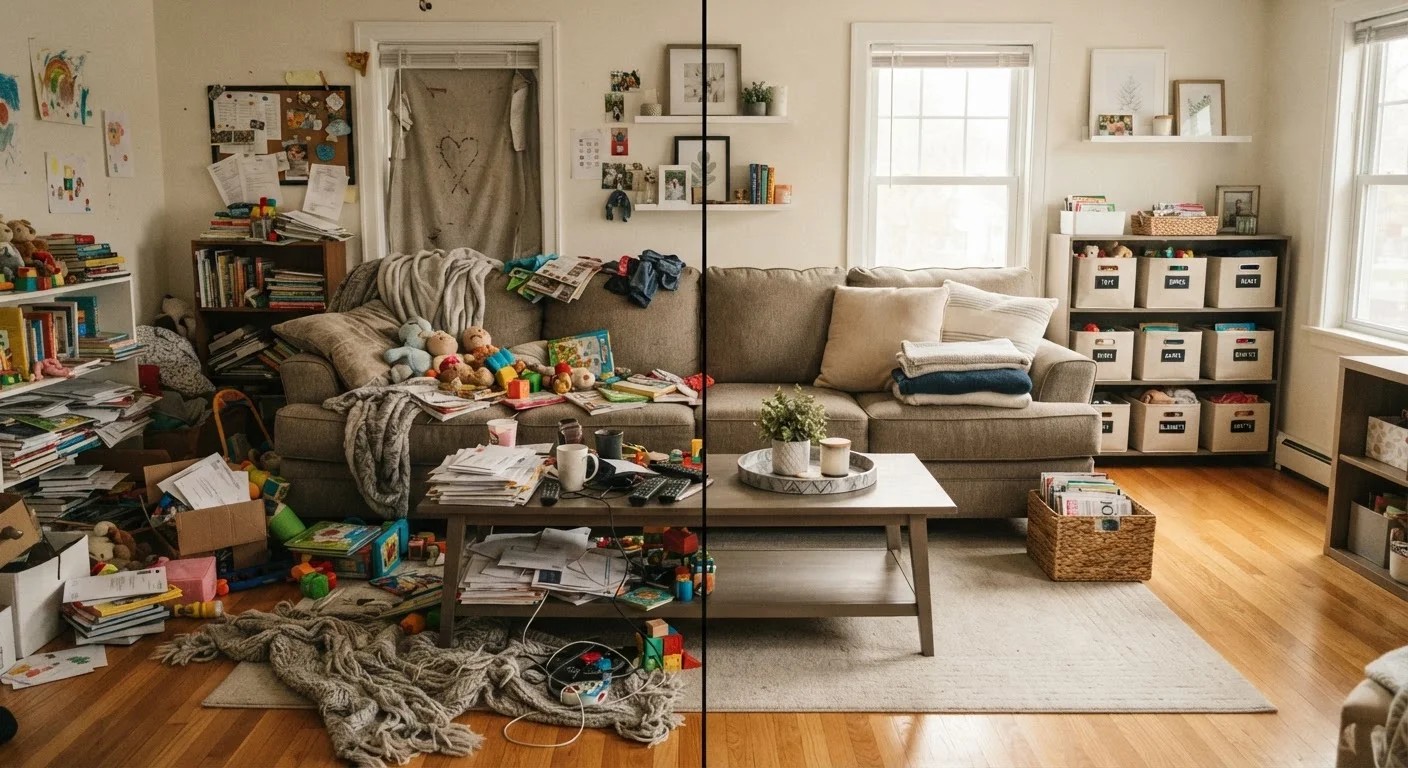
Option A
Decluttering
The essential first step - removing what doesn't belong.
Best for: Families who feel overwhelmed by volume and need to reduce what they own before any system can hold.
Option B
Organizing
The structure that makes a tidied home functional long-term.
Best for: Households that have already reduced their belongings and need reliable systems to keep everything accessible and in its place.
Two Different Jobs, Commonly Confused
Most families treat decluttering and organizing as interchangeable - two words for the same tidying activity. They're not. They're sequential steps that each require a different kind of thinking, and doing them out of order is the single most common reason a clean home reverts to chaos within weeks.
Decluttering is a decision-making process. You go through your belongings and ask: does this item earn its space in our home? You're reducing volume - letting go of duplicates, broken items, things that no longer fit your family's life. It's not about finding a clever place to put something; it's about honestly deciding whether it should stay at all.
Organizing is a design process. Once you know what you're keeping, you create consistent, logical homes for those items - zones that match how your family actually moves and lives. The goal is a system everyone can follow without thinking too hard about it.
The confusion is understandable. Both activities look similar from the outside: you're handling objects and making decisions. But the underlying question is completely different. Decluttering asks should this stay? Organizing asks where should this live? Skipping directly to the second question before answering the first is why so many families end up with beautifully labeled bins full of things they don't actually need.
Why Sequence Is Everything
Here's what happens when families organize before they declutter: they invest real time and often real money arranging items into containers, categories, and labeled zones - and within a few months, the system collapses. New items arrive, the categories blur, and the bins overflow. The family concludes they're just "not organized people," when the actual problem was structural from the start.
| Criterion | Decluttering | Organizing |
|---|---|---|
| Core question | Should this item stay? | Where should this item live? |
| Primary activity | Removing, donating, discarding | Sorting, grouping, assigning zones |
| Correct sequence | Always comes first | Follows after decluttering |
| Cost impact | Reduces need for storage purchases | May require some targeted storage tools |
| Time investment | Emotionally intensive, variable length | Practical, faster once volume is right |
| Risk if skipped | Organized clutter that quickly overflows | Reduced items with no reliable home |
| Long-term maintenance | Requires periodic re-evaluation | Requires household habit-building |
Organizing clutter doesn't eliminate it - it conceals it temporarily. When you build a storage system around excess, you're designing for a volume of stuff that should never have stayed in the first place. The system has to work too hard from day one.
Decluttering first changes the math entirely. When you've honestly reduced your belongings, you typically discover you need far fewer storage solutions than you anticipated. Many families find that a weekend of thoughtful decluttering removes the need for extra shelving, additional dressers, or the rolling cart they were about to purchase. That's a genuine cost saving - and it's one of the reasons the sequence matters so much for budget-conscious households.
If you've noticed this pattern with specific rooms in your home, the children's room clutter guide explores exactly why tidying alone doesn't hold - and what actually works long-term.
Building a System That Sticks
Once you've decluttered honestly, organizing becomes much simpler - because you're working with a realistic inventory rather than an optimistic one. Effective organizing for families rests on a few consistent principles:
- Group by use, not by category. Items used together should live together. A "junk drawer" that holds batteries, a screwdriver, and tape isn't junk - it's a repair station. Name it and embrace it.
- Make the right thing the easy thing. If putting something away takes more effort than leaving it out, the system won't survive contact with a tired parent or a busy child. Friction is the enemy of any organizational habit.
- Design for your actual family, not an ideal one. A system that works beautifully for one organized adult will fail a household of four with different habits and schedules. See our guide on organizing shared spaces for families with different habits for strategies everyone can realistically follow.
It's also worth revisiting common assumptions about what organizing requires. Many families believe matching containers are necessary, or that a full weekend is needed to declutter properly. The organization myths that waste families' time and money breaks down which beliefs are worth keeping and which quietly undermine your efforts.
Finally, the most overlooked element of lasting order isn't a storage product at all - it's household agreements. Simple rules about what comes in and what goes out do more to prevent clutter from returning than any bin or basket. The one-in, one-out guide outlines the habits most effective at keeping a decluttered home that way.
The content provided on our blog site traverses numerous categories, offering readers valuable and practical information. Readers can use the editorial team’s research and data to gain more insights into their topics of interest. However, they are requested not to treat the articles as conclusive. The website team cannot be held responsible for differences in data or inaccuracies found across other platforms. Please also note that the site might also miss out on various schemes and offers available that the readers may find more beneficial than the ones we cover.