

Our Verdict
The junk drawer is neither inherently good nor bad - it's a tool, and like any tool, its value depends on how deliberately you use it. Families who set a firm boundary around its contents and revisit it monthly tend to find it genuinely useful. Those who let it expand unchecked often find it becomes a source of low-grade stress. If keeping one, treat it as a managed zone rather than a default dumping ground.
Best for busy families who need a single, intentional catch-all for small, truly miscellaneous items - and who are willing to edit it occasionally to keep it functional.
What Actually Ends Up in a Junk Drawer (And Why)
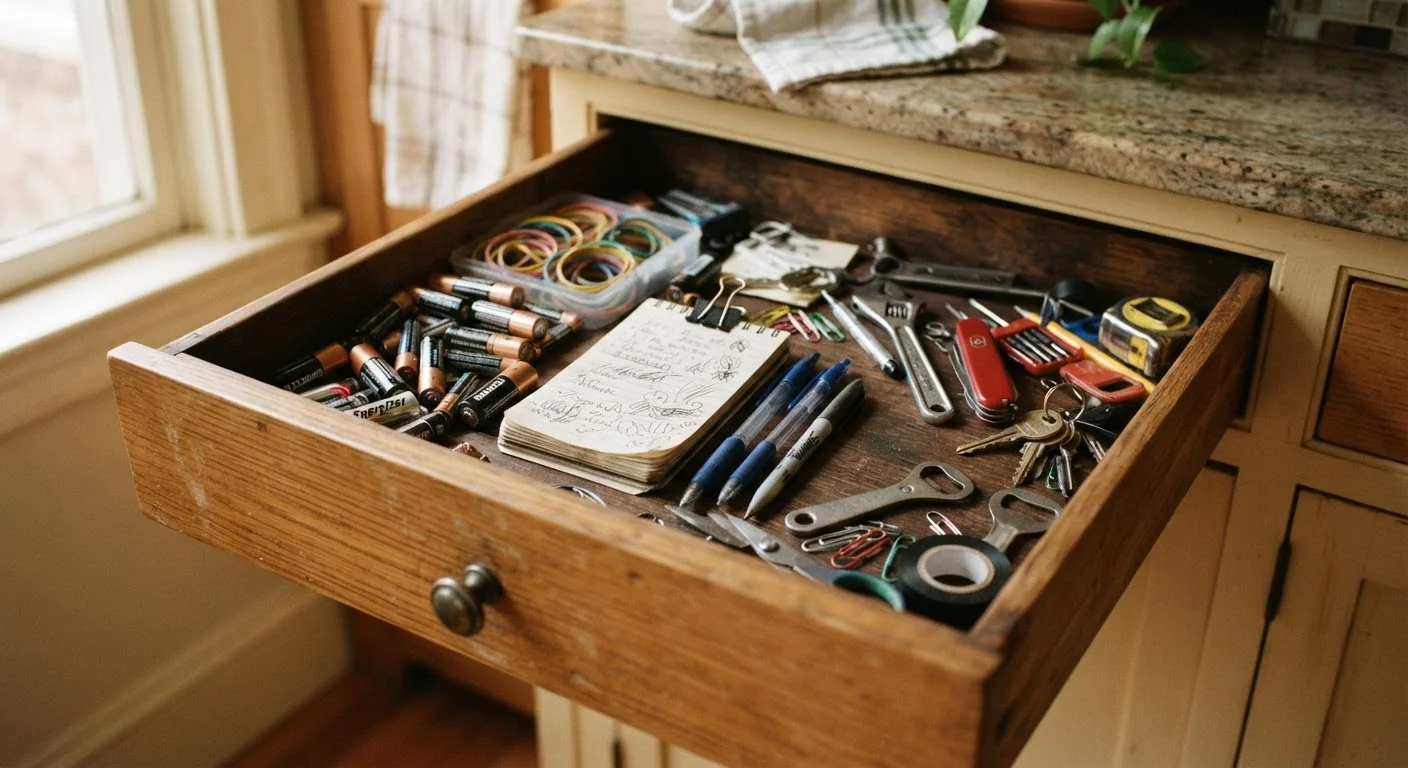
The junk drawer earns its reputation not because families are disorganized, but because some items genuinely resist categorization. A spare key, a takeout menu, a battery of uncertain charge, a twist tie - none of these belong in a clearly labeled cabinet. They're the residue of daily life, and they need somewhere to land.
Understanding why the drawer exists is the starting point for deciding what to do with it. If you're still working out the bigger picture of home organization, this introduction to getting started can help you build a foundation before tackling individual spaces.
The core problem isn't the drawer itself - it's when it becomes the destination for things that do have a rightful home elsewhere, or when it grows from one drawer to several. That's the tipping point from helpful to hindering.
The Case for Keeping It
There are honest, practical reasons the junk drawer has survived in nearly every household across generations.
Corrals miscellaneous items in one predictable spot
When small, hard-to-categorize items have a single landing zone, the rest of the kitchen stays clearer. The drawer acts as a pressure valve for everyday clutter.
Reduces decision fatigue for low-stakes items
Not every object warrants a dedicated storage solution. A junk drawer lets you defer micro-decisions on truly minor items without letting them colonize visible surfaces.
Creates a shared family reference point
Household members of all ages know where to check for spare batteries, a pen, or a mystery key - reducing the number of "where is it?" moments in a busy home.
Requires no investment to maintain
Unlike specialized storage systems, a well-managed junk drawer needs only an occasional five-minute edit. No bins, labels, or reorganization products are necessary.
A single contained zone for miscellaneous items actually protects the rest of your kitchen from clutter. If the drawer didn't exist, those same items would migrate to countertops, chair backs, and windowsills - far more visible and disruptive spots. Think of it as clutter containment by design.
For families with children, a junk drawer also functions as a shared "found items" zone - a predictable place to look before assuming something is lost. That kind of shared system is exactly the type discussed in organizing shared spaces for households with different habits.
The Case Against It
The arguments for eliminating the junk drawer aren't about perfectionism - they're about what the drawer can silently cost you.
Tends to expand silently over time
Without a firm boundary, one drawer often becomes two, and then a section of counter. Growth happens gradually and can go unnoticed until the problem is significant.
Delays real decisions about what to keep
Items placed in a junk drawer often represent avoided decisions. Over time, this accumulates into a backlog of objects that are neither used nor discarded.
Items become hard to find when needed
A disorganized drawer can mean spending minutes searching for something simple, which erodes the time-saving benefit the drawer was supposed to provide.
Can normalize clutter as a household standard
If children grow up treating the junk drawer as the default for anything inconvenient, it can establish habits that make broader tidiness harder to achieve over time.
The most persistent critique is that junk drawers tend to grow. One drawer becomes two. Two become a corner of the counter. Without a rule governing what enters, the space expands to fill available storage. This is the same dynamic covered in the principle of one-in, one-out household rules - without a boundary, accumulation is the default.
There's also a deeper issue: items stored in a junk drawer are often there because a decision was avoided, not made. Understanding the difference between decluttering and organizing matters here - organizing a junk drawer without first deciding what to remove often just shuffles the problem.
How to Make a Junk Drawer Actually Work
If you decide to keep one, the goal is to make it intentional rather than accidental. A few practical habits make the difference:
- Define its scope clearly. Decide in advance what belongs: small tools, batteries, spare keys, rubber bands, a notepad. Write it down if that helps. Everything else gets a different home or gets discarded.
- Use basic dividers. Repurposed containers - small boxes, ice cube trays, even folded cardboard - break the drawer into zones so items don't tangle together. You don't need to buy anything specialized.
- Edit it monthly. Set a five-minute recurring reminder. Remove anything that doesn't belong, discard anything depleted or broken, and return anything that wandered in from elsewhere.
- Limit it to one drawer. The moment you're tempted to overflow into a second, that's the signal to edit rather than expand.
When 'One Drawer' Becomes Many
A useful rule of thumb: if you have more than one designated catch-all zone in your kitchen, you likely have a clutter system rather than a clutter solution. A genuine junk drawer is singular and bounded. If you find yourself defending a second or third overflow space, that's a signal to edit the contents rather than expand the real estate.
For families weighing broader storage decisions - like how much should be open versus closed - the same principles apply. See how those trade-offs play out in open shelving vs. closed cabinets for a fuller picture.
The content provided on our blog site traverses numerous categories, offering readers valuable and practical information. Readers can use the editorial team’s research and data to gain more insights into their topics of interest. However, they are requested not to treat the articles as conclusive. The website team cannot be held responsible for differences in data or inaccuracies found across other platforms. Please also note that the site might also miss out on various schemes and offers available that the readers may find more beneficial than the ones we cover.