

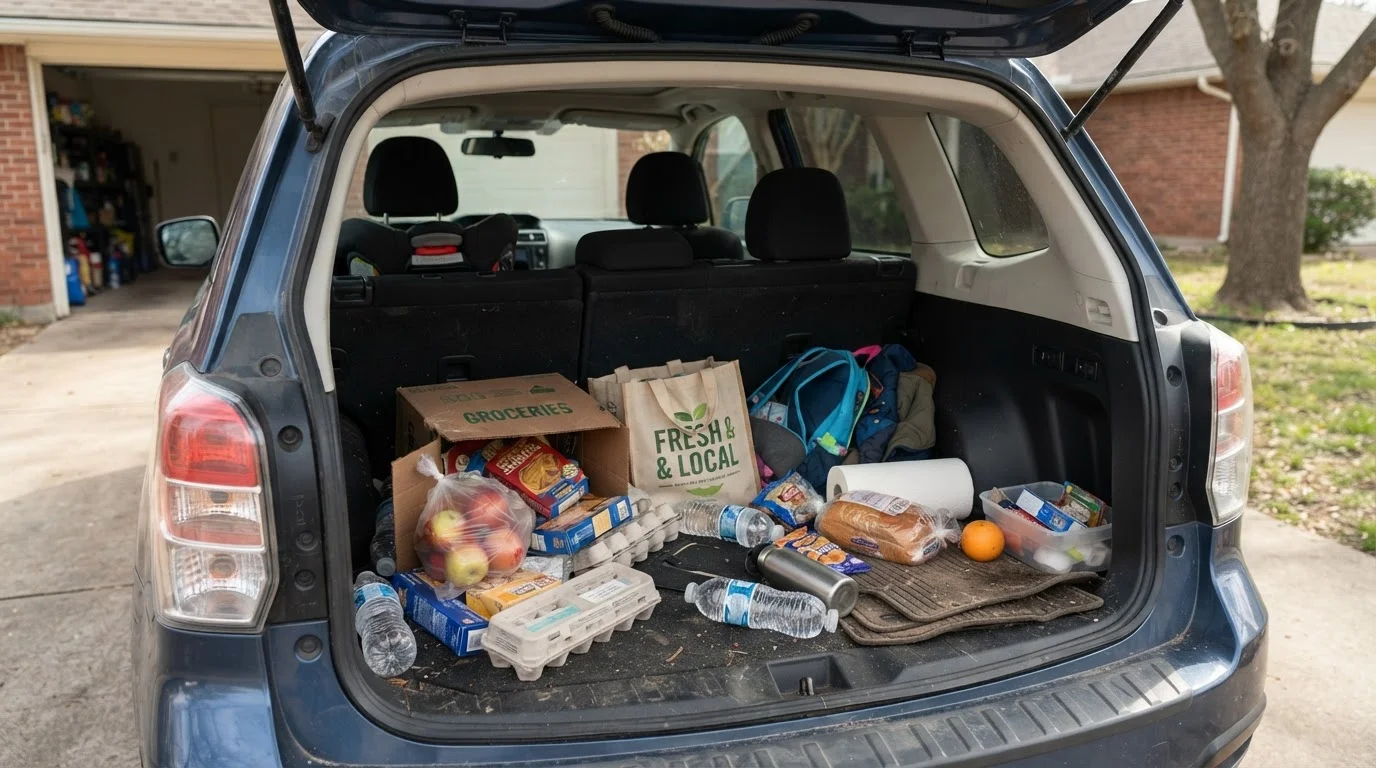
Why Physics Makes This a Family Safety Issue
Most families spend time thinking about car seats and seatbelts - and that attention is well placed. But the floor behind the front seat, the cargo area of an SUV, and the back window ledge often get loaded up without a second thought. That's where the physics problem starts.
In a crash or even a sharp emergency stop, every unsecured object in the vehicle continues traveling at the speed you were going before the brakes hit. A 10-pound backpack at 35 mph doesn't just slide - it flies. Research from safety organizations has long documented that loose objects in vehicle cabins contribute to injuries in crashes that passengers might otherwise survive with only minor harm.
Children are especially vulnerable. Rear-facing child seats position younger children facing directly toward the cargo area of a vehicle. Objects stored behind them in an SUV or minivan can travel forward in a crash and impact the back of the child's seat - or clear it entirely. See our guide on car seat installation errors for a broader picture of how in-vehicle setup decisions affect crash outcomes.
~13,000
US injuries annually linked to unsecured loads
AAA Foundation for Traffic Safety research has estimated that unsecured cargo contributes to roughly 13,000 injuries and over 500 deaths per year on US roads.
~500
Deaths per year attributed to unsecured loads
The same AAA Foundation research found that unsecured cargo is implicated in hundreds of US traffic fatalities annually, with many incidents involving items from passenger vehicles rather than commercial trucks.
3,000 lbs
Force a 20-lb object can generate at 55 mph
Safety engineers use crash physics calculations to illustrate that a 20-pound object in a 55 mph collision can exert forces equivalent to 3,000 pounds or more - far beyond what the human body can safely absorb.
The Objects Families Most Often Overlook
The hazard isn't limited to obvious items like power tools or full coolers. Common household objects that families routinely leave loose in vehicles include:
- Reusable grocery bags filled with canned goods - deceptively heavy
- Laptops and tablets left on rear seats or in seat pockets
- Sports equipment - cleats, helmets, water jugs, and balls in the cargo area
- Umbrellas with rigid handles, which can become spear-like projectiles
- Loose shoes on the floor behind the driver's seat
- Toolboxes or jump-starter packs stored unsecured in the trunk
The back window ledge deserves special mention. Items placed there - sunglasses cases, books, toys - sit directly in the path of objects that can be flung rearward in a rear-end collision and then bounce forward. It's best kept completely clear.
Pets: A Moving Hazard Many Families Underestimate
An unrestrained dog riding in the back seat is not just an animal at risk - it's an unsecured mass that follows the same crash physics as any other object. A medium-sized dog at highway speeds can generate an impact force that far exceeds its body weight. Beyond the crash scenario, a loose pet can distract a driver enough to cause an incident in the first place.
Crash-tested pet restraints and secured carriers meaningfully reduce this risk. It's worth noting that not all pet restraints are created equal - look for products that have undergone independent crash testing rather than relying solely on manufacturer claims. For more on how routine pet habits affect household safety, our article on common ways families undermine pet safety covers patterns that often go unnoticed.
Practical Steps for Securing Your Load
Reducing the risk doesn't require expensive equipment - it mostly requires a consistent habit before every trip.
Use what most vehicles already offer
Most SUVs and minivans come equipped with cargo anchor points - metal loops in the floor of the cargo area. Use them. Bungee cords and cargo nets attach to these anchors and prevent items from shifting during driving. Trunk organizers with rigid sides also keep grocery bags and sports gear from tipping and rolling.
Apply a weight-placement rule
Heavier items go lowest and furthest forward in the cargo area. A heavy cooler on the floor of a minivan's cargo zone is far safer than the same cooler perched on a folded-down rear seat. Distribute weight so nothing is stacked high enough to clear the seat backs.
Build a pre-trip check into your routine
Before every trip - and especially before longer ones - take 60 seconds to confirm that cargo is secured, the trunk is closed, and nothing is sitting on rear window ledges or piled unsecured behind passengers. Our pre-drive safety walkthrough offers a broader checklist format for families heading out on road trips.
For families who carry emergency supplies - which is a sound habit - those items also need to be secured rather than loose in the cargo area. See our piece on emergency supplies for family vehicles for guidance on what to carry and how to store it safely.
Make the 60-Second Cargo Check a Habit
Before pulling out of any parking lot or driveway, glance back and confirm nothing is loose behind the rear seats or on the back window ledge. It takes less than a minute and costs nothing. For longer trips, use cargo nets or organizers to keep heavier items anchored throughout the journey.
Frequently Asked Questions
Yes. A full 16-ounce water bottle weighs about one pound. At highway speeds, the forces involved in a crash can propel it with enough energy to cause head or neck injuries. Lighter objects become less dangerous, but no unsecured item is truly harmless in a high-speed collision.
Heavy items should go in the trunk or cargo area, as low and as far forward as possible, secured with cargo nets or tie-down straps. Avoid placing heavy objects on rear window ledges, on top of folded-down seats, or on the floor behind front seats where they can slide forward.
Yes. An unrestrained dog or cat becomes a projectile in a crash, just like any other unsecured object. A 60-pound dog at 35 mph can generate over 2,500 pounds of force on impact. Pet carriers secured by seatbelts or crash-tested restraints reduce this risk substantially.
Cargo nets, organizers, and trunk anchors meaningfully reduce the movement of items during normal driving and moderate stops. They are not designed to fully contain items in a severe high-speed collision, but they significantly reduce the risk of objects entering the passenger cabin during everyday driving.
Many US states have laws specifically addressing unsecured loads, particularly for trucks and larger vehicles. Penalties vary by state and can include fines or liability for damage caused by falling cargo. Check your state's DMV or transportation department for the specific rules that apply to passenger vehicles in your area.
Reusable grocery bags, laptops, sports equipment, toolboxes, umbrellas, and loose shoes are among the most commonly overlooked hazards. Items that seem harmless at rest - like a laptop bag on the rear seat - can cause serious injury when propelled in a crash.
The content provided on our blog site traverses numerous categories, offering readers valuable and practical information. Readers can use the editorial team’s research and data to gain more insights into their topics of interest. However, they are requested not to treat the articles as conclusive. The website team cannot be held responsible for differences in data or inaccuracies found across other platforms. Please also note that the site might also miss out on various schemes and offers available that the readers may find more beneficial than the ones we cover.