

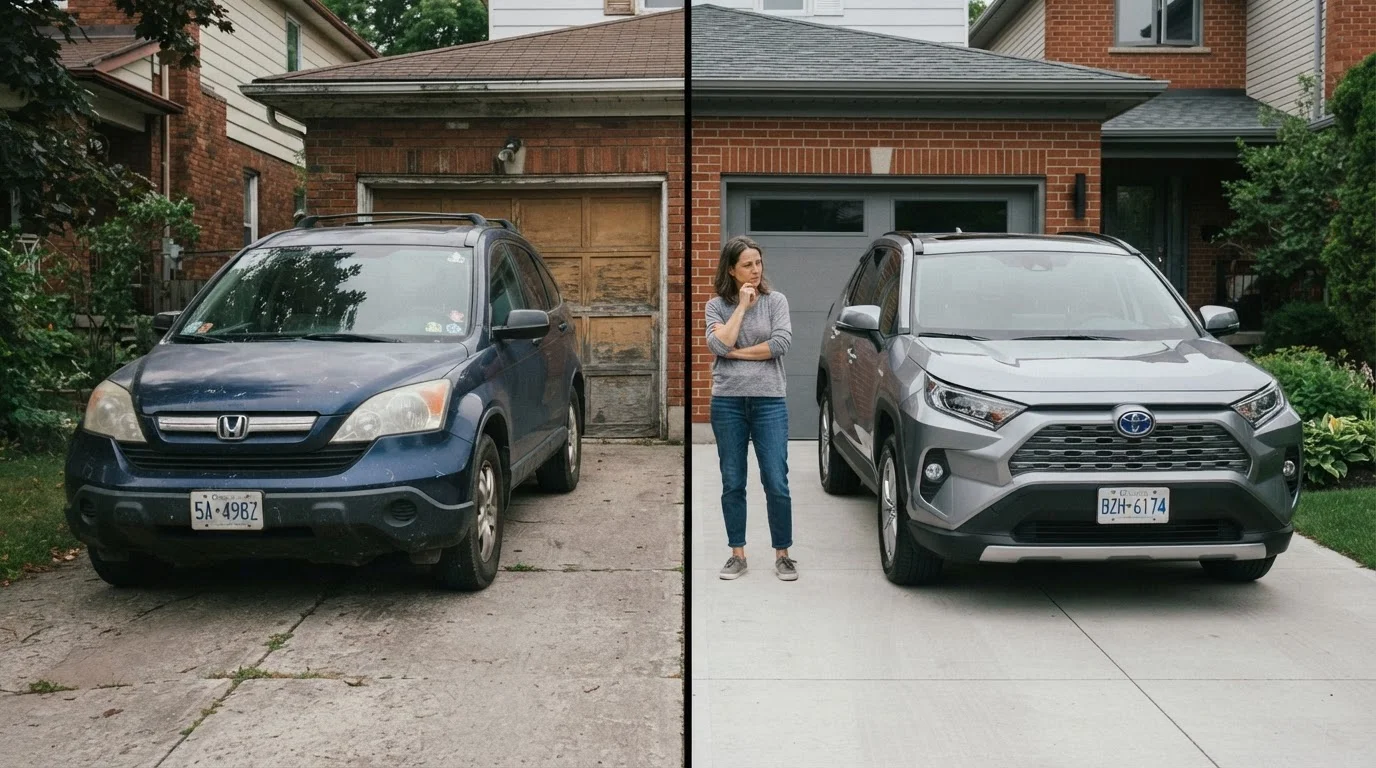
Our Verdict
For most budget-conscious families, keeping a reliable, paid-off vehicle tends to win on pure cost grounds - provided repair bills stay manageable and the car remains safe. Upgrading makes financial sense primarily when cumulative repair costs become unpredictable, safety is genuinely compromised, or a significant change in fuel or insurance costs tips the balance.
| Best for | Recommended |
|---|---|
| Families with a reliable, paid-off vehicle and manageable repair history | Keep the current vehicle |
| Drivers facing repair bills that rival or exceed the car's value annually | Consider upgrading |
| Those whose vehicle has documented safety system failures or structural concerns | Consider upgrading |
| Families who can absorb a car payment without stretching their budget | Upgrading - if depreciation and total cost of ownership are carefully evaluated first |
Why the Sticker Price Isn't the Real Question
When families debate replacing a car, the conversation usually starts in the wrong place - the monthly payment on something newer. The more useful question is: what does each option actually cost per year, all in?
Depreciation is typically the single largest cost of owning a vehicle, and it hits hardest in the first few years. Understanding how depreciation works is essential before making any upgrade decision, because a car that feels like a bargain at the lot can quietly cost thousands more than keeping an older vehicle running.
An older, paid-off car eliminates the monthly payment and the steepest depreciation curve. Even with occasional repair bills, the annual out-of-pocket cost is often lower than financing a replacement. The math only shifts when repairs become frequent, unpredictable, or approach the vehicle's actual market value.
| Keeping Current Vehicle | Upgrading to Newer Vehicle | |
|---|---|---|
| Monthly payment | Usually none (if paid off) | Typically $300-$600+ for financed vehicles |
| Depreciation hit | Minimal - curve already flattened | Steepest in first 1-3 years |
| Repair costs | Variable; may increase with age | Low initially, warranty may cover some |
| Insurance cost | Often lower on older, owned vehicle | Typically higher on newer or financed vehicle |
| Fuel economy | Fixed; may lag newer models | Potentially improved, especially on newer models |
| Safety features | Limited to original equipment | Access to updated crash ratings and driver aids |
| Financial predictability | Good if repair history is stable | Predictable payments, but adds long-term debt |
When Keeping the Car Usually Wins
The financial case for holding onto an aging vehicle is strongest when three conditions are true: the car is paid off, its repair history is reasonably predictable, and it passes safety inspections without structural concerns.
A useful rule of thumb: if annual repair costs stay below roughly one-third of what comparable replacement payments would total for the year, keeping the car is almost always the cheaper path. Maintenance spending - oil changes, tires, brakes - doesn't count as a reason to upgrade, because those costs follow you to any vehicle. Routine maintenance intervals are predictable and budgetable regardless of vehicle age.
It's also worth separating myth from reality in what aging cars actually need. Common maintenance myths lead some families to overspend on services a vehicle doesn't actually require, which can make an older car seem more expensive than it is.
Track Repair Costs Over 12 Months
Before deciding to upgrade, keep a simple running total of every repair bill for a full year - not including routine maintenance. If that number stays below roughly one-third of annual replacement costs, the older vehicle is likely the better financial choice. One large repair in isolation rarely justifies the total cost of switching to a newer vehicle.
When Upgrading Starts to Make Sense
There are scenarios where the numbers genuinely favor replacing a vehicle. The clearest is when repair costs become large and unpredictable - not a single expensive fix, but a pattern of failures suggesting the car is entering a costly final phase of life.
Delaying small repairs often accelerates this spiral. A timing belt deferred too long can turn a $400 job into an engine replacement. When a car requires multiple major repairs in a short window, the cumulative cost can approach or exceed what a lightly used replacement would cost annually.
Safety is a separate, non-negotiable consideration. If a vehicle's core safety systems - airbags, anti-lock brakes, structural integrity - are compromised and repair isn't feasible, that changes the calculus regardless of cost. Newer vehicles also carry updated crash-test ratings and driver-assistance features that older vehicles simply can't be retrofitted with.
Finally, significant shifts in insurance premiums or fuel costs can tip the balance. A high-mileage vehicle with poor fuel economy may cost noticeably more per mile to run than a more efficient replacement, depending on how much the family drives annually.
Building a Simple Framework for Your Situation
Rather than making an emotional decision, families are better served by running a quick annual cost comparison. Add up what the current vehicle costs per year: insurance, fuel, maintenance, and any repairs expected in the next 12 months. Then estimate what a replacement would cost: loan payments (or purchase price divided over expected ownership years), insurance on the newer vehicle, and its fuel costs.
If keeping the current car costs less - even accounting for a realistic repair budget - the math favors staying put. If the numbers are close, reliability and safety concerns should break the tie.
Families weighing the broader question of vehicle count - not just vehicle age - may also find it useful to consider the financial trade-offs of running one versus two vehicles. Sometimes the better move isn't upgrading a car but simplifying the fleet.
Whatever the outcome, decisions made with clear numbers in front of you tend to hold up far better over time than those driven by the appeal of something newer.
~$12,000
Average annual new vehicle ownership cost
According to AAA's annual Your Driving Costs study, the total cost of owning a new vehicle - including depreciation, financing, insurance, and fuel - frequently exceeds $10,000-$12,000 per year.
47%
Of car value lost in first three years
Industry data from vehicle valuation sources consistently shows that many new vehicles lose roughly 40-50% of their value within the first three years of ownership.
The content provided on our blog site traverses numerous categories, offering readers valuable and practical information. Readers can use the editorial team’s research and data to gain more insights into their topics of interest. However, they are requested not to treat the articles as conclusive. The website team cannot be held responsible for differences in data or inaccuracies found across other platforms. Please also note that the site might also miss out on various schemes and offers available that the readers may find more beneficial than the ones we cover.