

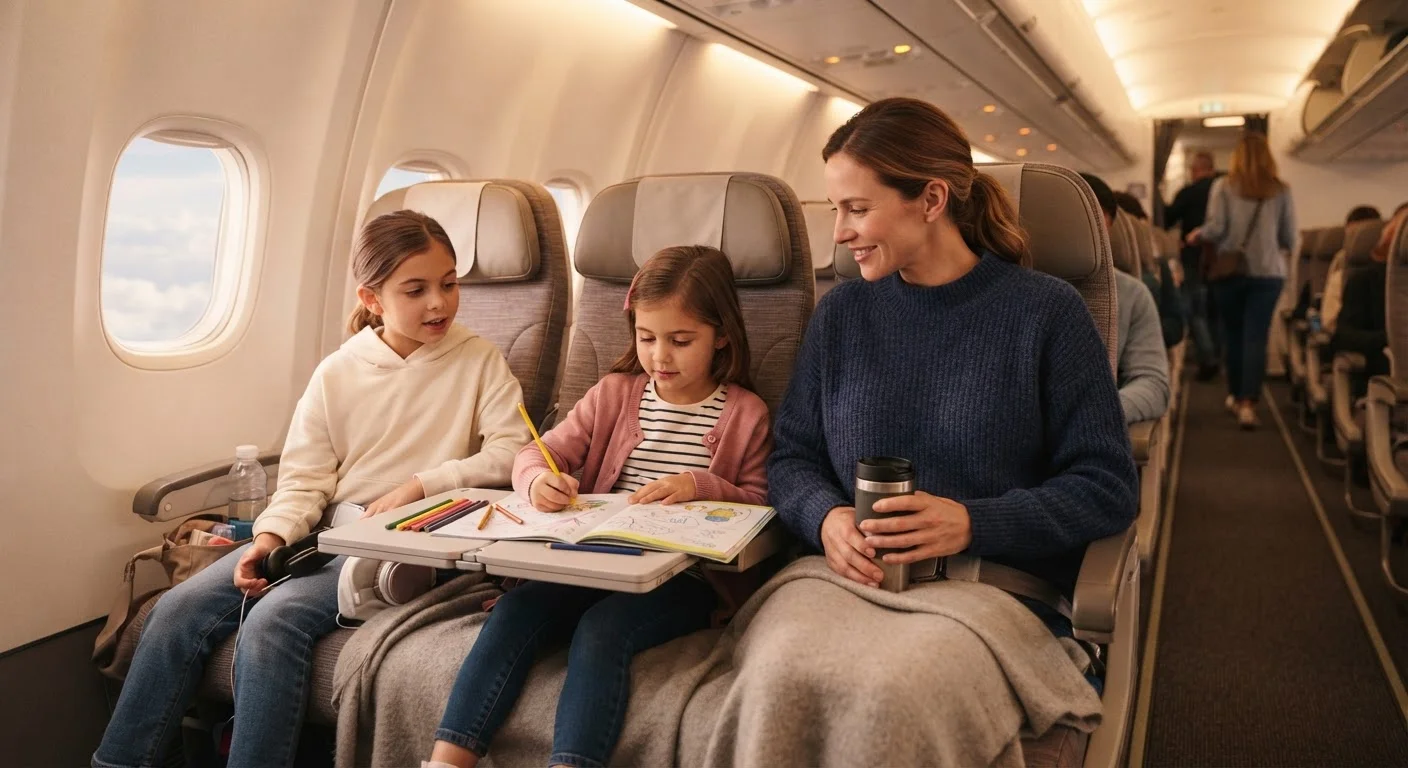
Why Screen-Free Matters - and How to Actually Pull It Off
Long-haul flights with children are manageable. They are rarely easy, but with the right preparation they don't have to be chaotic either. The instinct to hand over a tablet is understandable - it works, fast. But relying on screens as the only tool leaves families exposed when batteries die, Wi-Fi drops, or a four-year-old decides they're done with the show they picked thirty seconds ago.
This isn't about banning devices. It's about having a fuller toolkit. Research summarized in our balanced look at screen time and children's physical health suggests that mixing screen and non-screen activities generally supports better rest and alertness - useful context when you're trying to land with a child who can actually sleep on the plane.
The strategies below work across a wide age range, require minimal spending, and can be assembled the week before departure. For packing logistics, our family packing list covers exactly how to organize your carry-on for kids of different ages.
Build a Surprise Activity Kit - Revealed One Item at a Time
Wrap five or six small items individually before the flight. Think mini puzzle books, a new set of stickers, a small pad of dot-to-dot pages, or a travel-size tin of modeling putty. The wrapping itself buys time, and the novelty of an unknown object is often more compelling to a child than the object itself. Drip-feed them - one new item per hour or hour-and-a-half keeps the fresh-experience effect going across a long flight.
Aim to spend no more than $10-15 total on a kit for one child. Dollar stores, library book sales, and the odds-and-ends drawer at home are legitimate sourcing options.
Wrapped surprises revealed one at a time sustain novelty for far longer than a bag of loose toys.
Pack a Dedicated "Flight Journal" for Older Kids
For children ages six and up, a blank or lightly structured notebook becomes a surprisingly absorbing project. Give them a simple prompt list tucked inside the front cover: draw the view from the window, write what you think the city below looks like, list five things you want to do at the destination, invent a story about the person two rows ahead. This works especially well for kids who respond to having a "job" to do.
A composition notebook costs around $1-2 and carries zero battery anxiety. Some families let the child decorate the cover before departure as a pre-flight ritual that builds anticipation.
A flight journal with simple prompts gives older kids a purposeful, open-ended activity that lasts hours.
Use Audiobooks and Podcasts as a Middle-Ground Option
Audio content threads the needle between screen-free and device-free. A single device with downloaded audiobooks or kid-focused podcasts can serve multiple children through shared earbuds or a small travel speaker on low volume. Many public library systems offer free audiobook borrowing through apps - worth checking before you pay for anything.
Age-appropriate fiction works well for six-to-twelve-year-olds. For younger children, simple narrated story apps that require no visual interaction keep hands free for other activities. This approach also preserves screen time as a later-flight reward, which gives parents genuine leverage.
Downloaded audiobooks from your library app cost nothing and free children's hands for other activities.
Introduce Calm, Tactile Games That Work in a Tight Seat
Spatial constraints rule out a lot of activities - but not all. Magnetic drawing boards, lap-sized felt boards with reusable shapes, and simple card games (Go Fish, Uno, even a deck of regular cards) all work within the footprint of a tray table. Wikki Stix - bendable wax-coated strings - are a quiet, mess-free option that holds toddlers' attention longer than most parents expect.
Avoid anything with small loose pieces, liquid, or loud sound output. The goal is a self-contained activity that doesn't require parental management every three minutes.
Magnetic boards and bendable craft sticks are mess-free, quiet, and tray-table-friendly for any age.
Assign Kids a Simple In-Flight "Mission"
Framing activities as missions or challenges taps into children's natural drive for completion. Before the flight, write out a short list of observable tasks: count how many times the flight attendants walk past, spot three different countries on the moving map, find five shapes in the clouds, track how many meals are served. For the destination-curious child, add a printed fact sheet about where you're going and have them quiz a parent.
This costs nothing, generates conversation, and can be calibrated to any age or attention span. It also turns the aircraft environment - normally a source of boredom - into the activity itself.
Turning the cabin environment into an observation game costs nothing and sharpens rather than dulls curiosity.
Plan Snacks Strategically, Not Just Plentifully
Snacks serve double duty on long flights: they manage hunger and they fill time. The key is to spread them out deliberately rather than front-loading everything in the first two hours. Pack snacks that require some engagement - things to peel, dip, or assemble - and introduce them as transitions between activities. A new snack signals a new phase of the flight.
Stick to familiar foods to avoid stomach upset at altitude, and account for cabin pressure affecting taste perception (salty and sweet register differently at cruising altitude). Check airline policies on outside food before departure, as rules vary by carrier and route.
Spacing snacks as transition markers between activities structures the flight without adding cost.
Putting It All Together Before You Board
The families who handle long flights best tend to share one habit: they treat the flight like an event with a loose schedule, not an ordeal to survive. Breaking a ten-hour flight into two-hour blocks - activity, snack, story, rest, repeat - gives kids a sense of progress and gives parents predictable reset points.
Involve Kids in the Kit Before You Leave
Let children pick one or two items to include in their own activity kit during pre-trip packing. This small act of ownership meaningfully reduces in-flight resistance - kids are less likely to reject an activity they chose themselves. It also gives you a natural conversation about what the flight will look like, which lowers anxiety for children who find the unknown stressful.
If your itinerary involves a significant time-zone jump, managing the in-flight routine with rest in mind can ease the adjustment on the other end. Our article on jet lag in children explains how sleep timing on the plane affects recovery after landing. And if this is your family's first long-haul trip, the first-timer's complete walkthrough for flying with young children covers everything from seat selection to airport logistics in one place.
Budget matters too. Almost every item on this list costs under $5 individually and many can be sourced from dollar stores or repurposed from home - keeping your travel fund where it belongs. See our travel savings hub for broader strategies on keeping family trip costs under control.
The content provided on our blog site traverses numerous categories, offering readers valuable and practical information. Readers can use the editorial team’s research and data to gain more insights into their topics of interest. However, they are requested not to treat the articles as conclusive. The website team cannot be held responsible for differences in data or inaccuracies found across other platforms. Please also note that the site might also miss out on various schemes and offers available that the readers may find more beneficial than the ones we cover.