

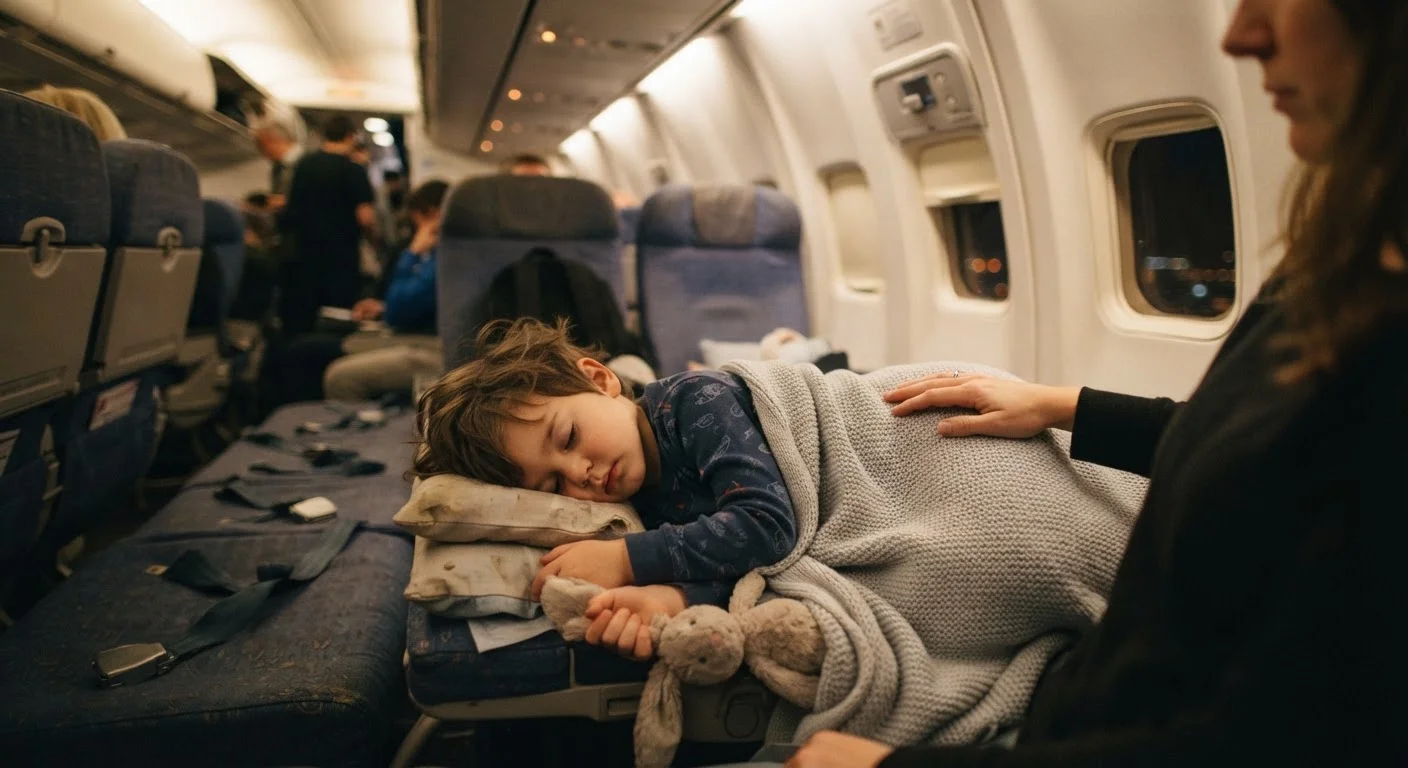
Why Children Experience Jet Lag Differently
Adults tend to power through jet lag with coffee and willpower. Kids don't have that option - and their reactions to circadian disruption are often more visible and less predictable. A toddler wide awake at 2 a.m. or a school-aged child melting down at dinner isn't misbehaving; their body clock is genuinely confused.
The core mechanism is the same across ages: when you cross multiple time zones rapidly, your internal clock is still anchored to the original time zone while local daylight, meals, and social cues push in a different direction. For children, whose sleep architecture is more structured around consistent schedules, this mismatch can feel especially disruptive.
Infants and toddlers are particularly sensitive because their circadian rhythms are closely tied to feeding and nap cues. Older children and pre-teens often adapt a bit faster, but they're not immune - especially on eastbound flights, which require the body to fall asleep earlier than it wants to.
Jet Lag Is Not an Illness
Jet lag is a physiological response to rapid time zone change - not a sickness, and not a sign that something is wrong with your child. Symptoms like nighttime waking, irritability, and daytime fatigue are temporary and self-resolving in otherwise healthy children. If symptoms are unusually severe or persist well beyond the expected adjustment window, consult your pediatrician.
Realistic Expectations for Recovery Time
A commonly cited general rule is roughly one day of adjustment for each time zone crossed, though individual variation is significant. A family flying from New York to London (five time zones) might expect four to six days before everyone is sleeping reasonably well at local hours. A transpacific trip - say, to Japan - could mean a week or more.
Direction matters too. Eastbound travel is broadly considered harder because it asks the body to advance its clock - going to sleep earlier than it naturally wants to. Westbound travel delays the clock, which most people find somewhat easier.
1 day
Estimated adjustment per time zone crossed
A widely referenced general guideline among sleep researchers, though individual recovery varies considerably by age, direction of travel, and sleep habits.
3-7 days
Typical full recovery window for children
Most pediatric sleep guidance suggests children normalize their sleep patterns within this range for medium-haul international flights.
~60%
Travelers who report jet lag symptoms after crossing 5+ zones
Survey data from various travel medicine studies suggests the majority of passengers on long-haul flights experience at least some circadian disruption.
Planning for this adjustment window honestly is one of the most useful things parents can do. If you're traveling for a week and expecting two solid days of disruption, build that into your itinerary rather than scheduling major activities on day one. The off-season travel approach many budget families use - traveling outside peak windows for lower costs - also tends to mean lower-pressure itineraries, which helps when a child needs an extra slow morning to catch up on sleep.
General Strategies to Support Adjustment
No approach eliminates jet lag entirely, but several evidence-informed strategies can reduce its duration and severity in children.
Before You Fly
Shifting a child's bedtime by 30 to 60 minutes in the direction of the destination time zone - starting three to five days before departure - can soften the landing. It doesn't need to be a dramatic shift; small adjustments compound. If flying east, put them to bed slightly earlier each night. Flying west, slightly later.
During the Flight
Encourage sleep during segments that align with nighttime at the destination. Keeping kids occupied during destination-daytime hours on the plane helps too. See low-screen entertainment ideas for long-haul flights for practical options that keep energy up without overstimulating before a sleep window.
At the Destination
Get outside in natural daylight as soon as possible after arrival. Light is the most powerful external cue for resetting the circadian clock. Keep meals and bedtimes aligned with local time from the first day, even if a child resists. Avoid long naps that would push nighttime sleep further off track - a short 20-minute rest is typically safer than a two-hour one.
For parents managing their own exhaustion alongside their children's disruption, it's worth understanding how sleep quality affects recovery - something covered in depth in our piece on sleep quality versus duration for exhausted parents.
What Parents Can Control - and What They Can't
Jet lag in children is not a parenting failure, and no preparation fully prevents it. What you can control is how you respond to it: keeping a calm, consistent routine at the destination, managing expectations with older children so they understand why they feel strange, and building enough slack into your schedule that one rough night doesn't derail the trip.
If your family prefers land-based travel, road trips with kids avoid jet lag entirely - a real logistical advantage for shorter international or domestic journeys.
For children with underlying health conditions or those who are particularly sensitive sleepers, it's worth a conversation with your pediatrician before departure. They can offer guidance tailored to your child's specific needs - including whether any sleep aids are appropriate - rather than the general information that applies to most families.
This article is for general informational and educational purposes only and is not medical advice. Consult a qualified healthcare professional for guidance specific to your child's health and needs.
Frequently Asked Questions
Most children recover within 3 to 7 days, though toddlers and infants may take a little longer. The number of time zones crossed is the biggest factor - more zones generally means a longer adjustment. Consistent sleep cues at the destination can speed up the process.
Flying east tends to be harder because it requires going to sleep earlier than your body wants to, which most people find more difficult than staying up later. This applies to children as well as adults. Budget extra adjustment time for eastbound long-haul trips.
Some pediatric sleep researchers suggest low-dose melatonin may help reset a child's body clock during travel. However, dosing, timing, and safety considerations vary by age and health status. Always consult your child's pediatrician before using melatonin or any supplement.
For short trips of two to three days, staying closer to home time may make sense. For longer stays, switching to local time as quickly as possible generally produces a better outcome. Pediatric sleep guidance leans toward adapting to local time for trips lasting a week or more.
Common signs include waking in the middle of the night fully alert, refusing naps at expected times, unusual fussiness, and difficulty settling at bedtime. These behaviors are normal responses to circadian disruption, not illness, and typically resolve without treatment.
The content provided on our blog site traverses numerous categories, offering readers valuable and practical information. Readers can use the editorial team’s research and data to gain more insights into their topics of interest. However, they are requested not to treat the articles as conclusive. The website team cannot be held responsible for differences in data or inaccuracies found across other platforms. Please also note that the site might also miss out on various schemes and offers available that the readers may find more beneficial than the ones we cover.