

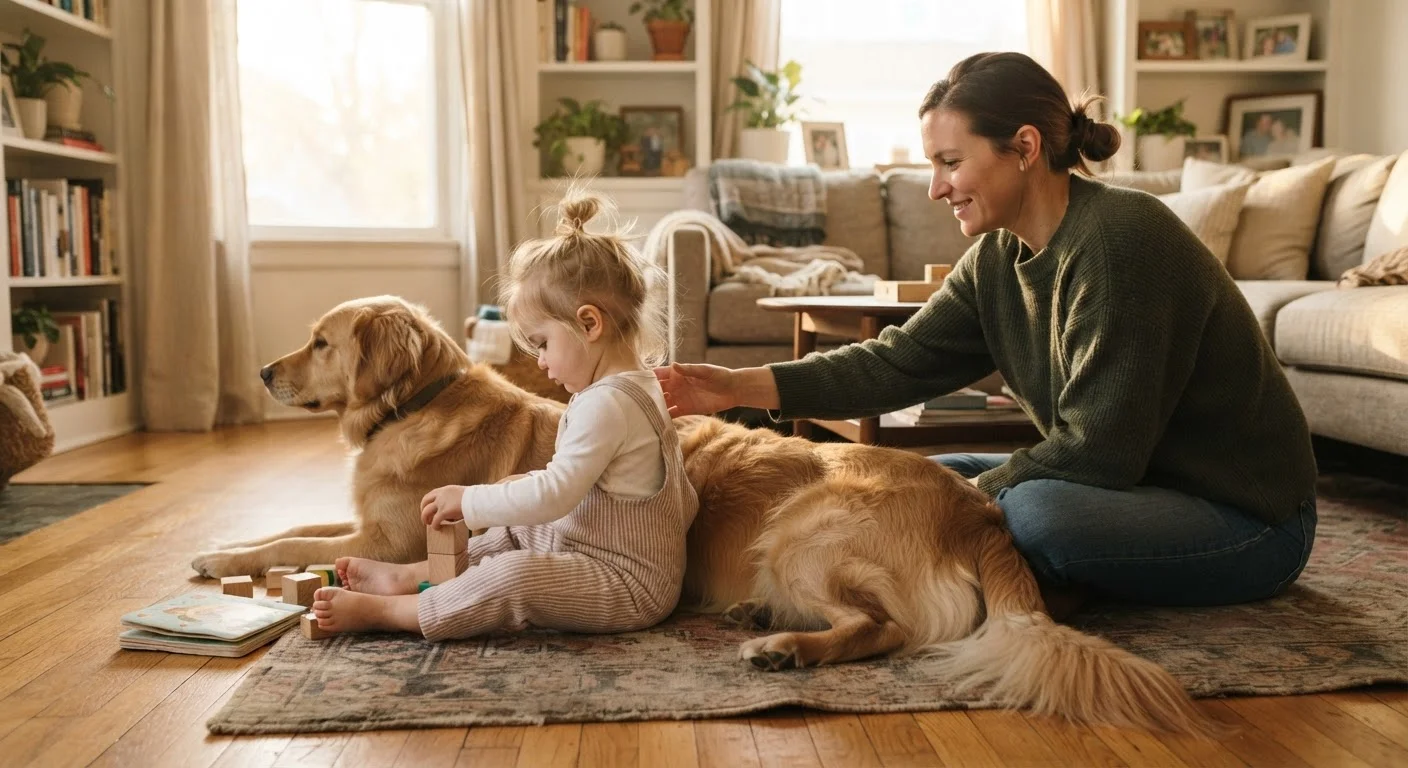
Why a Growl Deserves a Calm Response
A pet's growl is one of the most misunderstood moments in a family home. Many parents react with alarm or frustration - raising their voice, scolding the animal, or rushing in. While completely understandable, those reactions can actually increase the risk of the situation escalating.
Veterinary behaviorists generally agree that growling is a pet's way of communicating discomfort before resorting to a snap or bite. In that sense, it is a valuable warning signal - one that deserves to be taken seriously rather than suppressed. Punishing a pet for growling can cause them to skip that warning step in the future, which is genuinely more dangerous for everyone in the home.
Understanding why dogs escalate to snapping starts with recognizing the earlier signals - and a growl sits toward the top of that ladder. If your child and pet have reached this point, it's worth addressing thoughtfully and without panic.
Never Punish a Pet for Growling
Scolding, startling, or physically correcting a pet immediately after a growl may seem like the right correction in the moment - but it removes the warning signal without addressing the underlying discomfort. Pets that learn growling leads to punishment may stop growling and bite without warning instead. Treat the growl as information, not defiance.
Step-by-Step: What to Do in the Moment
The seconds immediately following a growl matter. Here is how to respond in a way that prioritizes everyone's safety while keeping emotions in check.
Stay calm and lower your own energy
Take a slow breath before doing anything else. Yelling, lunging, or panicking signals danger to both the child and the pet, often amplifying the pet's stress. A measured tone and unhurried movements help de-escalate the situation faster than a reactive response.
Create distance without confrontation
Gently guide the child backward and away from the pet. Do not pull the child sharply or step between them in a way that crowds the animal further. The goal is to increase space, which almost always reduces tension immediately.
Remove the child from the space
Once the child is safely out of arm's - or paw's - reach, move them to a different room. This is not a punishment for either party; it is simply the fastest way to end the stressful interaction and let both the child and the pet reset.
Give the pet space to settle
Do not immediately approach, comfort, or scold the pet. Allow them to move to a preferred resting spot on their own. Forcing interaction too soon can reignite the stress response. Check on the pet once the situation has clearly settled - usually after 10 to 15 minutes.
Check in with your child at their level
After both parties have calmed, talk briefly with your child about what happened. Use simple, non-blaming language appropriate to their age. Acknowledge that the pet was feeling upset, and explain that the growl was the pet's way of asking for space - not a sign the pet is "bad."
After the immediate situation is resolved, resist the urge to either catastrophize or brush it off. Both extremes prevent you from doing the most important work: understanding what caused it.
After the Incident: Understanding and Preventing a Repeat
Once the moment has passed and everyone is calm, carve out time - ideally the same day - to think through what happened. Ask yourself a few honest questions: Was the pet eating, sleeping, or guarding a resource? Was the child's interaction too rough, too fast, or too close to the pet's face? Had the pet been showing other stress signals that went unnoticed earlier?
Many growling incidents are preceded by subtler warning signs - a stiff body, whale eye (the whites of the eyes showing), or a tucked tail. Helping your child learn to read these body language cues is one of the most durable safety investments you can make.
Next, look at your household setup. Are there spaces where the pet can truly retreat and decompress without being followed by curious little hands? A crate, a gated room, or a raised bed can give animals the buffer they need. For a broader look at physical safeguards, our guide on pet-proofing your home for young children covers practical room-by-room adjustments.
If growling recurs - especially toward the same child or in similar contexts - that pattern warrants professional input. A certified applied animal behaviorist or a veterinary behaviorist can assess your specific situation without judgment. This is not a failure; it is responsible pet ownership. Teaching children respectful habits goes hand in hand with this process - see our guidance on teaching children to interact safely with the family pet for age-appropriate approaches.
This article provides general educational information only. For concerns about your pet's behavior or your child's safety, please consult a qualified veterinary behaviorist and, if a bite occurs, appropriate medical and animal control professionals.
The content provided on our blog site traverses numerous categories, offering readers valuable and practical information. Readers can use the editorial team’s research and data to gain more insights into their topics of interest. However, they are requested not to treat the articles as conclusive. The website team cannot be held responsible for differences in data or inaccuracies found across other platforms. Please also note that the site might also miss out on various schemes and offers available that the readers may find more beneficial than the ones we cover.