

Why History Feels Irrelevant to Many Children
History occupies a strange place in many children's minds: simultaneously everywhere (in films, games, and family stories) and nowhere useful. When a child says history is boring, they usually mean one of a few specific things - the content feels disconnected from their life, the learning approach is passive, or the sheer volume of names and dates creates anxiety rather than curiosity.
Understanding which of these is at play helps you respond more effectively than simply encouraging them to try harder. This article is part of a broader effort to help parents confidently step into subject-specific support - you can explore strategies across all core subjects in our subject-specific study strategies guide.
Follow Your Child's Lead First
Before introducing any new approach, ask your child which part of history class feels most pointless to them and why. Their answer will tell you whether the barrier is the content itself, the pace, or the way it's being taught. Tailoring your home support to that specific friction point is far more effective than a generic enrichment plan.
It's also worth noting that disengagement from history is rarely about intelligence. Many historically significant thinkers found school history dull precisely because it was taught as received truth rather than open inquiry. Reframing the subject - even slightly - can shift a child's entire relationship with it.
What to Do at Home: A Step-by-Step Approach
The steps below are designed to be low-effort, low-cost, and adaptable to your child's age and current school curriculum. None require specialist knowledge on your part - curiosity and a willingness to explore alongside your child are the only real prerequisites.
What you will need
You'll find these approaches work best when introduced gradually rather than all at once. Pick the step that feels most natural given your child's current attitude toward the subject, and build from there.
Public library card
Provides free access to illustrated history books, graphic novels about historical events, and documentary DVDs suitable for children.
Historical maps (free printable or online)
Visual learners often engage more deeply when they can see geography change over time alongside events.
Family photographs or documents
Personal family history artifacts make abstract historical eras tangible and emotionally meaningful for children.
Notebook or sketchbook
A low-pressure space where children can draw timelines, sketch scenes, or write questions rather than formal notes.
Find the hook - connect history to what already interests your child
Start by identifying one thing your child genuinely cares about - sport, fashion, technology, food, or music - and trace it backwards in time together. A child fascinated by video games can explore how computing evolved from wartime code-breaking. A child who loves football can discover how the modern rules were standardised in Victorian England. This isn't a stretch; almost every contemporary interest has rich historical roots.
The goal isn't to trick your child into studying - it's to show them that history is the backstory of everything they already find interesting.
Swap dates-first learning for stories-first learning
When children encounter history as a sequence of dates and names, it feels like a phone book. Shift the entry point: start with a vivid human story, then let the date emerge as context. Ask questions like, "What was it actually like to be a child your age during that time?" This reframes historical figures as real people navigating real uncertainty - far more compelling than a textbook summary.
Illustrated narrative histories, historical fiction aimed at the relevant age group, and documentary storytelling all achieve this naturally.
Make it visual with maps, timelines, and primary sources
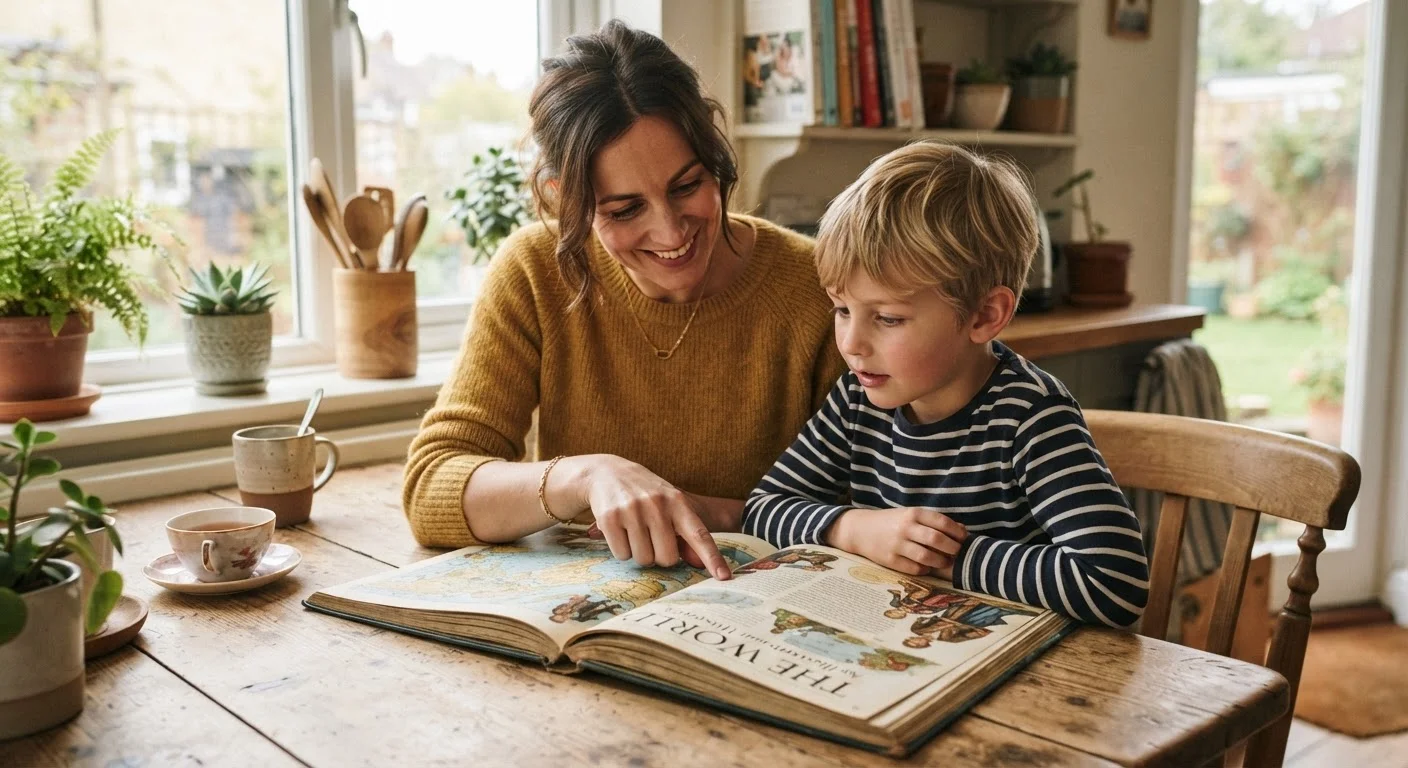
Many disengaged history learners are visual thinkers who struggle with dense text. A hand-drawn timeline on a long strip of paper - created together - can make chronology click in a way that a textbook list never does. Free online archives from institutions like national museums and libraries offer genuine historical photographs, posters, and letters that children can examine as mini-detectives.
Ask your child: "What does this image tell us? What questions does it raise?" That detective framing mirrors exactly how historians actually work.
Connect family history to the curriculum
If your family has grandparents, great-grandparents, or older community members willing to share memories, even a brief recorded conversation can make a historical era feel immediate. A grandparent's memory of a major national event lands differently than a paragraph in a textbook. Old photographs, letters, or objects can anchor abstract periods to something personally meaningful.
If direct family memories aren't available, community archives, local historical societies, and even neighbourhood landmarks can serve the same purpose.
Keep home engagement brief, regular, and low-stakes
Consistency matters far more than duration. A five-minute conversation over dinner about something historical - sparked by the news, a film, or a question your child raised - does more over a school year than an occasional two-hour deep dive. The aim is to normalise curiosity about the past, not to run a parallel curriculum at home.
For more ideas on building subject-specific habits without burning out, see building consistent study habits across subjects - routines that work for maths won't always transfer to humanities learning.
History Is More Than Memorization
Many children - and parents - associate history with rote learning of dates and rulers. In reality, school history curricula increasingly focus on evidence, cause-and-effect, and perspective. When you support your child at home, aim to reinforce that analytical thinking rather than drilling facts alone. This shift in framing often reduces resistance almost immediately.
For families looking to extend home learning without any extra cost, our free home learning resources guide covers a wide range of no-cost tools that work well alongside the approaches described here. History also pairs naturally with geography - if your child is more engaged by place than time, geography at home offers complementary ideas worth exploring.
The content provided on our blog site traverses numerous categories, offering readers valuable and practical information. Readers can use the editorial team’s research and data to gain more insights into their topics of interest. However, they are requested not to treat the articles as conclusive. The website team cannot be held responsible for differences in data or inaccuracies found across other platforms. Please also note that the site might also miss out on various schemes and offers available that the readers may find more beneficial than the ones we cover.