

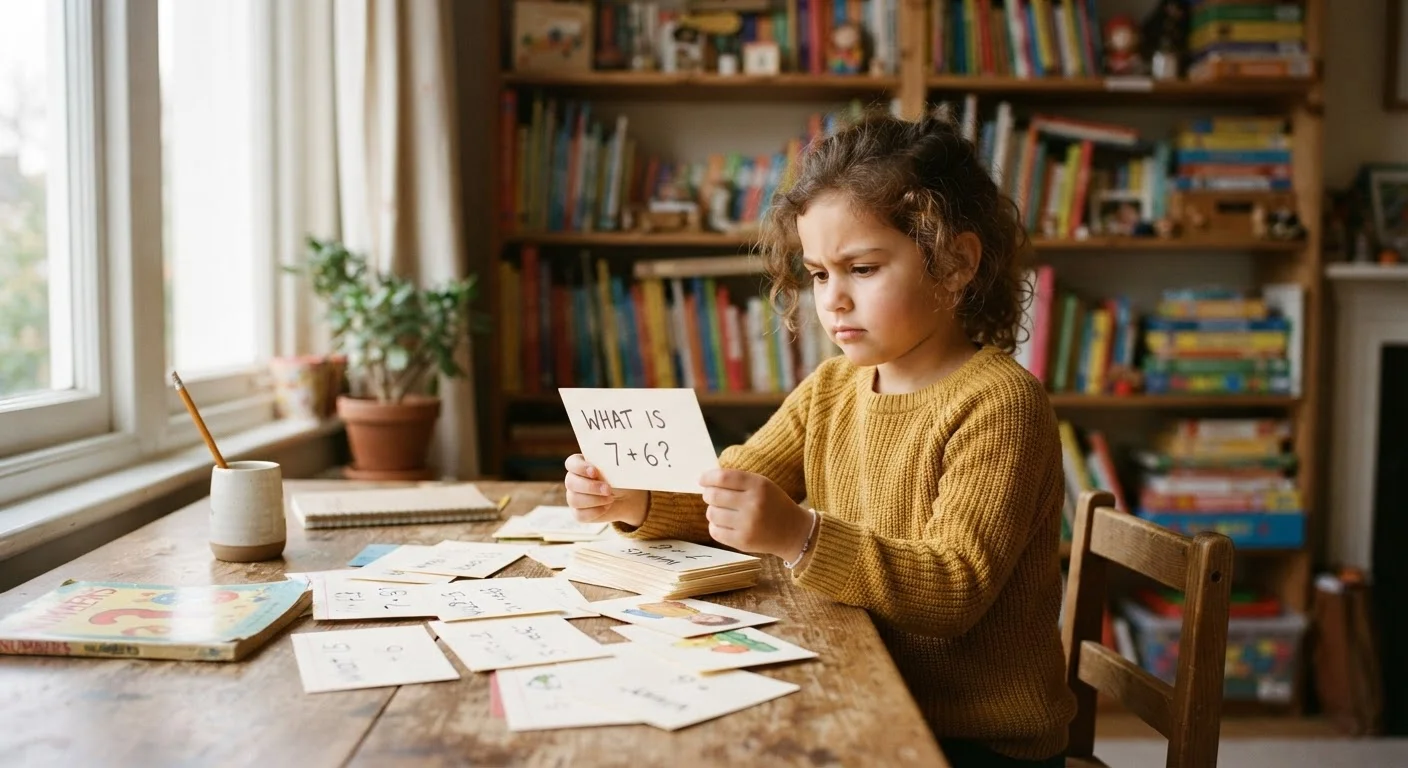
Option A
Active Recall
The effortful retrieval method backed by cognitive science.
Best for: Children who need to retain information long-term, prepare for tests, or build confident independent study habits.
Option B
Passive Re-Reading
The familiar but often misleading comfort of re-reading notes.
Best for: Initial exposure to new material or quick orientation before deeper study - not as a primary study strategy.
Why Re-Reading Feels Like Studying (But Often Isn't)
When kids sit down with their notes and read through them again - and again - it feels productive. The material starts to look familiar. Pages feel recognizable. Children often finish re-reading sessions convinced they've learned the content.
Cognitive scientists call this the fluency illusion: the ease with which information flows during re-reading is mistaken for genuine knowledge. Familiarity and recall are not the same thing. A child who recognizes a definition when they see it may still be unable to produce it independently on a test.
Passive re-reading requires almost no mental effort - and that's precisely the problem. Learning that sticks requires the brain to work. When a child just reads, the brain processes the words without being forced to retrieve or reconstruct anything. The result is shallow encoding that fades quickly.
This doesn't mean re-reading is useless. A first or second read is a reasonable starting point for new material. The mistake is treating it as a sufficient study strategy rather than a first step.
What Active Recall Actually Means - and Why It Works
Active recall (also called retrieval practice) means deliberately pulling information out of memory rather than passively reading it in. Flashcards, practice questions, covering up notes and writing down what you remember, oral self-quizzing, or simply closing the textbook and summarizing what you just read - all of these are forms of active recall.
The cognitive mechanism behind its effectiveness is called the testing effect. Every time the brain is required to retrieve a piece of information, the neural pathway for that memory is strengthened. The act of retrieval itself - not just the exposure to the material - consolidates learning. Research in cognitive psychology, including influential work by researchers such as Henry Roediger III and Mark McDaniel, has documented this effect across age groups and subject areas.
Crucially, this works even when children get the answer wrong. Struggling to retrieve something and then checking the correct answer produces stronger retention than if the answer had been easy to recall or simply re-read. That productive struggle is part of what makes the method so effective.
| Criterion | Active Recall | Passive Re-Reading |
|---|---|---|
| Cognitive effort required | High - retrieval demands mental work | Low - recognition feels effortless |
| Long-term retention | Strong - retrieval strengthens memory | Weak - familiarity fades quickly |
| Exposes knowledge gaps | Yes - errors surface immediately | No - gaps stay hidden |
| How it feels during study | Challenging and sometimes frustrating | Comfortable and reassuring |
| Research support | Extensive - testing effect well documented | Limited - not recommended as primary method |
| Best use case | Test prep and long-term learning | First exposure to new material |
| Cost to implement at home | Free or very low (paper, index cards) | Free (uses existing notes/textbooks) |
For a broader look at retrieval practice alongside other evidence-backed methods, see our complete guide to study techniques.
Simple Ways to Introduce Active Recall at Home
Parents don't need specialized training or expensive materials to make active recall part of the homework routine. The following approaches are free or low-cost and practical for most families:
- The blank page method: After reading a chapter or reviewing notes, your child closes everything and writes down every key point they remember. Then they open the book and check what they missed.
- Homemade flashcards: Index cards cost very little. Your child writes a term or question on one side and the answer on the other. The physical act of making the cards is itself a mild form of recall practice.
- Parent as quizzer: Simply read your child's notes and ask them questions. No expertise required - just ask them to explain concepts back to you in their own words.
- Practice problems first: For math or science, encourage children to attempt problems before re-reading examples. Mistakes made before instruction are often remembered longer than correct answers given after passive reading.
Active recall pairs powerfully with spaced repetition - reviewing material at increasing intervals rather than cramming it all at once. Our guide to spaced repetition explains how to set this up in a practical way at home.
If you're weighing whether to use digital apps or printed tools to support these strategies, our comparison of printable vs. app-based learning resources can help you decide what fits your child's learning style.
Helping Your Child Make the Switch
One of the biggest hurdles is that active recall feels harder - because it is. Children may resist it precisely because it's uncomfortable, especially when they're used to the reassuring ease of re-reading. Reframing difficulty as a sign that learning is actually happening can help shift that mindset.
Start small. Ask your child to do one recall attempt at the end of each study session - close the notes, say three things they remember, then check. That single habit, repeated consistently, outperforms an hour of passive highlighting.
Reading comprehension is a related area where these principles matter. If your child struggles with understanding what they read - not just memorizing it - our article on why kids struggle with reading comprehension explores the underlying causes and what families can do.
The goal isn't to eliminate re-reading entirely. It's to make sure children are spending most of their study time on strategies that actually move the needle on what they can remember and do independently - and that starts with understanding the difference between feeling like you know something and actually knowing it.
The content provided on our blog site traverses numerous categories, offering readers valuable and practical information. Readers can use the editorial team’s research and data to gain more insights into their topics of interest. However, they are requested not to treat the articles as conclusive. The website team cannot be held responsible for differences in data or inaccuracies found across other platforms. Please also note that the site might also miss out on various schemes and offers available that the readers may find more beneficial than the ones we cover.