

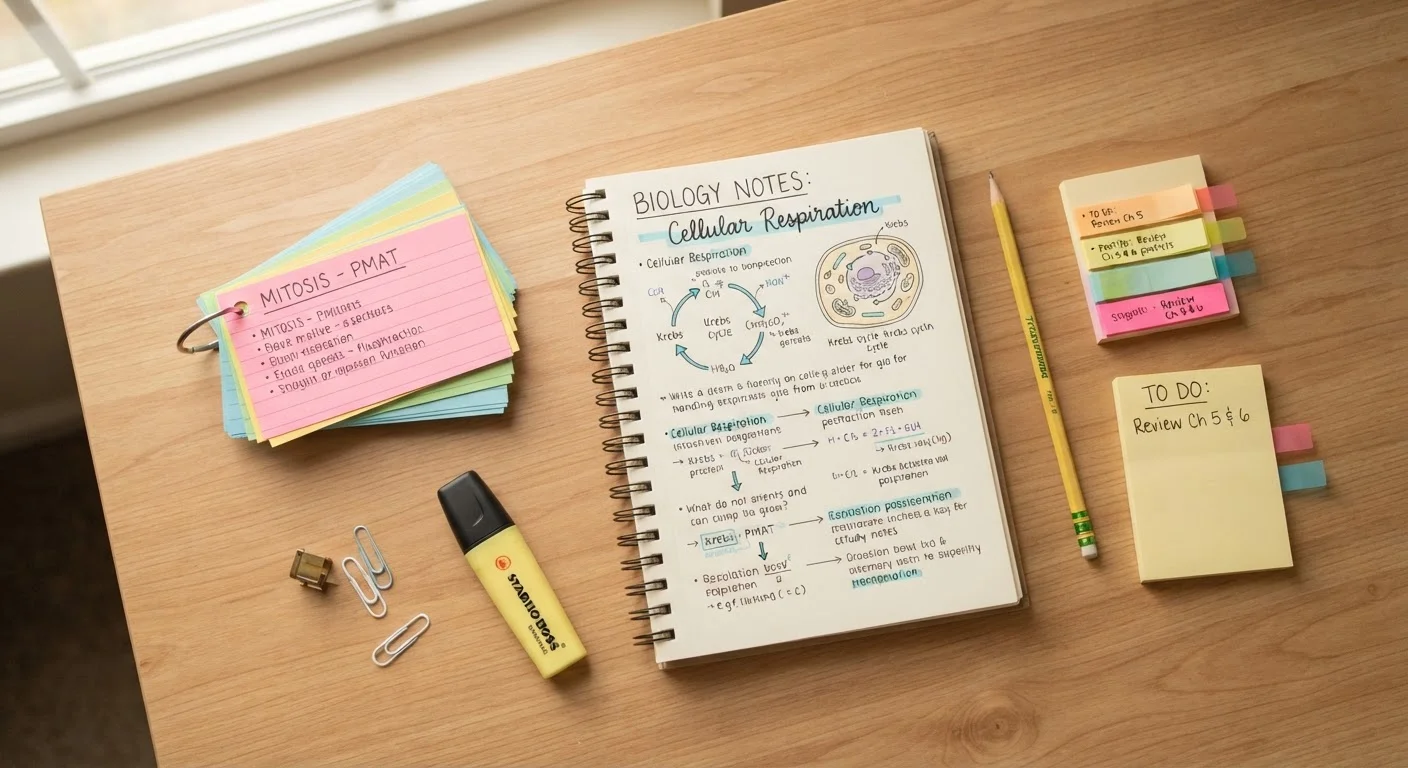
Why Study Technique Vocabulary Matters for Parents
When a teacher mentions that your child should try spaced practice instead of cramming, or a school counselor recommends retrieval practice, it helps to know exactly what those terms mean - and why they work. This reference guide explains the most widely researched and commonly used study methods in plain language, so you can guide your child toward the ones that fit each situation.
These techniques are drawn from cognitive science research on how memory and learning work. None of them require expensive materials or formal training to apply at home. For a look at free digital tools that pair well with these methods, see free learning platforms by age group.
Active Recall
A technique where the learner deliberately retrieves information from memory without looking at notes or a textbook. Instead of re-reading a chapter, a student closes the book and tries to recite key facts aloud or write them down. Research consistently shows this strengthens long-term retention more than passive review.
Spaced Practice
Spreading study sessions over time rather than massing them into one sitting. For example, reviewing spelling words for 15 minutes on Monday, Wednesday, and Friday is more effective than one 45-minute session the night before a test. The gaps between sessions force the brain to reconstruct memories, making them more durable.
Interleaving
Mixing different topics or problem types within a single study session rather than blocking all practice of one type together. A student might alternate between algebra, geometry, and word problems rather than completing all algebra problems first. Interleaving improves the ability to distinguish between concepts and choose the right approach.
Elaborative Interrogation
Asking 'why' and 'how' questions about material to connect new information to existing knowledge. For instance, rather than simply memorizing that warm air rises, a student asks why it does and explains it in their own words. This deepens understanding and makes facts easier to recall in new contexts.
The Feynman Technique
A method where a learner explains a concept as simply as possible - as if teaching it to someone with no background on the topic. Gaps or hesitations in the explanation reveal exactly where understanding is incomplete. Named after physicist Richard Feynman, it is particularly useful for complex science and math concepts.
Mind Mapping
A visual note-taking approach where a central idea is placed in the middle of a page and related concepts branch outward. The branching structure mirrors the way memory works through associations. Mind maps are especially useful for subjects with many interconnected ideas, such as history or biology.
The Pomodoro Technique
A time-management method that divides study time into focused intervals - traditionally 25 minutes - followed by a short break of around 5 minutes. After four intervals, a longer break is taken. It helps children maintain concentration and prevents burnout during longer homework sessions.
Distributed Practice
A broader term that encompasses spaced practice - planning study across multiple shorter sessions over days or weeks rather than cramming. A study schedule built around distributed practice gives the brain repeated opportunities to consolidate information into long-term memory.
Self-Explanation
The habit of narrating one's own thinking aloud or in writing while working through a problem. Rather than simply copying a solution, the student explains each step and why it makes sense. Research in educational psychology suggests this catches misunderstandings early and reinforces procedural knowledge.
Retrieval Practice
A category of techniques - including flashcards, practice tests, and quizzing - that require the learner to produce an answer from memory. It is closely related to active recall. Low-stakes self-testing at home (such as a parent asking quiz questions) is one of the most accessible and effective forms.
Dual Coding
Combining verbal information with visual representations - such as pairing written notes with diagrams, timelines, or charts. When the brain encodes information in two formats simultaneously, recall becomes more reliable. Drawing a diagram while taking notes on a science lesson is a simple example.
Concrete Examples
Grounding abstract concepts in specific, relatable scenarios to make them easier to grasp and remember. A child learning fractions, for example, benefits from cutting an apple into equal parts rather than working only with symbolic notation. This technique bridges abstract thinking and real-world application.
Core Study Techniques at a Glance
Use the quick-reference card below to orient yourself, then read the fuller definitions in the glossary above for context on when each method applies best.
| Best for memorization | Active recall, retrieval practice, spaced practice |
| Best for deep understanding | Elaborative interrogation, Feynman Technique, self-explanation |
| Best for visual learners | Mind mapping, dual coding, concrete examples |
| Best for focus and time management | Pomodoro Technique, distributed practice |
| Works well for mixed subjects | Interleaving |
| Requires no materials | Active recall, Feynman Technique, self-explanation |
Matching the right technique to the right task makes a measurable difference. Memorizing vocabulary for a spelling test calls for a different approach than preparing for a science exam that requires understanding concepts. For a deeper look at how to apply these methods in specific subjects, see subject-specific study strategies for school-age children.
You'll also want to consider when your child studies, not just how. Short sessions and longer blocks serve different purposes depending on age and subject matter - the article short study sessions vs. long study blocks breaks this down clearly.
Once you're comfortable with these foundational techniques, a natural next step is comparing specific study tools. Flashcards vs. mind maps explores how two popular formats serve different types of learners - a helpful read before your child's next big exam. For subject-specific homework help, the Subject-by-Subject Help hub offers targeted guidance across core school subjects.
The content provided on our blog site traverses numerous categories, offering readers valuable and practical information. Readers can use the editorial team’s research and data to gain more insights into their topics of interest. However, they are requested not to treat the articles as conclusive. The website team cannot be held responsible for differences in data or inaccuracies found across other platforms. Please also note that the site might also miss out on various schemes and offers available that the readers may find more beneficial than the ones we cover.