

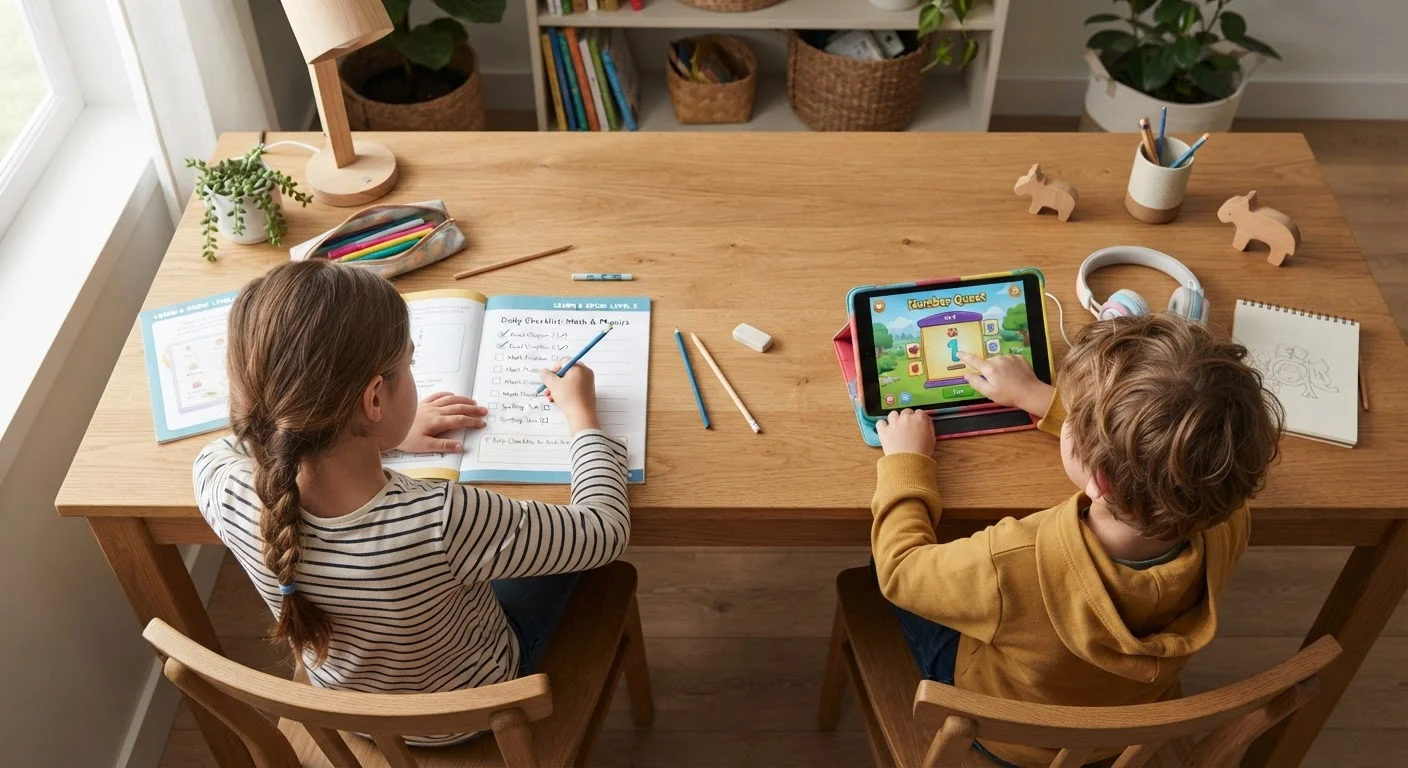
Option A
Structured Learning Tools
The guided, sequential approach to building skills step by step.
Best for: Children who need clear goals, consistent feedback, and a defined progression path to stay on track.
Option B
Self-Paced Free Learning Tools
The flexible, curiosity-driven approach that puts the learner in control.
Best for: Children who are self-motivated, have specific interests to explore, or need freedom to move at their own speed.
What Makes a Learning Tool 'Structured'?
Structured learning tools are designed around a defined sequence of skills or concepts. They typically present one lesson before unlocking the next, include mastery checks or quizzes, and give learners - and parents - a visible sense of where they stand. Think of platforms that organize content by grade level, subject strand, or skill ladder.
The core benefit is predictability. A child knows what comes next, and a parent can see whether their child completed this week's lessons. For subjects where skill-building is cumulative - like math or phonics - that sequential structure matters. Skipping ahead can leave gaps; a well-designed structured tool prevents that from happening by design.
Structured tools also tend to include accountability features: streaks, completion badges, parent dashboards, or email summaries. These features aren't just motivational gimmicks - research in educational psychology consistently links goal visibility with sustained effort, particularly in younger learners. See our overview of free digital learning tools for a broader look at how these platforms work and what to evaluate before handing one to your child.
| Criterion | Structured Learning Tools | Self-Paced Free Learning Tools |
|---|---|---|
| Lesson order | Fixed, sequential progression | Learner chooses what to explore |
| Progress tracking | Built-in dashboards and mastery checks | Limited or self-monitored |
| Best subject fit | Cumulative skills (math, phonics, grammar) | Enrichment, interest-driven topics |
| Parental oversight needed | Low - tool guides the child | Moderate - check-ins recommended |
| Motivation style served | External milestones and feedback | Intrinsic curiosity and autonomy |
| Age suitability | Works well K-12 | Most effective for older children |
| Free access | Often available with limitations | Frequently fully free |
What Makes a Learning Tool 'Self-Paced'?
Self-paced tools hand control to the learner. There's no required order, no lock-step progression, and often no ceiling on how far a child can go in a single session. A curious eight-year-old can spend an afternoon going deep on volcanoes; a reluctant math student can revisit fractions at their own speed without the pressure of a timer or a class moving on without them.
These tools work especially well for enrichment - topics beyond what school covers - and for children who already have some internal drive. They're also valuable when a child's interest outpaces their grade level in a specific subject. A self-paced tool won't hold them back.
The trade-off is accountability. Without structure, it's easy for screen time to drift toward passive content rather than active learning. Parents play an important role in periodic check-ins, not to micromanage but to ask open questions: What did you figure out today? What was confusing? That kind of light-touch involvement keeps self-paced sessions purposeful. For tips on building that kind of consistent habit, our article on habits that make free learning resources work is a practical next step.
70%
Students preferring some control over learning pace
A survey by the Gates Foundation found roughly 70% of students reported wanting more control over when and how fast they learn.
K-3
Age range most benefiting from guided structure
Educational development research broadly supports that children in early elementary grades rely on external scaffolding before self-regulation matures.
2x
Engagement boost with learner-chosen topics
Studies on intrinsic motivation in educational settings suggest interest-driven choice can significantly increase time-on-task compared to assigned topics.
How to Choose - or Combine - Both Approaches
The most effective home learning setups rarely rely on just one format. A useful starting framework: use structured tools for core academic skills that must be built sequentially, and self-paced tools for exploration, enrichment, and subjects driven by a child's personal curiosity.
Consider your child's current motivation level too. A child who is disengaged from a subject may need the small wins built into a structured path to rebuild confidence. A child who loves learning independently may feel constrained by rigid sequencing and thrive better when trusted with more autonomy.
Age matters as well. Younger children (roughly K-3) typically benefit more from structured guidance because they're still developing the self-regulation skills that self-directed learning requires. Older children - especially middle schoolers - are better positioned to manage self-paced tools, particularly if you're working on the longer-term goal of raising a genuinely self-directed learner.
For families ready to put this into practice, setting up a free home learning routine walks through how to build a consistent daily schedule using tools from both categories - without spending a dollar.
This article is for general informational and educational purposes. Results will vary by child, subject, and consistency of use. No specific outcomes are guaranteed.
The content provided on our blog site traverses numerous categories, offering readers valuable and practical information. Readers can use the editorial team’s research and data to gain more insights into their topics of interest. However, they are requested not to treat the articles as conclusive. The website team cannot be held responsible for differences in data or inaccuracies found across other platforms. Please also note that the site might also miss out on various schemes and offers available that the readers may find more beneficial than the ones we cover.