

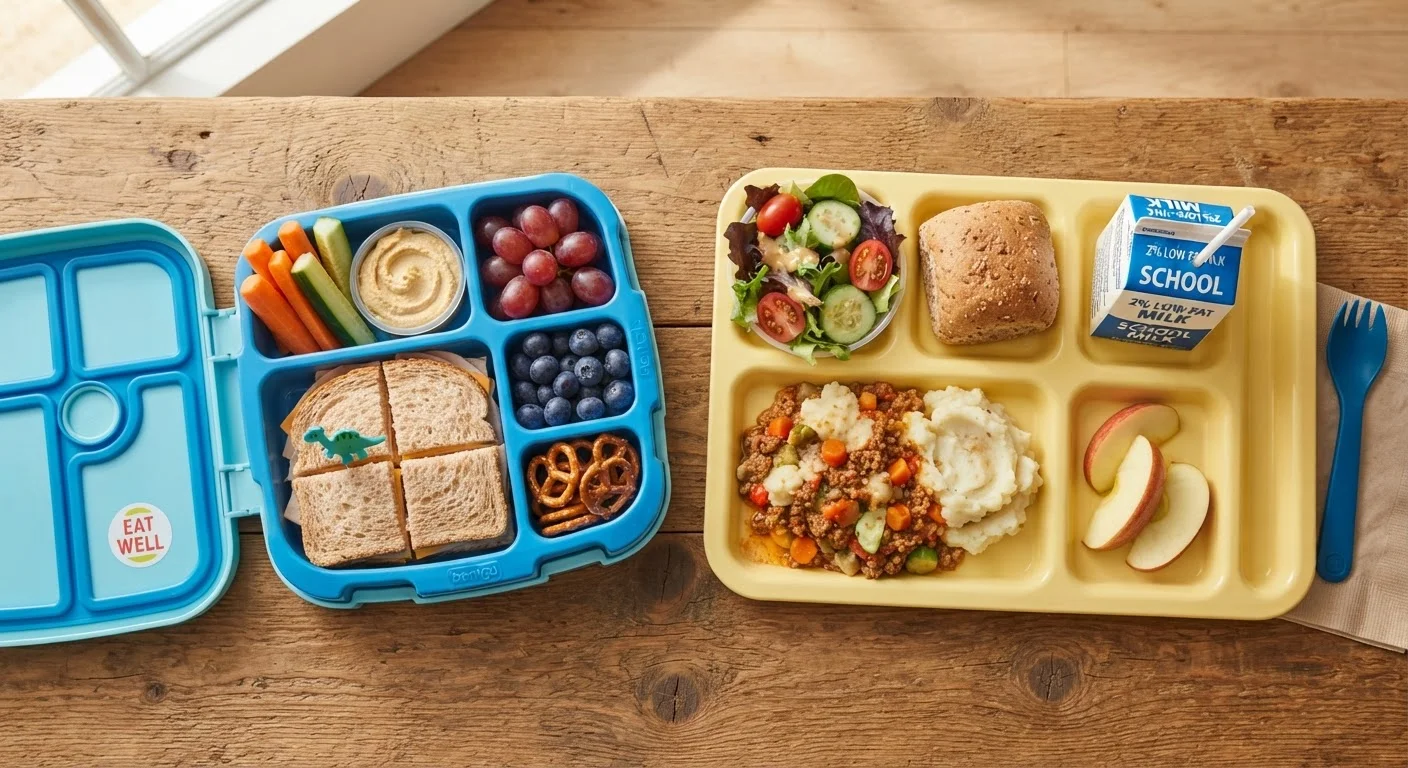
Option A
Packed Lunch
The parent-controlled, customizable option.
Best for: Families who want direct oversight of ingredients, portions, and food preferences.
Option B
School Cafeteria
The federally regulated, hot-meal alternative.
Best for: Families who need a reliable, affordable, nutritionally standardized meal with no daily preparation burden.
What the Research Actually Shows
The intuition that a home-packed lunch is always the healthier choice turns out to be more complicated than it looks. Studies - including a widely cited analysis published in JAMA Pediatrics - have found that many packed lunches contain higher levels of sodium, added sugars, and saturated fat than school cafeteria meals, while often falling short on fruits, vegetables, and whole grains.
That's not because parents are making poor decisions. It often comes down to what kids will actually eat, what's quick to prepare, and what's affordable - the same constraints that shape all family food decisions. Understanding what each option genuinely offers helps parents make a more informed call.
For a broader look at how families can eat well under real-world pressure, the Family Nutrition hub covers practical, budget-friendly strategies across all meals.
| Criterion | Packed Lunch | School Cafeteria |
|---|---|---|
| Nutritional standards | Varies by parent's choices | Must meet USDA NSLP requirements |
| Customization | Fully customizable | Fixed rotating menu |
| Allergen control | Parent-controlled | Managed by school - verify directly |
| Daily cost | Varies; can be comparable or higher | Free to reduced-price for eligible families |
| Preparation burden | Daily parent effort required | No daily prep needed |
| Fruit/vegetable inclusion | Often lower in practice | Federally required at each meal |
| Sodium and added sugar | Can be high without planning | Capped by federal standards |
| Likelihood child eats it | Often higher (familiar foods) | Variable; some waste documented |
The Case for School Cafeteria Meals
School meals served through the USDA's National School Lunch Program (NSLP) must meet federal nutrition standards - including minimum servings of fruits, vegetables, whole grains, and lean protein, along with caps on sodium and saturated fat. These requirements were significantly strengthened following the Healthy, Hunger-Free Kids Act.
For families who qualify for free or reduced-price meals, the cafeteria option removes both the financial and logistical burden of daily lunch preparation. This matters: food insecurity affects millions of US children, and the NSLP serves as a meaningful nutritional safety net for many of them.
Cafeteria meals also tend to include a hot component, which research suggests supports satiety better than many room-temperature packed options. The social experience of eating with peers in a shared space has developmental value too, though it's rarely cited as a nutritional factor.
The Case for Packing Lunch at Home
Where packed lunches genuinely shine is in customization. Parents who know their child's preferences, allergies, or sensitivities can tailor every component - and that level of control is simply not possible with a shared cafeteria menu. For children managing celiac disease, tree nut allergies, or other medically significant dietary needs, a packed lunch is often the safer, more practical route. Always consult your child's healthcare provider and the school's nutrition staff about managing food allergies in a school setting.
Packed lunches also sidestep one real limitation of the cafeteria: food waste. Research from the Harvard T.H. Chan School of Public Health has documented that a significant portion of fruits and vegetables served in school cafeterias go uneaten. A child who reliably finishes a packed lunch - even if it's less nutritionally perfect on paper - may actually be getting better overall intake.
The quality of a packed lunch is, of course, highly variable. Including a lean protein, a whole-grain element, a fruit or vegetable, and a calcium source gives a practical framework for building a nutritionally solid box. For ideas on keeping ingredients accessible without overspending, building a well-stocked pantry makes daily prep far easier. And don't overlook frozen and canned produce - they're nutritionally sound and budget-friendly additions to any lunchbox.
Practical Considerations for Busy Families
The most nutritious lunch is the one that consistently gets made, packed, and eaten - so practical sustainability matters as much as any nutritional metric. Families juggling early school starts, work schedules, and multiple children know that a complicated packed lunch plan quickly collapses.
A realistic hybrid approach works well for many: use the cafeteria on most days, and pack on days when the menu doesn't suit your child or when you have ingredients already prepped. Batch-prepping components over the weekend - portioned fruit, cut vegetables, pre-cooked grains - dramatically reduces morning friction.
It's also worth noting that ultra-processed packaged snacks, while convenient, can tip a packed lunch's nutritional profile in the wrong direction without parents realizing it. The hidden nutritional costs of ultra-processed foods are worth understanding before those items become lunchbox staples. And for parents whose own meals get neglected while managing everyone else's, eating well on autopilot offers strategies that don't demand extra effort.
Free and Reduced-Price Meal Eligibility
The USDA's National School Lunch Program provides free or reduced-price meals to children from income-eligible households. Eligibility is determined by family size and income level relative to federal poverty guidelines. If you're unsure whether your child qualifies, contact your school district's nutrition services office - enrollment is confidential and straightforward in most districts.
This article is for general informational purposes only and is not a substitute for advice from a registered dietitian or qualified healthcare professional. Families managing children's specific health or dietary needs should consult appropriate professionals.
The content provided on our blog site traverses numerous categories, offering readers valuable and practical information. Readers can use the editorial team’s research and data to gain more insights into their topics of interest. However, they are requested not to treat the articles as conclusive. The website team cannot be held responsible for differences in data or inaccuracies found across other platforms. Please also note that the site might also miss out on various schemes and offers available that the readers may find more beneficial than the ones we cover.