

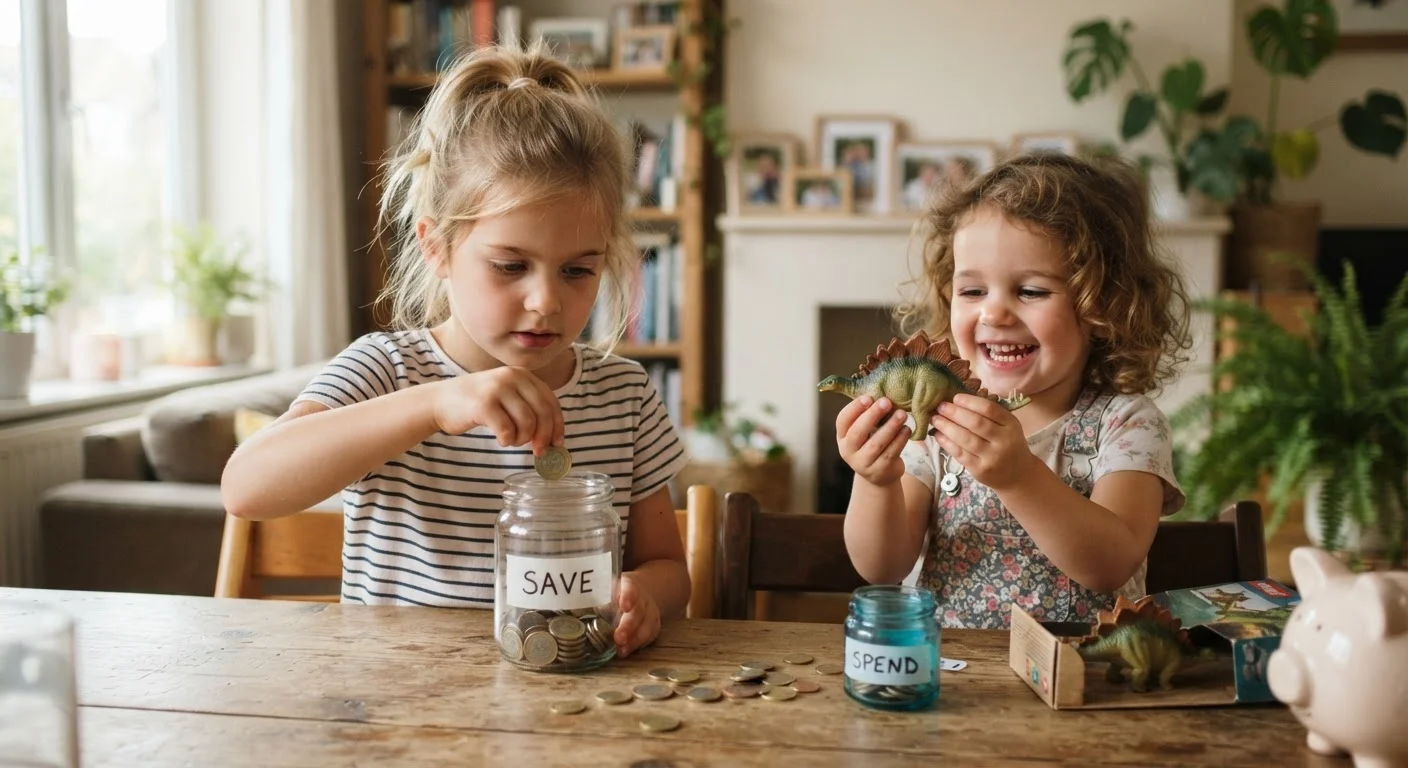
Why Money Personalities Show Up So Early
Hand a five-dollar bill to two siblings and you might see two completely different reactions within seconds. One child runs to the store. The other puts the money in a drawer and checks on it a week later. These patterns aren't random - they reflect real differences in how children relate to money, delayed gratification, and risk.
Temperament plays a role. Children who tend toward caution in other areas of life - new foods, new situations - often carry that caution into money decisions. More impulsive, novelty-seeking kids frequently become enthusiastic spenders. Neither trait is a flaw. Both are normal parts of child development.
Environment matters just as much. Kids absorb how their parents talk about money, argue about it, or avoid it entirely. If spending is used as a reward or comfort in your household, children notice. If saving is framed as deprivation rather than a choice, they notice that too. Child development research shows that concrete, visible money interactions teach more than abstract conversations at most ages.
Age 7
When basic money habits begin forming
Research from the University of Cambridge has suggested that many financial habits and attitudes are already taking shape by around age 7, underscoring the value of early, consistent guidance.
~1 in 3
Children who receive no financial education at home
Surveys conducted by various financial literacy organizations have consistently found that a significant share of U.S. children grow up without regular money conversations at home.
3 jars
Classic spend-save-give division used by educators
The three-jar method (spend, save, give) is a widely recommended framework among financial educators for making money allocation concrete and habit-forming for school-age children.
The Natural Saver: Strengths and What They Still Need to Learn
Natural savers are every parent's envy - until you realize that hoarding money without purpose isn't the same as being financially healthy. Kids who strongly prefer saving can struggle to enjoy money at all, feel anxious about spending even on things they genuinely want, and may resist giving or sharing.
Strengths to build on: patience, goal-setting, and comfort with delayed gratification. These are genuinely valuable skills. Reinforce them by helping your child name a specific goal - a toy, a game, a contribution to a family outing - so saving feels purposeful rather than reflexive.
What they still need: practice spending intentionally. A saver child benefits from being given permission and encouragement to use some of their money on something they enjoy. Framing it as a choice rather than a loss helps. You might say, "You earned this - it's okay to use part of it on something that makes you happy."
Also make sure saver kids learn to give. Introducing charitable giving alongside saving and spending helps build a balanced, values-driven relationship with money rather than a fearful one.
The Natural Spender: Strengths and What They Still Need to Learn
Spender children get a bad reputation, but their instinct to use money - to enjoy it, share it, or invest it in experiences - isn't a character flaw. Generosity, enthusiasm, and a willingness to take action are traits that serve people well in adult financial life, too. The problem comes when spending is impulsive and unexamined.
Strengths to build on: generosity, social connection through money, and motivation. Spender kids are often highly motivated by a purchase goal, which makes them surprisingly good at earning and saving - once the goal is concrete enough.
What they still need: structure and a pause before spending. The envelope or jar method works well here: divide money physically at the moment it arrives. If a third goes into a save jar before it can be spent, the decision is already made. Teaching impulse control is a process, not a one-time conversation.
It also helps to teach spender kids the difference between categories of wants. A needs, wants, and wishes framework gives children a mental pause button before they ask to buy something.
How to Work With - Not Against - Your Child's Tendency
The most effective money lessons meet children where they are. Lecturing a spender about frugality rarely works. Pressuring a saver to loosen up breeds anxiety. Instead, use your child's natural lean as a starting point and build from there.
A few principles that apply to both personality types:
- Make money tangible. Abstract conversations about saving rarely stick for younger children. Physical jars, envelopes, or even a simple savings method that they can see and touch works better than telling them to "be responsible."
- Use structure, not willpower. Divide money into spend, save, and give portions automatically when it arrives - don't rely on the child to make that split in the moment every time.
- Involve kids in real decisions. Age-appropriate conversations about the family budget build financial awareness without transferring adult stress to children.
- Model what you want to teach. Your own relationship with money is the loudest lesson in the house. Name your decisions out loud: "I'm going to wait a week before buying this because I want to be sure it's worth it."
Neither a saver nor a spender personality predicts adult financial success on its own. What predicts success is developing a full toolkit: the ability to earn, save, spend thoughtfully, and give. Your job as a parent is to fill in whichever pieces your child's natural personality leaves out - without making them feel broken for who they are.
This article is for general informational and educational purposes only and does not constitute personalized financial advice. For guidance specific to your family's situation, consider consulting a qualified financial professional.
Frequently Asked Questions
No. Tendencies that emerge in childhood are real, but they're not fixed. Consistent, low-pressure guidance from parents can shape habits significantly through the teenage years. The goal is to build skills, not change who your child is.
Watch what happens when they receive money - birthday cash, allowance, or a small gift. Do they immediately ask where to spend it, or do they tuck it away and forget about it? Patterns that repeat across situations are a strong signal of their natural lean.
Pressure and shame rarely work and can backfire by creating negative associations with money. Instead, build structure into how money arrives - for example, dividing allowance into spend, save, and give portions automatically. Small wins build the habit over time.
Extreme reluctance to spend can signal anxiety rather than healthy saving. Keep the conversation positive and help your child practice spending intentionally on things they genuinely value. Money is a tool, and learning to use it confidently is part of financial health.
Simple concepts like choosing between two items or setting a small goal can start as young as age 4 or 5. The conversations should grow in complexity as your child's understanding develops. See our <a href="/family-finance/kids-and-money/getting-started-with-teaching-kids-about-money">beginner's guide to teaching kids about money</a> for a starting framework.
Research on this is mixed and inconclusive. Temperament and household environment appear to be far stronger predictors of financial behavior than birth order or gender. Avoid assuming tendencies based on these factors.
The content provided on our blog site traverses numerous categories, offering readers valuable and practical information. Readers can use the editorial team’s research and data to gain more insights into their topics of interest. However, they are requested not to treat the articles as conclusive. The website team cannot be held responsible for differences in data or inaccuracies found across other platforms. Please also note that the site might also miss out on various schemes and offers available that the readers may find more beneficial than the ones we cover.