

Our Verdict
All three approaches - reading aloud, silent reading, and audiobooks - contribute distinct and complementary skills to a child's reading comprehension toolkit. None is a complete substitute for the others, and the most effective home reading routine draws on each method intentionally depending on the child's needs and the text at hand.
| Best for | Recommended |
|---|---|
| Early or emergent readers building fluency and decoding confidence | Reading Aloud |
| Developing readers who need to build independent processing and focus | Silent Reading |
| Children with learning differences, or those accessing above-grade-level stories | Audiobooks |
| Families who want a well-rounded comprehension routine at home | A Rotation of All Three Methods |
Why the Method of Reading Matters
When we talk about reading comprehension, we usually focus on what children read. But how they encounter text matters just as much. Reading aloud, reading silently, and listening to audiobooks each activate the brain differently - and each builds a distinct set of comprehension skills.
Parents don't need a teaching degree to use this information strategically. Understanding what each method does best makes it easier to choose the right approach for the right moment. For a deeper look at why children sometimes struggle with comprehension regardless of method, see why kids struggle with reading comprehension and what you can do about it.
Reading Aloud: Building Fluency and Shared Understanding
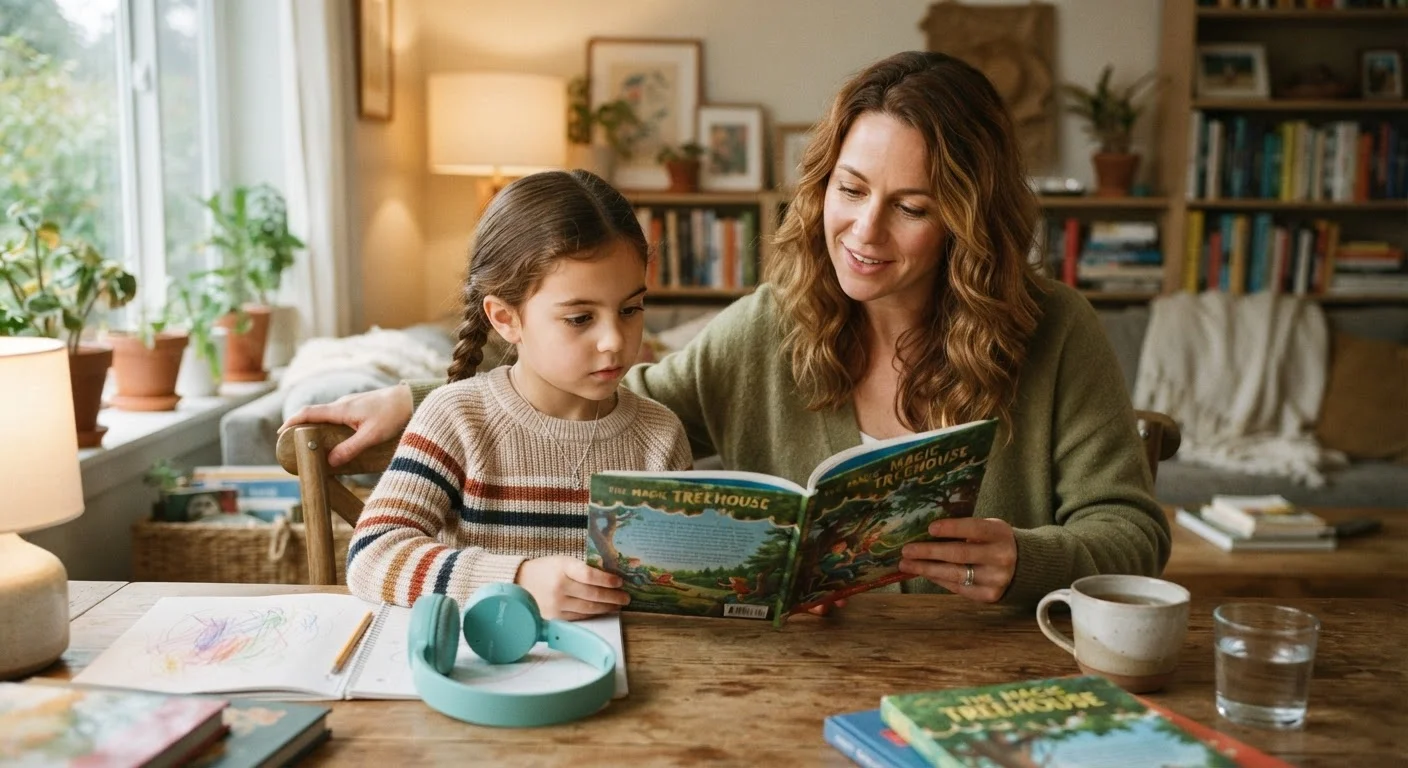
Reading aloud - whether a parent reads to a child, a child reads to a parent, or they take turns - is one of the most powerful comprehension tools available at home. Here's what it specifically develops:
- Fluency and expression: Hearing how a skilled reader uses pacing, tone, and emphasis teaches children how meaning is carried beyond the words themselves.
- Decoding confidence: When children read aloud, they get immediate feedback on pronunciation and phrasing, helping them catch errors in real time.
- Shared comprehension: Reading aloud naturally invites conversation - pausing to ask "what do you think happens next?" or "why did the character do that?" turns reading into active, collaborative thinking.
- Access to complex texts: A parent reading aloud from a slightly above-grade-level book exposes children to richer vocabulary and sentence structures than they could independently decode.
Reading aloud is especially valuable for early readers and is a strong starting point if you're also exploring phonics versus whole language approaches to foundational reading instruction.
| Reading Aloud | Silent Reading | Audiobooks | |
|---|---|---|---|
| Primary comprehension skill built | Fluency and shared meaning-making | Independent processing and self-monitoring | Listening comprehension and vocabulary |
| Decoding skill development | High - immediate feedback on errors | Moderate - errors go unnoticed sometimes | None - decoding not required |
| Vocabulary growth | High with discussion | Moderate through context | High through narration and context |
| Best age or stage | Early and emergent readers | Developing and independent readers | All ages; especially useful for struggling readers |
| Parental involvement needed | Active participation required | Light monitoring recommended | Minimal, but discussion helps |
| Accessibility for learning differences | Supportive with adult guidance | Can be challenging for dyslexia | Highly accessible |
| Reading stamina building | Moderate | High | Moderate |
Silent Reading: Developing Independent Processing
Once children have a working grasp of decoding, silent reading becomes a crucial next step. It trains a different - and equally important - set of comprehension skills:
- Reading speed and stamina: Without the physical constraint of speaking, children can read faster and sustain focus for longer periods.
- Internal visualization: Silent reading gives children mental space to build their own images, predictions, and emotional responses to a story.
- Self-monitoring: Skilled silent readers learn to notice when something doesn't make sense and re-read - a metacognitive habit that research links to stronger comprehension over time.
- Personal engagement: When children choose their own books for silent reading, motivation tends to rise, and motivated readers generally comprehend more.
The challenge with silent reading is that it's harder to observe. A child who looks like they're reading may be skimming without processing. Periodic, low-pressure check-ins - asking them to summarize a page or predict what's coming - can keep comprehension active without making reading feel like a test. This connects directly to the principles explored in active recall vs. passive re-reading.
Audiobooks: Listening Comprehension and Accessibility
Audiobooks are sometimes dismissed as "not really reading," but that view doesn't hold up to scrutiny. Listening to a well-narrated book develops distinct and valuable comprehension skills:
- Listening comprehension: Following a spoken narrative requires sustained attention and the ability to hold earlier details in mind - skills that transfer directly to reading comprehension.
- Vocabulary in context: Hearing unfamiliar words used naturally by a fluent narrator helps children absorb meaning more readily than encountering the same word on a page.
- Access for struggling readers: Children with dyslexia or other learning differences can engage with grade-appropriate stories through audio without being blocked by decoding difficulties. Free resources for children with learning differences can help families find no-cost audiobook options.
- Prosody and narrative structure: Professional narrators model how a story breathes - building tension, shifting tone, marking dialogue - which deepens structural understanding.
The main limitation is that audiobooks don't build decoding skills. A child who only ever listens may struggle when asked to read independently. For a wider set of audio and literacy tools, see free literacy resources for early readers.
Try the "Audio-Then-Print" Pairing
If your child is reluctant to read a particular book independently, try letting them listen to the first chapter as an audiobook first. Familiarity with the story reduces the cognitive load of decoding, which often makes children more willing to pick up the print version on their own. This approach is especially useful for longer chapter books that feel intimidating at first glance.
How to Combine All Three at Home
The most effective home reading routine treats these methods as a team rather than competitors. A practical framework many educators suggest:
- Read aloud daily with younger children (or any child working below grade-level fluency) to model expression and discuss meaning together.
- Build in daily silent reading time with books the child has chosen, targeting a comfortable but slightly challenging level.
- Use audiobooks strategically - during car rides, for books above the child's independent level, or as a bridge for a child who resists reading.
Rotating methods keeps reading from feeling like a chore, and each session reinforces the others. A child who hears a story in audio may be inspired to read the print version independently; a child who reads aloud with a parent gains the fluency that makes silent reading more rewarding.
The goal isn't to pick a winner - it's to give your child a fuller relationship with text, one method at a time.
The content provided on our blog site traverses numerous categories, offering readers valuable and practical information. Readers can use the editorial team’s research and data to gain more insights into their topics of interest. However, they are requested not to treat the articles as conclusive. The website team cannot be held responsible for differences in data or inaccuracies found across other platforms. Please also note that the site might also miss out on various schemes and offers available that the readers may find more beneficial than the ones we cover.