

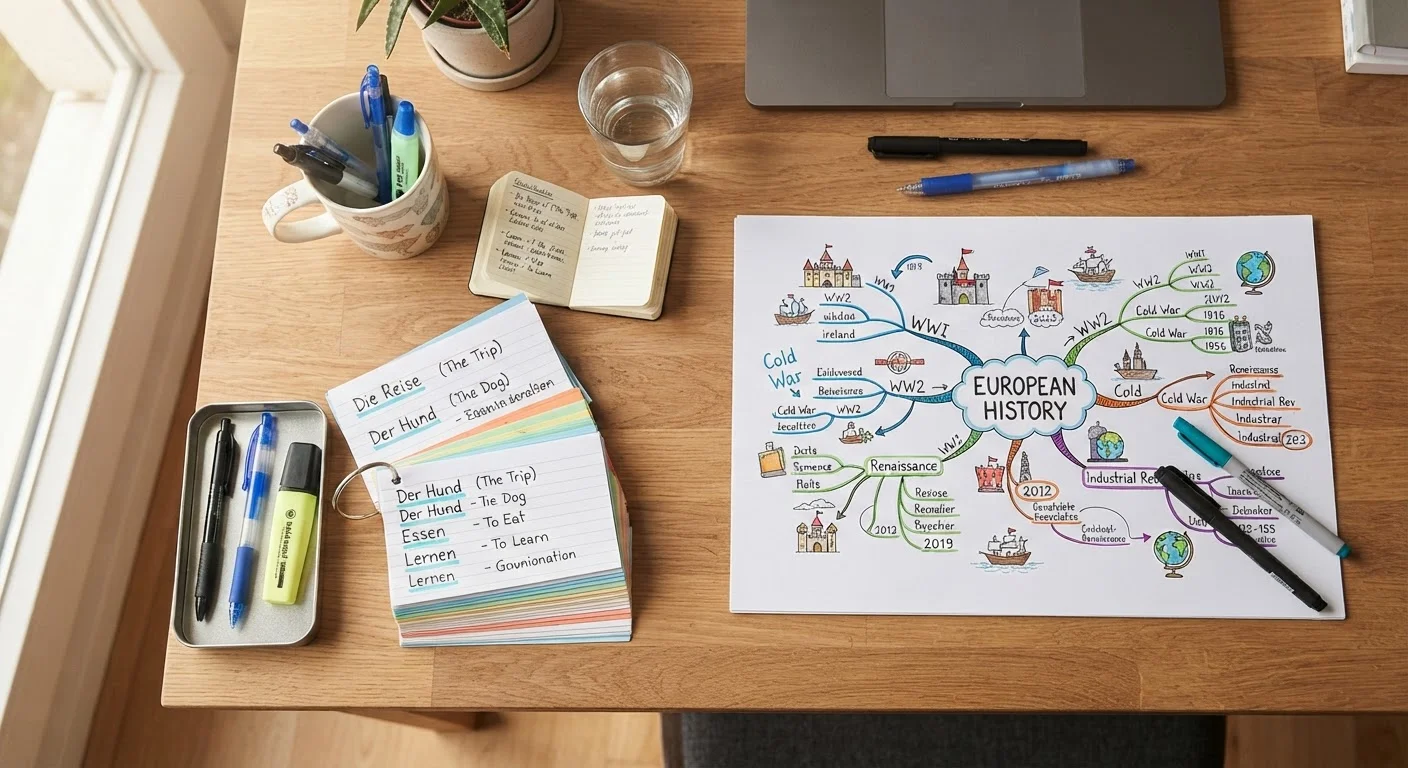
Option A
Flashcards
The focused, repetition-driven recall tool.
Best for: Children who need to memorize discrete facts, vocabulary, formulas, or definitions quickly and efficiently.
Option B
Mind Maps
The visual, connection-making thinking tool.
Best for: Children who learn by seeing how ideas relate to one another, especially in concept-heavy or essay-based subjects.
How Each Tool Actually Works
Understanding what each method does - not just what it looks like - helps parents steer their children toward the right fit at the right time.
Flashcards work through active recall: a child reads a prompt on one side (a word, a question, or a formula) and retrieves the answer from memory before flipping the card. When paired with spaced repetition - revisiting cards at increasing intervals - this process steadily moves information into long-term memory. The method is deliberately narrow by design: one fact, one response, no surrounding noise.
Mind maps work differently. A central idea is placed at the page's center, and related concepts branch outward like a tree. The act of drawing those branches forces a child to decide how ideas connect, which deepens comprehension rather than just reinforcing recall. Because the finished map is visual and spatial, many children find it easier to mentally "navigate" when writing or speaking about a topic later.
Neither tool is universally superior. Their value comes from matching them to the right task - and sometimes to the right child. See our subject-specific study strategies guide for a broader look at tailoring methods to core school subjects.
Which Subjects Suit Each Method
Subject type is often the clearest deciding factor - more reliable, in fact, than any generalized claim about a child's learning style.
| Criterion | Flashcards | Mind Maps |
|---|---|---|
| Primary skill built | Memory recall | Concept comprehension |
| Best content type | Isolated facts, terms, formulas | Connected ideas, themes, processes |
| Format | Question-and-answer pairs | Branching visual diagram |
| Session style | Short, frequent repetition | Longer, exploratory creation |
| Top subjects | Languages, math, science terms | History, literature, science concepts |
| Materials needed | Index cards or a flashcard app | Plain paper or diagramming tool |
| Works well for | Sequential, detail-oriented learners | Visual, big-picture thinkers |
Flashcards shine in:
- Foreign language vocabulary - pairing a word with its translation is a textbook flashcard use case.
- Math facts - multiplication tables, fraction equivalents, and unit conversions all respond well to rapid-fire repetition.
- Science definitions - terms like photosynthesis or mitosis can be isolated and drilled effectively.
Mind maps excel in:
- History and social studies - mapping causes, events, and consequences of a historical period makes relationships visible.
- Reading comprehension and literature - character relationships, themes, and plot arcs translate naturally into branching diagrams.
- Science concepts - when the goal is understanding how a system works (e.g., the water cycle or food webs), a map outperforms a stack of cards.
For math-focused families, our guide to matching math approaches to your child's thinking style offers complementary strategies worth combining with flashcard practice.
Reading Your Child's Signals
Children often vote with their behavior. A child who lines up cards methodically and feels satisfaction checking off mastered ones is likely responding well to flashcard structure. A child who doodles during notes or narrates connections aloud - "this is like that because..." - is showing you that visual-relational thinking comes naturally to them.
That said, learning-style labels can be overstated. Research on the topic suggests that matching instruction rigidly to a self-identified style does not reliably improve outcomes. A more practical approach: observe which tool helps your child feel less anxious and more confident about a subject, and start there. Introduce the other tool when the task demands it.
Pair either method with an appropriate session length for your child's age. Our breakdown of short vs. long study sessions explains why younger children benefit from 10-15 minute card drills while older students can sustain a longer mind-mapping exercise.
Practical Tips for Getting Started
Both tools are low-cost and accessible. Index cards, pencils, and plain paper are all a family needs to begin. Digital versions - free apps that support flashcard decks or digital mind-mapping - are widely available if a child prefers a screen. For a side-by-side look at print versus digital formats, see Printable vs. App-Based Learning Resources.
When to Use Both in the Same Study Session
Flashcards and mind maps are not mutually exclusive. For any subject with both conceptual depth and specific terminology - such as biology or history - consider starting with a mind map to establish the framework, then building a flashcard set from the specific terms that appear on the map. This sequence mirrors how memory researchers describe effective studying: understand first, then memorize within that understanding.
Using both tools together is often the smartest approach. A child studying a science chapter might start with a mind map to understand the big picture, then create flashcards for the specific terms and definitions on that map. This two-pass strategy builds both comprehension and recall - the combination most exams actually test.
Encourage your child to make the tools their own: color-coding flashcard categories, adding small drawings to mind map branches, or writing questions in their own words. Personalization increases engagement and, with it, retention. Explore the Free Learning Tools hub for resources that support both approaches without added cost.
The content provided on our blog site traverses numerous categories, offering readers valuable and practical information. Readers can use the editorial team’s research and data to gain more insights into their topics of interest. However, they are requested not to treat the articles as conclusive. The website team cannot be held responsible for differences in data or inaccuracies found across other platforms. Please also note that the site might also miss out on various schemes and offers available that the readers may find more beneficial than the ones we cover.