

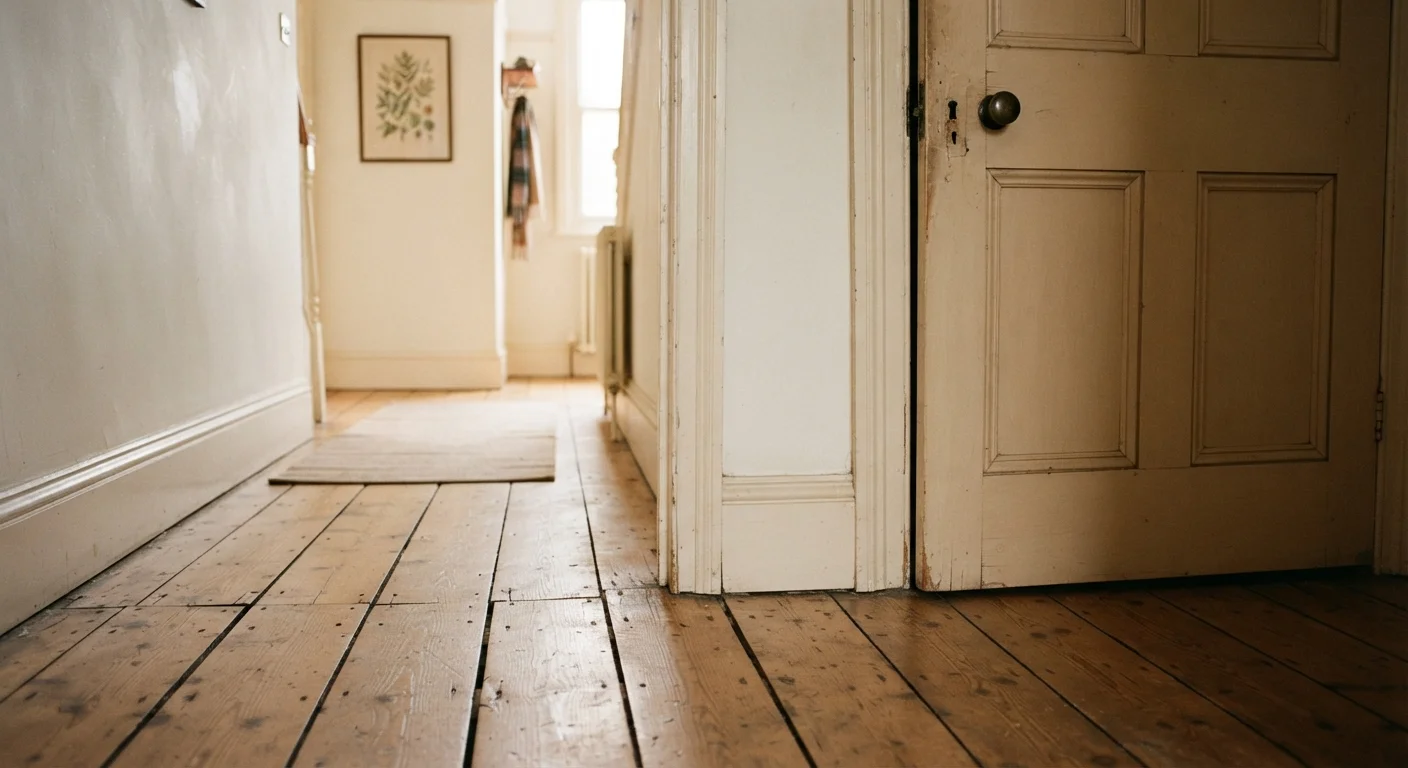
Why Your House Moves With the Seasons
Wood is a hygroscopic material, meaning it continuously exchanges moisture with the surrounding air. When indoor humidity climbs in spring and summer, wood fibers absorb that moisture and physically swell. When heat runs all winter and indoor air dries out, that same wood releases moisture and shrinks. Your house is doing this constantly - in the floors, door frames, window casings, and wall framing behind your drywall.
This movement is entirely normal and is factored into how homes are built. Framing lumber is deliberately spaced with small tolerances, and finish flooring is installed with expansion gaps. The problem arises when conditions push beyond what those tolerances can accommodate - or when original installation left no room for movement at all.
Seasonal Patterns Are Your Best Diagnostic Tool
Keep a simple note - even a phone memo - of when problems appear and when they ease. A squeak that shows up in December and disappears in April points squarely at winter dryness. One that appears in June and fades by September points at summer humidity. This pattern knowledge tells you exactly where to focus your fix.
Understanding the seasonal pattern of your specific symptoms is one of the most useful diagnostic tools you have. Problems that worsen in July and ease by October point clearly to humidity as the driver.
Diagnosing Squeaky Floors
Floor squeaks happen when two surfaces rub together under load - your foot pressing down on a board causes it to flex and slide against an adjacent board, a nail, or the subfloor beneath. There are a few common causes worth ruling out in order:
- Subfloor separation: Over time, the adhesive or fasteners between your finished flooring and the subfloor can loosen, leaving a gap that flexes when walked on.
- Nail movement: Cut nails and ring-shank nails used in older floors can work loose, causing the board to squeak as it rides up and down on the fastener.
- Board-to-board friction: Especially in solid hardwood floors, tightly packed boards that have swollen can rub at their edges.
Walk the floor methodically and mark squeaky spots with painter's tape. Note whether the squeak is worse after a humid stretch or a dry one - that tells you whether swelling or shrinkage is the root cause. Many squeaks can be addressed from below by a family member in the basement or crawlspace while another walks above, locating the exact flex point.
~1%
Dimensional change per 4% humidity shift in hardwood
Wood science research consistently shows that common hardwoods like oak can change roughly 1% in width for every 4-percentage-point change in equilibrium moisture content.
35-50%
Recommended indoor relative humidity range
Guidelines from building science and indoor air quality organizations generally suggest this range as optimal for minimizing wood movement and maintaining occupant comfort.
Diagnosing Sticky and Stiff Doors
A door that drags or won't latch properly is one of the most common seasonal complaints. Before reaching for a plane or sander, do a quick seasonal check: if the door sticks consistently only in humid months, wood swelling is almost certainly the cause. If it's stiff year-round or getting progressively worse, that's a different story.
Look closely at the door's edges where it meets the frame - you'll often see a shiny, worn strip where friction is occurring. That's your rub point. Common locations include the top corner of the latch side (the side with the handle) and the bottom edge near the hinge side.
Also inspect the hinge screws. Loose hinges allow the door to sag, creating drag at the opposite corner. Tightening or replacing screws with longer ones is often all that's needed. If the door frame itself appears racked - meaning the opening is no longer square - that's worth investigating further, as it can indicate settling. See our guide to weatherstripping doors and windows for related tips on keeping frames properly sealed and functional.
Practical Steps to Reduce Seasonal Movement
You can't stop wood from responding to humidity, but you can narrow the range of fluctuation it experiences. These steps help keep seasonal movement within manageable bounds:
- Monitor indoor humidity. Use an inexpensive hygrometer to track levels in your home. Aim to keep relative humidity in the 35-50% range year-round.
- Run a humidifier in winter. Forced-air heating dries indoor air dramatically. A whole-house humidifier attached to your HVAC system is the most effective option; portable room units help in targeted spaces.
- Run a dehumidifier in summer. Basements are especially prone to high humidity, which travels upward into floors. Dehumidifying below-grade spaces reduces moisture available to floor systems.
- Seal gaps around doors and windows. Uncontrolled air infiltration brings in outside humidity. Proper weatherstripping and door sweeps help moderate indoor moisture levels.
- Address squeaks early. Squeaks that appear one season and disappear the next are low-priority. Squeaks that worsen year over year suggest ongoing subfloor deterioration worth inspecting.
Seal Bare Wood After Any Adjustment
If you plane or sand a door edge to stop sticking, always apply a coat of paint or wood sealer to the exposed bare wood before rehinging. Unfinished wood absorbs moisture far faster than sealed wood, meaning an untreated edge can re-swell within one humid season and stick again. This one step dramatically extends how long your fix lasts.
Frequently Asked Questions
In most cases, no. Squeaks typically occur when floorboards rub against each other or against subfloor fasteners as they expand and contract. However, if squeaking is accompanied by visible sagging, bouncing, or soft spots, it's worth having a professional inspect the subfloor and joists.
Summer humidity causes wood to absorb moisture and swell. Door frames and door edges expand toward each other, creating friction. The sticking usually eases in drier winter months as the wood shrinks back. A dehumidifier or improved ventilation can reduce how severe this seasonal cycle gets.
Often, yes. From below, you can drive screws through the subfloor into the finished floor to pull boards tight. From above, powdered graphite or talcum powder worked into the seams can reduce friction. These are low-cost, non-invasive first steps.
Humidity-related sticking tends to ease in dry seasons and affects multiple doors at once. Foundation-related sticking typically worsens over time, affects doors consistently year-round, and is often accompanied by diagonal wall cracks near door corners or visible gaps in the structure. If you see those signs, consult a structural engineer or licensed contractor.
Most home comfort and building guidelines suggest keeping indoor relative humidity between roughly 35% and 50%. This range minimizes the swelling-and-shrinking cycle that causes squeaks and sticking. A basic hygrometer - an inexpensive tool that measures humidity - can help you monitor your home's levels.
The content provided on our blog site traverses numerous categories, offering readers valuable and practical information. Readers can use the editorial team’s research and data to gain more insights into their topics of interest. However, they are requested not to treat the articles as conclusive. The website team cannot be held responsible for differences in data or inaccuracies found across other platforms. Please also note that the site might also miss out on various schemes and offers available that the readers may find more beneficial than the ones we cover.