

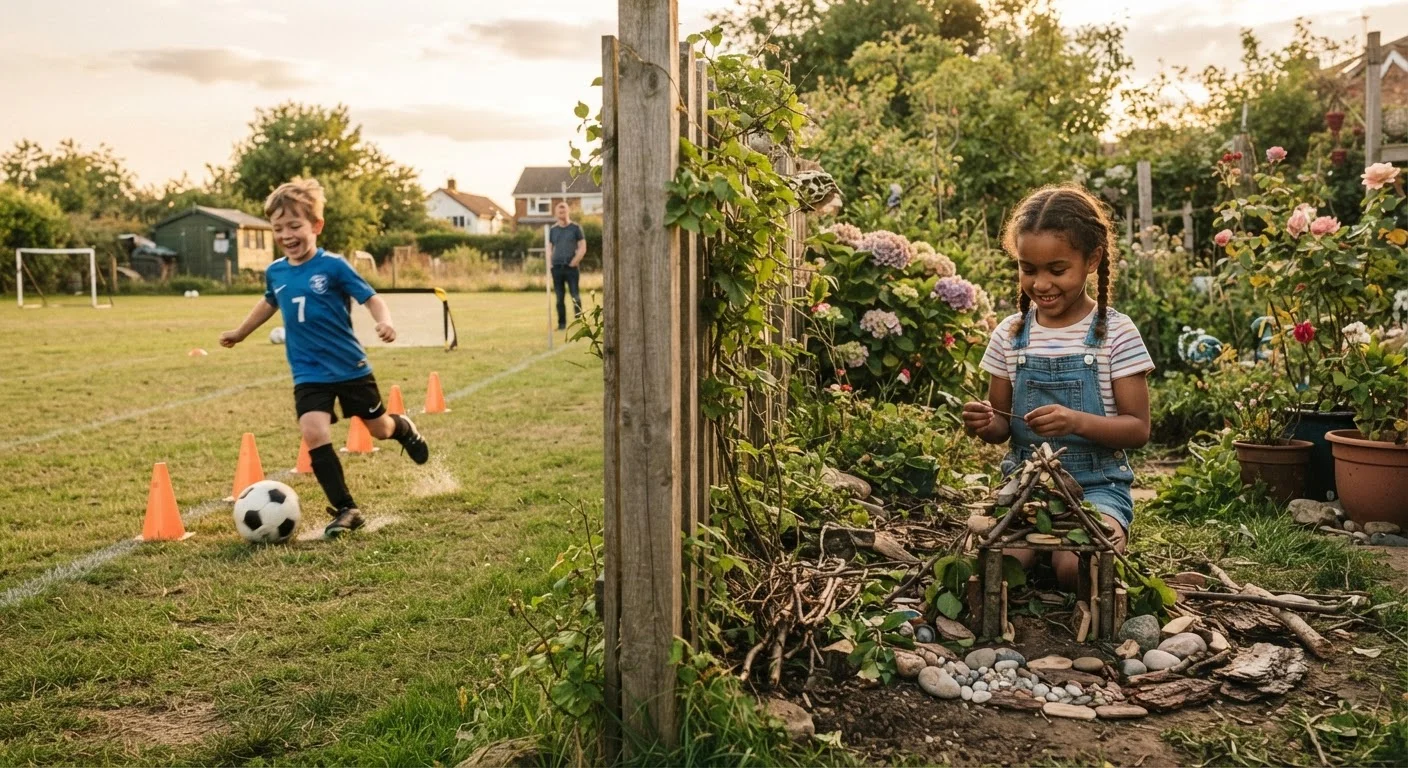
Option A
Structured Sport
The organised, coach-led approach to physical activity.
Best for: Children who thrive with clear goals, team belonging, and consistent skill-building opportunities.
Option B
Unstructured Play
The child-directed, open-ended approach to exploration.
Best for: Children of all ages who need space to develop creativity, self-regulation, and intrinsic motivation.
What Each Approach Actually Looks Like
Structured sport means any organised, adult-led physical activity with defined rules, goals, and regular schedules - youth soccer leagues, swim teams, gymnastics classes, and school athletics all qualify. An adult sets the agenda, tracks progress, and provides instruction.
Unstructured play, by contrast, is child-initiated and child-directed. There's no score, no coach, and no predetermined outcome. It might look like building a fort, inventing a game with neighbourhood kids, digging in dirt, or staging an elaborate imaginative scenario with dolls and action figures. The child decides what happens next.
These two categories are genuinely different in what they ask of a child's brain and body - which is exactly why developmental researchers and paediatricians increasingly argue that families need to think about both, not just one. For a broader look at how child-directed versus adult-directed learning plays out in academic settings, see our overview of structured vs. self-paced learning tools.
What the Research Says Each One Develops
Organised sports consistently show benefits for cardiovascular fitness, motor skill development, and social competence. Children in team sports learn to follow rules, manage frustration, cooperate with peers, and respond to coaching - all transferable life skills. The American Academy of Pediatrics (AAP) recognises sport as a meaningful context for physical and social development.
Unstructured play, however, addresses a different and arguably more foundational layer of development. Studies published in developmental psychology journals link child-directed play to stronger executive function - the set of mental skills that includes self-control, working memory, and flexible thinking. When children negotiate the rules of a made-up game, manage conflict without an adult referee, and sustain attention on something purely because it interests them, they are exercising these capacities in ways that structured environments rarely demand.
| Criterion | Structured Sport | Unstructured Play |
|---|---|---|
| Who sets the agenda | Adult coach or instructor | The child |
| Primary developmental gains | Motor skills, teamwork, discipline | Creativity, self-regulation, problem-solving |
| Social dynamic | Peer interaction within rules | Peer negotiation without rules |
| Cost and logistics | Fees, travel, scheduling required | Free; needs only time and space |
| Adult involvement | High - adult-directed throughout | Low - adult steps back |
| Current availability for most kids | Growing in many communities | Declining in recent decades |
Crucially, the AAP and leading child development researchers have raised concern about the declining hours of free play in children's lives over recent decades - a trend linked to increased scheduled activities, academic pressure, and screen time. This doesn't mean sport is harmful; it means free play has become the scarcer resource for many families. Our article on screen time and children's physical health explores one major factor in that shift.
Finding a Balance That Works for Your Family
There's no single formula - the right mix depends on your child's age, temperament, and how their week is already structured. A few evidence-informed principles can help guide you:
- Younger children (under 6) benefit most from play-heavy schedules. Their brains are wired for exploration, and formal sport at very young ages offers limited developmental returns compared to imaginative, physical free play.
- School-age children can benefit meaningfully from one or two organised activities, provided there's still genuine downtime - unscheduled hours where they choose what to do.
- Watch for signs of overload. Chronic fatigue, resistance to activities they once enjoyed, or anxiety around performance can signal that a child's schedule needs more breathing room.
Small daily habits - outdoor time after school, weekend mornings without a plan - can quietly protect a child's capacity for self-directed exploration. Our piece on daily habits that support children's mental wellbeing offers practical, low-cost ideas for weaving these moments into ordinary family life.
This article is for general informational and educational purposes only and is not a substitute for personalised advice from a qualified healthcare or child development professional. If you have concerns about your child's development, activity levels, or wellbeing, please consult your paediatrician or a licensed child development specialist.
The content provided on our blog site traverses numerous categories, offering readers valuable and practical information. Readers can use the editorial team’s research and data to gain more insights into their topics of interest. However, they are requested not to treat the articles as conclusive. The website team cannot be held responsible for differences in data or inaccuracies found across other platforms. Please also note that the site might also miss out on various schemes and offers available that the readers may find more beneficial than the ones we cover.