

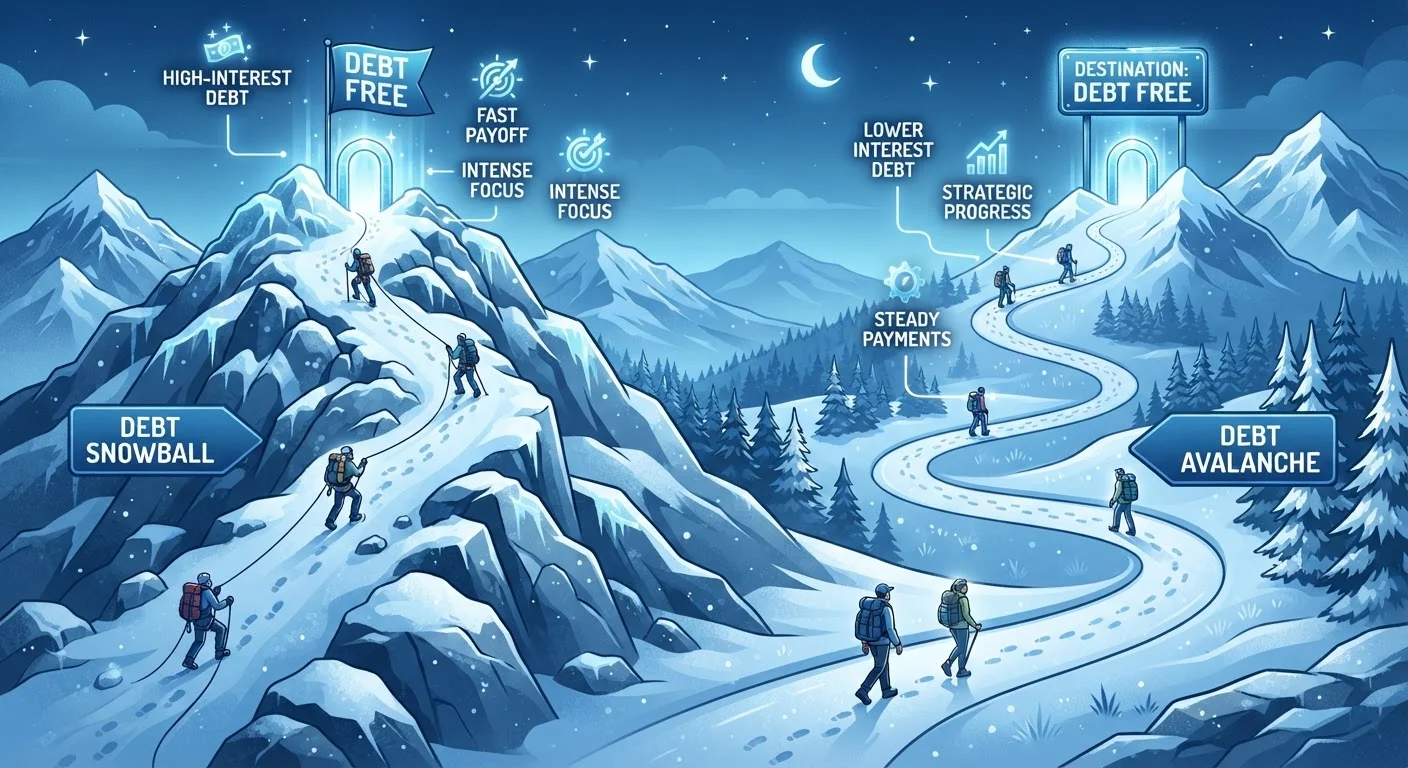
Option A
Debt Avalanche
The mathematically efficient choice.
Best for: Households who can stay motivated without quick wins and want to minimise total interest paid.
Option B
Debt Snowball
The psychologically rewarding alternative.
Best for: Families who need visible early progress to stay engaged with their debt payoff plan.
How Each Method Actually Works
Both strategies share the same foundation: you make minimum payments on all your debts every month, then direct any extra money toward one target debt at a time. Where they differ is in how you choose which debt to target first.
With the debt avalanche, you rank your debts from highest interest rate to lowest. Your extra payment goes toward the top of that list. Once that debt is gone, you roll its full payment amount into attacking the next-highest-rate debt - and so on down the line.
With the debt snowball, you rank your debts from smallest balance to largest - ignoring interest rates entirely. Your extra payment goes toward the smallest balance first. Once it's cleared, you roll that freed-up payment into the next-smallest balance.
The "rolling" step is critical in both methods. It's what creates momentum. Understanding why interest matters so much here is worth a moment's thought - our explainer on compound interest breaks down the mechanics in plain terms.
| Criterion | Debt Avalanche | Debt Snowball |
|---|---|---|
| Payoff order | Highest interest rate first | Smallest balance first |
| Total interest paid | Generally lower | Potentially higher |
| Time to first debt cleared | Often longer | Often shorter |
| Motivational structure | Delayed early wins | Frequent early wins |
| Best-suited personality | Patient, numbers-driven | Progress-driven, habit-focused |
| Complexity | Low (requires rate comparison) | Low (requires balance comparison) |
The Real Difference: Math vs. Motivation
In straightforward financial terms, the avalanche method almost always costs less over time. By eliminating high-rate debt first, you shrink the balances that interest is calculated on sooner - meaning less total interest accrues across your repayment period.
The snowball method, by contrast, may leave high-rate balances growing in the background while you clear smaller ones. Depending on your specific debts, that gap in total interest paid could be modest or it could be meaningful - there's no single answer without your actual numbers.
What the snowball offers in return is a behavioural edge. Paying off an account completely - receiving that zero-balance confirmation - triggers a real sense of progress. Studies in behavioural economics have examined how achieving sub-goals supports long-term follow-through, and debt payoff is no exception. A plan you abandon halfway costs more than a slightly less optimal plan you finish.
~$1,000+
Potential interest saved with avalanche method
NerdWallet illustrative examples suggest households with mixed high- and low-rate debt can save over $1,000 in interest by prioritising the highest-rate balance - exact amounts depend on individual debt profiles.
35%
Of US adults carrying credit card debt month-to-month
According to the American Bankers Association's Consumer Credit Monitor, roughly a third of cardholders routinely carry a balance, underlining how common structured payoff planning is as a need.
It's also worth being honest about a common pattern: many families overestimate how disciplined they'll be over a multi-year payoff timeline. Debt tends to linger longer than expected for reasons that have nothing to do with willpower - irregular income, unexpected expenses, and minimum-payment inertia all play a role.
Choosing the Right Strategy for Your Household
A few honest questions can help narrow this down for your situation:
- How spread out are your interest rates? If your debts cluster around similar rates, the avalanche's mathematical advantage shrinks - the snowball's motivational edge may outweigh it.
- How close is your smallest balance to being paid off? If you're two or three months away from clearing a small debt regardless, you could get the psychological win quickly without sacrificing much mathematically.
- What's your household's track record? Be honest. If past attempts stalled, the snowball's early wins might be exactly what keeps this attempt alive.
You're not locked in permanently. Some households start with the snowball to build confidence, then switch to the avalanche once they've cleared a couple of accounts and feel steadier. That flexibility is fine - what matters is keeping the momentum going.
For a grounded look at common thinking errors that slow families down, see debt payoff myths that keep families stuck.
Both Methods Require One Key Ingredient
Neither the avalanche nor the snowball works without a consistent extra payment - even a small one - applied each month above the minimums. If your budget is currently too tight to free up anything extra, addressing that constraint first (through expense trimming or income additions) is the necessary first step. A debt payoff strategy is only as effective as the cash flow behind it.
This article is for general informational purposes only and does not constitute personalised financial advice. For guidance specific to your situation, consult a licensed financial professional.
The content provided on our blog site traverses numerous categories, offering readers valuable and practical information. Readers can use the editorial team’s research and data to gain more insights into their topics of interest. However, they are requested not to treat the articles as conclusive. The website team cannot be held responsible for differences in data or inaccuracies found across other platforms. Please also note that the site might also miss out on various schemes and offers available that the readers may find more beneficial than the ones we cover.