

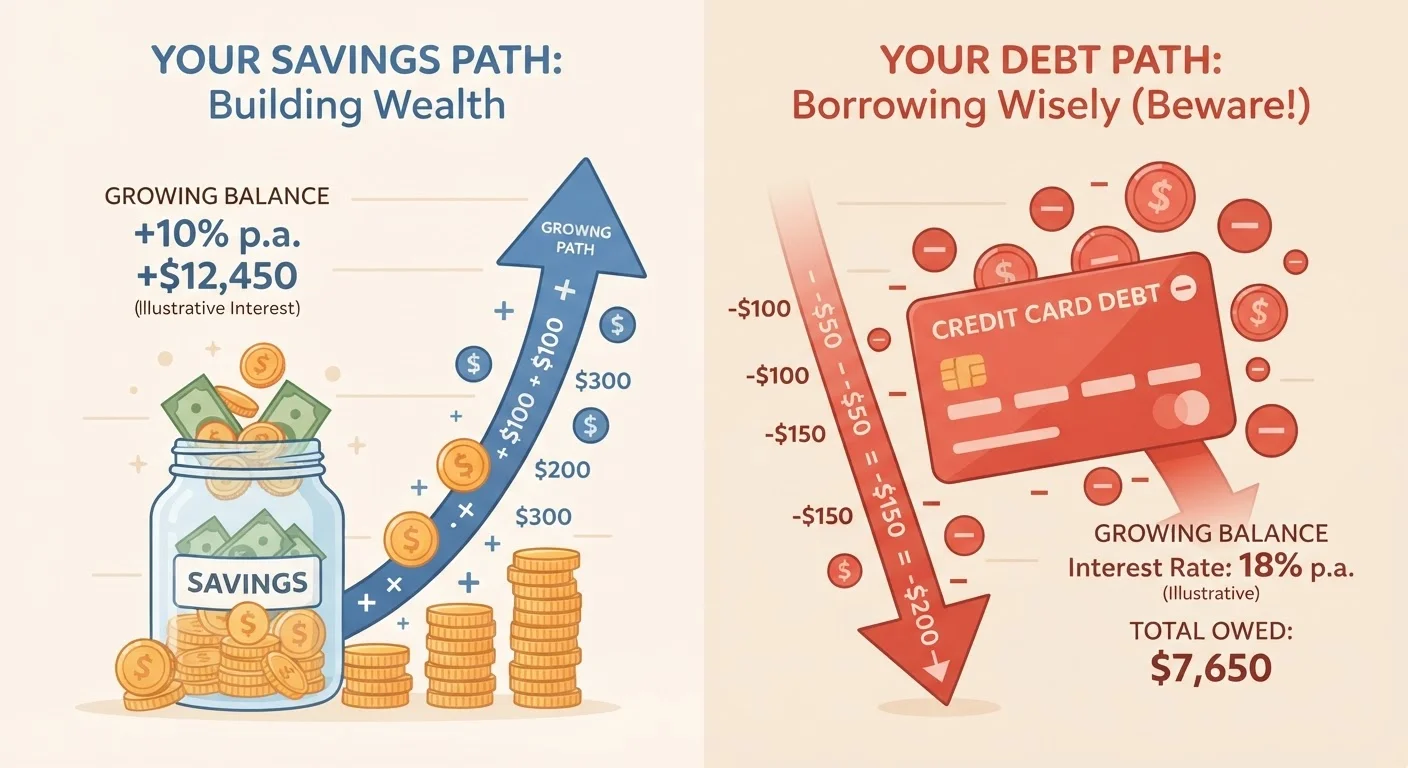
The Core Mechanic: Interest on Interest
Most people learn that interest is a percentage charge on money borrowed or a percentage earned on money saved. What's less intuitive is that interest itself becomes part of the balance - and then earns or incurs its own interest. That loop is compounding.
Consider a straightforward savings example. If you deposit $1,000 at a 5% annual rate compounded annually:
- After year one, you earn $50 in interest. Balance: $1,050.
- After year two, you earn 5% on $1,050 - that's $52.50. Balance: $1,102.50.
- After year three, you earn $55.13. Balance: $1,157.63.
Each year's interest is slightly larger than the last because you're earning a return on a bigger base. This isn't magic - it's arithmetic working in your favor consistently over time.
For a plain-language breakdown of the terms used here - principal, APR, and related concepts - the household debt and savings glossary is a useful starting point.
365×
How often many credit cards compound interest
Most US credit card issuers apply a daily periodic rate - your APR divided by 365 - meaning interest accrues every single day on the outstanding balance.
~2×
Rough doubling time at 7% annual compounding
The Rule of 72 - a common financial education shorthand - suggests dividing 72 by the interest rate to estimate years to double; at 7%, that's roughly 10 years.
$1,000+
Extra interest paid on a $3,000 card balance at 20% APR with minimum payments
General financial education estimates suggest carrying a $3,000 balance on a 20% APR card and making minimum payments can result in paying well over $1,000 in interest before the balance clears.
When Compounding Works Against You: Debt
The same mechanic that grows savings can quietly expand a debt balance. Credit card interest, for example, typically compounds daily. The card issuer divides the annual percentage rate (APR) by 365 to get a daily rate, applies it to your outstanding balance each day, and adds the result to what you owe.
If you carry a $3,000 balance on a card with a 22% APR and make only minimum payments, you'll pay far more than $3,000 before that balance reaches zero - and it will take years longer than most families expect. The interest charged in month one gets folded into the balance. Month two's interest is then calculated on a larger number. And so on.
This is why paying above the minimum is so impactful: every extra dollar reduces the principal that compounding works against. Even an additional $25 a month accelerates payoff meaningfully over 12-24 months. For a deeper look at common assumptions that keep families in debt longer, see debt payoff myths worth correcting.
Time Is the Variable Families Underestimate
Among all the inputs in compound interest - rate, principal, frequency - time does the heaviest lifting. A longer runway means more compounding cycles and a bigger gap between what you put in and what you end up with.
A family that begins setting aside $50 a month into a savings account at age 30 will accumulate substantially more by age 60 than a family that starts the same habit at age 45, even if the later family tries to catch up by saving more. This isn't an argument for guilt about a late start - it's a practical case for starting now, whatever "now" looks like.
The same logic applies to debt. A balance left to compound for five years is significantly harder to pay off than the same balance addressed in year one. Understanding this is one reason financial educators consistently emphasize tackling high-rate debt quickly rather than making minimum payments indefinitely.
For families weighing whether to prioritize saving or debt repayment, this breakdown of high-interest debt vs. low-rate savings walks through the tradeoffs clearly.
Putting Compounding to Work for Your Family
Understanding the mechanics creates an actionable framework. Two habits move the needle most for average households:
- Automate savings contributions, however small. Consistent, automatic deposits keep the compounding clock running. Even modest amounts deposited regularly mean the interest base keeps growing without requiring active decisions each month. The guide to automating family savings covers how to set this up without disrupting regular cash flow.
- Pay more than the minimum on high-rate debt. Because interest is calculated on the remaining principal, reducing that principal is the fastest way to slow compounding's negative effect. Even irregular extra payments - a tax refund, an overtime check - shrink the base the interest rate works against.
Compounding is also a practical concept to introduce to kids. A savings jar that earns notional "interest" each week, or a simple spreadsheet showing a balance growing, makes the idea concrete long before a child has their own bank account. The Kids & Money hub has resources for age-appropriate money conversations.
This article is for general informational and educational purposes only and does not constitute personalized financial advice. Consult a qualified financial professional for guidance specific to your situation.
Frequently Asked Questions
Simple interest is calculated only on the original principal. Compound interest is calculated on the principal plus any interest already earned or charged. Over time, compound interest produces a noticeably larger balance - in savings accounts or on debt balances.
The more often interest compounds, the faster your balance grows. A savings account compounding daily will accumulate slightly more than one compounding monthly at the same rate. On debt, more frequent compounding means your balance climbs faster if left unpaid.
Yes, though the absolute dollar amounts are modest at first. The real power shows up over years, not months. A consistent habit of depositing even small amounts into an interest-bearing account lets compounding work in your favor over a long horizon.
Credit card interest typically compounds daily and is charged monthly. If your payment only covers or slightly exceeds the interest added that month, very little principal is actually reduced. This is why balances can linger for years on minimum payments alone - see our article on <a href="/family-finance/saving-and-debt/why-families-pay-off-debt-more-slowly-than-they-expect">why debt payoff takes longer than expected</a> for more detail.
Compound interest on debt works against you when you carry a balance, but a fixed-rate mortgage or student loan with straightforward amortization is more predictable. The most damaging compounding happens on revolving high-rate debt, like credit cards, where balances fluctuate and rates are high.
Knowing how compounding works encourages two habits: adding consistently to savings so interest has more to build on, and paying more than the minimum on high-rate debt to shrink the principal that's being charged interest. Small, regular actions produce disproportionate results over time.
The content provided on our blog site traverses numerous categories, offering readers valuable and practical information. Readers can use the editorial team’s research and data to gain more insights into their topics of interest. However, they are requested not to treat the articles as conclusive. The website team cannot be held responsible for differences in data or inaccuracies found across other platforms. Please also note that the site might also miss out on various schemes and offers available that the readers may find more beneficial than the ones we cover.