

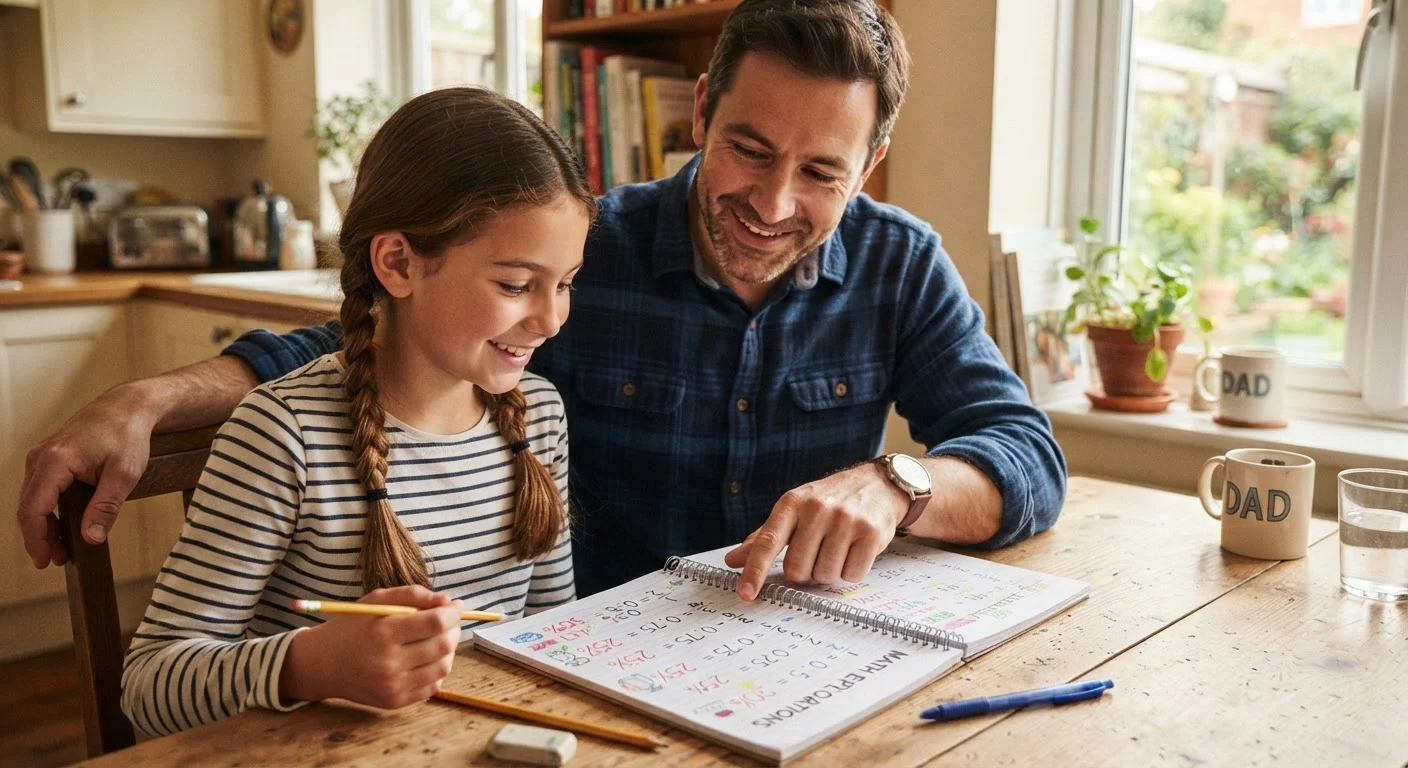
Why the Gap Exists in the First Place
Most elementary and middle school math programs follow a sequential structure: fractions come first, decimals arrive a year or so later, and percentages appear closer to fifth or sixth grade. Each topic gets its own unit, its own set of worksheets, and its own test. By the time a child encounters percentages, fractions may feel like ancient history.
This pacing makes sense from a curriculum-planning standpoint - each concept does build on the last. The problem is that without an explicit "these are all the same thing" moment, children store them as separate procedures. They learn to add fractions, place decimal points, and calculate tips, but never realize they are working with one unified idea expressed in different ways.
The result is predictable: children who are comfortable with fractions freeze when they see a decimal, and students who can calculate a percentage on a worksheet can't recognize that 0.5 and 50% and 1/2 all live at the same point on the number line. Just as science topics can create isolated pockets of knowledge - see how science concepts trip up upper primary students - so too can disconnected math instruction leave real gaps.
The Core Connection: One Value, Three Languages
The single most clarifying idea a parent can share is this: a fraction, a decimal, and a percentage are three different ways to write the same number. Consider 1/2. Divide 1 by 2 and you get 0.5. Multiply 0.5 by 100 and you get 50%. All three expressions describe exactly half of something.
Here's the conversion path that makes it mechanical enough for children to practice:
- Fraction → Decimal: Divide the top number by the bottom number (3 ÷ 4 = 0.75)
- Decimal → Percentage: Multiply by 100 (0.75 × 100 = 75%)
- Percentage → Decimal: Divide by 100 (75 ÷ 100 = 0.75)
- Decimal → Fraction: Read the place value - 0.75 is 75 hundredths, or 75/100, which simplifies to 3/4
Once children see this loop, they stop feeling like each form is a separate language and start treating them as dialects of the same mathematical idea.
Grade 6-7
When full conversion fluency is typically expected
Common Core State Standards expect students to fluidly convert between fractions, decimals, and percentages by the end of sixth or seventh grade in most U.S. states.
1 in 3
Students who show procedural gaps in rational number fluency
National Assessment of Educational Progress (NAEP) data consistently shows that a substantial share of 8th graders struggle to apply fraction and decimal concepts in context, not just in isolation.
Making It Stick With Everyday Contexts
Abstract conversion practice alone rarely builds lasting understanding. Anchoring the connection to real situations is far more effective - and parents are perfectly placed to do this without any formal teaching setup.
Start With the Benchmarks Children Already Know
Most children already have an intuitive sense of 1/2, 1/4, and 3/4 from everyday life. Use these as anchors - once a child is confident that 1/2 = 0.5 = 50%, they have a mental reference point for estimating whether any other conversion looks reasonable. Building out from familiar benchmarks is far more effective than drilling a conversion rule in the abstract.
Shopping and discounts are the most accessible starting point. A 25% off sale means the item costs 75% of the original price - which is 75/100, or 3/4, or 0.75 as a decimal multiplier. Walking through a receipt together or estimating a sale price in a store creates a genuine need to convert between forms.
Cooking and recipes offer fraction-heavy practice. Halving a recipe requires dividing fractions; expressing the result as a decimal or percentage is a natural extension. "We used 0.5 cups of sugar - what fraction is that?" is a low-pressure question with a high conceptual payoff.
Sports statistics connect percentages back to fractions in a context many children already care about. A free-throw percentage of 80% is the same as making 4 out of every 5 attempts (4/5) or a success rate of 0.8. This framing is particularly engaging for children who follow a favorite team.
These connections also lay useful groundwork for financial thinking. Understanding that a 20% tax is the same as multiplying by 0.2, or that interest rates are percentages of a principal amount, gives children a head start - something explored further in the building blocks of financial literacy for children.
How to Step In as a Parent
You don't need to replicate classroom instruction. The most useful thing a parent can do is prompt flexible thinking - the habit of asking, "Can I write this a different way?"
A few practical approaches:
- Keep a conversion reference card handy. A simple table showing common fractions (1/4, 1/2, 3/4, 1/3, 2/3) alongside their decimal and percentage equivalents lets children self-check and spot patterns without relying on memorization alone.
- Ask translation questions during homework. If your child solves a problem using fractions, ask them to rewrite the answer as a decimal. If they're working with percentages, ask what fraction that represents. This costs almost no extra time but reinforces the connection repeatedly.
- Use estimation to build number sense. "Is 0.3 closer to a quarter or a half?" encourages children to think about where values sit relative to each other, which is the real goal beneath the procedural conversions.
Building these habits fits naturally alongside broader subject-specific study strategies. If you're thinking about how to structure home support across subjects, building consistent study habits across different subjects offers a practical starting point for creating routines that adapt to math, writing, and science equally well.
Frequently Asked Questions
Schools often teach these topics in separate curriculum units, sometimes months apart. Without an explicit bridge, children store them as distinct procedures rather than related representations of the same value. Revisiting all three together - even briefly - helps the connections stick.
Divide the numerator (top number) by the denominator (bottom number). For example, 3/4 means 3 ÷ 4 = 0.75. A calculator is fine for practice - the goal is understanding the relationship, not mental arithmetic speed.
Multiply the decimal by 100 and add a percent sign. So 0.75 becomes 75%. You can think of it as sliding the decimal point two places to the right.
Most U.S. curricula introduce fractions in grades 3-4, decimals in grades 4-5, and percentages in grades 5-6. By grade 6 or 7, students are generally expected to convert fluently between all three forms.
Shopping is highly effective - a 25% discount is the same as paying 3/4 of the price, or multiplying by 0.75. Letting children work through a store receipt or a sale price makes abstract conversions immediately meaningful.
You don't need to reteach the curriculum. Simply asking questions like 'Can you write that as a decimal?' or 'What percentage is that?' during everyday activities encourages flexible thinking without requiring formal instruction.
The content provided on our blog site traverses numerous categories, offering readers valuable and practical information. Readers can use the editorial team’s research and data to gain more insights into their topics of interest. However, they are requested not to treat the articles as conclusive. The website team cannot be held responsible for differences in data or inaccuracies found across other platforms. Please also note that the site might also miss out on various schemes and offers available that the readers may find more beneficial than the ones we cover.